
Anita Brett
Clip: Season 2026 Episode 5 | 7m 5sVideo has Closed Captions
No description
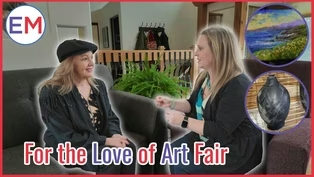
🎨✨ On this week’s <em><strong>Experience Michiana</strong></em>, we meet <strong>Anita Brett</strong>, who is making her first appearance at the <strong>For the Love of Art Fair</strong> — and she’s excited to share her work with the community! Her paintings are wonderfully diverse in style and subject, with a special love for the human form and the beache...
Problems playing video? | Closed Captioning Feedback
Problems playing video? | Closed Captioning Feedback
Experience Michiana is a local public television program presented by PBS Michiana
Anita Brett
Clip: Season 2026 Episode 5 | 7m 5sVideo has Closed Captions
🎨✨ On this week’s <em><strong>Experience Michiana</strong></em>, we meet <strong>Anita Brett</strong>, who is making her first appearance at the <strong>For the Love of Art Fair</strong> — and she’s excited to share her work with the community! Her paintings are wonderfully diverse in style and subject, with a special love for the human form and the beache...
Problems playing video? | Closed Captioning Feedback
How to Watch Experience Michiana
Experience Michiana is available to stream on pbs.org and the free PBS App, available on iPhone, Apple TV, Android TV, Android smartphones, Amazon Fire TV, Amazon Fire Tablet, Roku, Samsung Smart TV, and Vizio.
Providing Support for PBS.org
Learn Moreabout PBS online sponsorshipWe're talking to another artist coming up for the love of Art fair.
And Anita, is this your first time participating in this art fair?
Absolutely.
It has.
Okay, so what have you heard about it?
Because I this is what I've been to for a number of years.
I love this art fair.
I'm very excited that you're going to be part of it.
Oh.
Thank you.
I met Shereen and her daughter in Kensington Park at an art fair in Kensington Park, and she asked me if I would join for the love of art and, I sometimes live in East Lansing, but we've been down here for about a year, and, so she didn't realize that I was in South Bend.
And so that really helped promote the, interest in that.
And what I've heard is that there are large, spectacular paintings, that are very novel and, really help, display the, the artist creativity and self.
And you're going to love the art fair.
I have to tell you that I know a lot of times we don't have time to look at all the I mean, I hope you do find time to do that, too.
Let's talk a little bit about your art.
I looked at some of your pieces, and they're very wide range as far as style, as far as the different kinds of media that you're using.
What would you say is generally your sweet spot?
I really enjoy painting people or the human form and not necessarily, a recognizable human form, but just to give the mood of an area.
And because, you know, we're in Michiana, the beach, the boats.
Absolutely.
That's my happy place.
Besides my studio.
I'm glad you can do it for us, because I'm still very much stick figure.
Oh, that.
That's out of my art capability.
I don't do interviews, so.
Yeah.
Great.
We're meeting in Portland today.
How did you get started on, drawing and art?
Well, there's a longer story.
TV friendly.
All right.
When I was little, I used to, you know, join.
There were art competitions in the newspaper, and so I would join those as a ten year old and thought, oh, my gosh, whatever.
My dad said, don't ever go into art.
You can't do that.
So I went into, occupational therapy, and there was an artist who drew the attempt at anatomical drawings, and his name was F Netter.
And I studied him.
He was beautiful.
LED me into studying Michelangelo.
Beautiful form.
And so when my kids were little and they would sit still long enough, then I would draw their form, and then I'd add watercolor because it was quick to dry, and they would be safe if I painted and then I grew into oils.
Wow.
That's amazing.
That's I love the I love the story behind it.
And I know Michelangelo, that kind of component that really made an impact in your art.
Oh, absolutely.
Yeah.
He was able to study the anatomical figure in autopsies that he did that were legal.
So illegal.
I'm sorry.
So he would do, autopsy studies at the Santo Spirito church in southern Florence.
And he would have a day to study that anatomical form, and, he could study men, but not women.
And so there's a lot of, masculine tendencies toward his human form.
And yeah, he was I mean, he got the insertion, the origin of all those muscles.
Exact.
And so it's fun.
I had no idea that was the background of that story.
Okay, so you're incorporating some, I don't know.
Yeah.
Let's talk about this piece that you're working on right now.
This is this one that's going to be at For the Love of Art fair.
It, it will not.
Okay.
I don't think it'll dry fast enough.
I was doing a series called community and it's the idea of the human form, but without, recognizing exactly who it is.
Okay.
And so these are two people that were communicating at the MoMA in October, and, she was canceling her.
I don't know if you can see her hand is covering her eyes and her hand is like, rubbing her face, but the lighting was beautiful.
The, the Ottoman is like the anchor for the whole thing.
So just so you know, the Ottoman isn't done.
She's not done.
But I. I like this part of the form, the background.
I don't usually do first, but I wanted to make sure the colors, were, homogeneous.
Okay.
So that's why I talked to us about the process.
Because I know every artist is kind of different.
Sometimes you paint the background, sometimes you're thinking of idea, you're doing your outline.
Talk to us about what's your past looks like and is a different, time.
It is different?
Yes.
So sometimes I'll, I always do an underpainting on the canvas, and I do that so that you don't need to have super tight lines.
So you'll always see this burnt Sienna underneath it, and it, it also brings that whole painting together.
Then, I'll draw the, the image that I want.
Sometimes I do just block it in with paint, and then, you always work like your focal point can be super tight.
Contrast is going to be really hard.
And then it kind of, blurs almost as you go out.
So you have a strong sound line which will be here.
And then these are kind of last lines like, you don't know, you know, this is the last line.
Yeah.
As well as this.
Like you don't need to know where that line.
And the beauty of art is it's always changing.
It's always unique.
And I know you were showing me some of your paintings before we got started to that.
You're still kind of, you know, put it on the wall, see how it feels and does it.
Is it missing something or does it need something else?
Right.
Yeah.
If I'm, if I finally move through the whole thing and it's perfect, then great.
If I get stuck because something isn't very interesting or I lose the main image, or I don't find that line that I was hoping for, then I'll go back and I might go back, hopefully only for a few months.
But sometimes I. I'll shelf it and then come back and come back to it later.
Yeah.
And especially with oil painting, there's, you know, there's a modification process even to kind of readjust.
Yes.
You can file off the old you can paint over the old if it's, smooth enough to paint back.
Interesting.
Is there anything else you want to share with us about your.
No.
I'm glad to see you at the I. For the love of art.
I hope a lot of you and I want to tell I'm sharing too.
We have so many pieces from there.
I don't know if you have any room left at our walls, but we're.
I mean, we love to come to the art fair.
My husband and I both.
So I hope everyone out there, I hope you'll join us for the love of art fair.
And and get to see your work for the first time.
Thank you.
Thanks.
Nice to meet you.
Thank you so much.
And hear that.
Thanks.
Video has Closed Captions
Clip: S2026 Ep5 | 7m 38s | No description (7m 38s)
Providing Support for PBS.org
Learn Moreabout PBS online sponsorship















Support for PBS provided by:
Experience Michiana is a local public television program presented by PBS Michiana