
January 29th, 2026
Season 2026 Episode 5 | 28m 45sVideo has Closed Captions
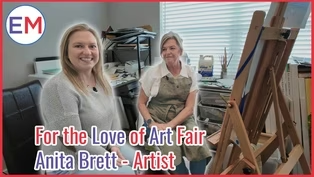
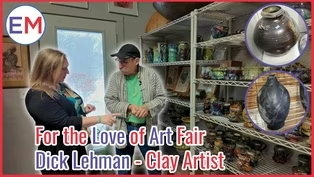
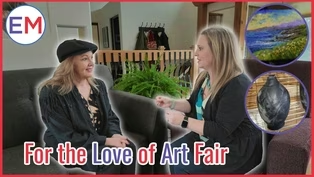
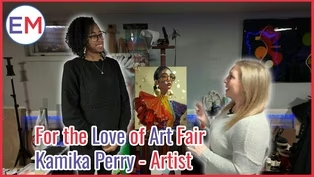
For the Love of Art Fair, Dick Lehman - Clay Artist, Kamika Perry, Anita Brett
Art is in the air this week on Experience Michiana! 🎨✨ Whether you’re a seasoned collector or just love a good creative vibe, we’re taking you inside the heart of the local art scene to preview one of the area's most beloved events.Here’s what’s coming up:The Main Event: For the Love of Art FairWe sit down with producer Shireen Cline to get all the details on the u...
Problems playing video? | Closed Captioning Feedback
Problems playing video? | Closed Captioning Feedback
Experience Michiana is a local public television program presented by PBS Michiana
January 29th, 2026
Season 2026 Episode 5 | 28m 45sVideo has Closed Captions
Art is in the air this week on Experience Michiana! 🎨✨ Whether you’re a seasoned collector or just love a good creative vibe, we’re taking you inside the heart of the local art scene to preview one of the area's most beloved events.Here’s what’s coming up:The Main Event: For the Love of Art FairWe sit down with producer Shireen Cline to get all the details on the u...
Problems playing video? | Closed Captioning Feedback
How to Watch Experience Michiana
Experience Michiana is available to stream on pbs.org and the free PBS App, available on iPhone, Apple TV, Android TV, Android smartphones, Amazon Fire TV, Amazon Fire Tablet, Roku, Samsung Smart TV, and Vizio.
Providing Support for PBS.org
Learn Moreabout PBS online sponsorship1234.
Get my shoes in.
Out the door.
Five.
I'm lost.
Six.
Seven.
Eight.
Feels great.
I'm gonna shine.
After I do what I'm gonna do.
I do it again.
Yeah.
Look at the sky with the beautiful color.
But never just for me.
You gotta share it with another.
I got to show, to give.
Let I want singing show.
Take a look and say a beautiful morning that turns into a beautiful evening.
And together make beautiful art.
And if you wanna see that, come along with me.
That's right.
Welcome to Experience Michiana.
We're so glad you're joining us this week.
And this is one of my favorite times of the year.
It's for the love of art fair.
It is coming up here soon and we're talking to the director Shireen and three of the incredible artists and their beautiful work.
Take a look.
You guys know I love art and for the love of art fair is got to be like my favorite art show that we have here in Michigan.
I have my friend Shireen with me.
Hello, it's always good to see you and always an exciting time as we head into this wonderful art show that you create so magnificently.
Well this year I am really excited.
It is our 12th annual year and we have some of your favorite artists returning.
Yeah, we have some of your favorite ones.
Okay.
And then we have a whole bunch of new artists that we've this year.
We've heard from Wisconsin and also more from Ohio.
Okay.
So we're still talking regional art.
Yeah.
Regional artists.
Okay.
And local artists as well.
Yeah.
And you have a lot of local artists too.
I know I've met a number of them personally and have become friends with some of them too.
And actually some of our local artists have been with us the longest, like David Mark, a Czech, has been with us for 12 years.
Oh my gosh.
And you know, when you are working on curating and figuring out who's going to be a part of the show, what goes into that?
It's a lot of driving to art fairs.
Okay, so there's like five art fairs that I go to and those like, those are really large art fairs.
They have some of the best artists there.
And so I'm walking.
I'm going to every single booth and chatting with them, and then they get an invite.
Yeah.
And if they get invited then they're invited to come to the show and I don't have to go through all that during.
But it is a great show because I get people from out of the blue, will send me an application and I'll need to jury them into the show.
Oh, understood.
Okay, so what are the different art forms that are usually, represented?
Well, we have sculptures, so that could be either ceramics or could be bronzes or could be glass.
Yeah.
And then we also have paintings.
So with 2D art it's all over the place.
Like everyone has a different style.
Someone might be a surrealist, another one might be more landscape, another one a portrait artist.
So it's a variety.
And then of course, wearable art, I guess.
And you know, Valentine's Day is like the following weekend, which is the art show, February 7th and eighth, seventh and eighth.
Okay.
So perfect.
So it's just before Valentine's Day.
Those gifts for your loved ones.
Someone special.
Yeah.
So we have the jewelry and then we also have wearable art.
Oh, as in like clothing as well.
I love that.
And one of the things that I love about the art show, too, is that you are usually have artists who are making and creating at the same time.
That right.
We do have a few artists that will do a little sampling and like, Laura Glass Willer, she's a sell artist.
I know that's one of your favorites.
We're looking at pieces.
I know you do.
So she'll, like, have a little salt thing out there.
She's just demonstrating.
That is just fascinating, too, especially for someone I know a lot of people bring their kids.
We bring our kids every year, too.
But, you know, continuing that art generation.
Oh, that is so that's one of my favorite things, is seeing young families bring in their little children.
And some of the artists, they'll get right down to their level and talk with them and let them touch the art.
Oh, cool.
And so it's a great experience for them.
It's it's not about face painting.
It's them being one on one with the artists.
Yeah, yeah.
And you also have performing arts happening in this.
So too.
Yeah.
We want to make it, you know like create that an ambiance.
And so we have, several artists.
We have Marco Villareal, who is a Spanish guitarist, and then we have, Jake Michael, which is a favorite around town and informal, which is on the cello.
He comes every year.
Yeah, yeah.
And then we also have, the San Ramos people love them.
Their band.
Oh, and there's one other, and his name is Annabelle Farkas.
Well, I can't pronounce his name, but he, plays, like, a little bit of a jazz guitar.
Okay.
Yeah.
So we have a little jazz artist coming, too.
I like that, really.
It is really.
Right.
Best thing when you are at the.
And now you guys have been doing this for 12 years, is it still going to be over at the Century Center?
Yeah, that's our home Southend's our home.
We love South Bend.
We have so many sponsors from South Bend.
Yes, that, you know, people have said, why don't you move it here and move it there like, no, I really depend on these sponsors to do what they do for us.
And they're amazing.
They are amazing.
Now, I know this is 12 years in now.
What's your future looking for this.
So, like, do you have a husband?
I always ask me that because the surgery center would love for me to move to a larger room.
I know, but but when do you have opportunity for those artist.
Right, right.
If I move to the other room, you lose the whole, like there's, the other room has concrete and we have carpet, we have chandeliers.
They don't have chandeliers.
You have the lighting.
Okay?
Can lose the intimacy, right?
You lose that intimacy.
And all of our artists say not.
We like that 50, you know, give or take.
Yeah, 50.
And I'd love to that the artists themselves, it's a wide range of price points too.
So anybody can find something that they can take home with them.
Right.
And you know they do that on purpose because we want to let who come through the door if they've never been to an art fair, to be able to take something home that's within the 60 to $100 range.
But then we have the people who are true collectors and they might spend, you know, maybe over $1,000 easily.
I will tell you, my kid is the one he spends the most with art because she's got so many pieces in her room, like, okay, I have to ask them, okay, who's her favorite?
Oh, it's the one that makes the jewelry that has, like, different kind of art within the jewelry.
Oh, I can't think of what her name is, but see that she's got.
Yes, she does the photography.
The photography with the jewelry.
Yes.
Carol Estes.
Yes.
Yes, I love it.
My daughter loves her.
So.
All right, we have some artists we can talk to.
Yes, we're going to go see Dick Lehmann in his studio.
Awesome.
All right, let's head.
All right.
Thanks.
Okay.
The honorary artist of the year is Dick Lehmann.
Thank you so much for joining me.
And you know, Clay, art is your specialty in clay.
Art has really been around for 400,000 years, right?
And I love that you moved into this pieces of kind of the fossil, really.
It kind of brings it back to the original purpose of what Clay art was.
Yeah.
And it also acknowledges that sometimes we discover by failing.
This whole process was discovered when I was doing American Raku.
And, that's a process of healing things quickly, taking them out red hot and putting them in combustible materials.
Okay.
I did that with a Canadian potter and we said, look, we've got this many pieces this few days, we're going to get them all done, right?
Yeah.
Well, you know, tempt fate.
What happens?
We had a tornado.
Tornado touched down about one mile away.
The northeast winds blew the hot pot down a hill into some grasses.
And the cover, the metal cover a block away.
Phil went after the cover.
I retrieved the pot.
We covered it.
We sat there holding it down in the rain.
But when it cooled, there were images of the grasses and pots that it made it in.
And that was the beginning of an idea that started me on this.
Well, is this the pot that was in the tornado?
This is not me thought I was going to say, but do you have that one on display in your home?
Yeah.
So it allows me to, to create what kind of fast fossils we had some.
What a cool idea.
We had some folks from Notre Dame stopped by.
They were at a conference, and they said, now what?
What are you doing here?
And I explained the process.
So let me tell you what you're really doing.
You're making fast fossils.
The vegetation is turning to activated charcoal.
It's releasing a film of carbon.
And you're collecting the film of carbon in the form of an image in the pot.
And so this is something I've done for the last 35 years, and I come back to it occasionally.
I have just three, but these will be coming with me to the show.
They will be available, I love it.
How long have you been doing, Claire?
40.
Well, since the 1976 76.
A long time you've been doing it.
You've really mastered it.
And I love that you have created so many unique concepts from that time.
Well, I would say not mastered because the process itself keeps leaving me to new things.
Okay.
I mean, one of the oldest ways of working with, clay is, is wood firing.
Okay.
But I'm I'm doing some long firings.
I designed the kiln that I could fire for 15 days.
12 days by myself.
And that was by building a huge firebox on the kiln and feeding it just five times a day, filling it up.
Breakfast.
I ran home from lunch.
This is commitment.
Supper before I went to bed.
Once during the night.
And those pots?
This was sitting on a crown of shells.
So the drip that you see coming off the bottom was actually on the bottom.
This is all the ash from the from the fuel.
Different trees absorb different kind of, soluble and, and soluble minerals through their enzyme work.
And so this was the Chinese elm that gave this kind of ash on the piece.
And like I used to do a lot of that, I don't have my own kill anymore.
So I worked as a guest.
But let me show you what the most recent work is.
All right.
Let's go see it.
Now.
These are eye catching.
I mean, this draws you in your artwork here.
So these pieces, have three glazes on them.
And I was very interested to see what an accumulation of more than one glaze on a pot might do.
Of course, more is better for me.
Can never say too much.
Right?
Well, yeah.
I mean, I started out with, less is more.
What do you get?
So many artists start with that kind of concept.
And I tried more with less.
Okay, now I'm just saying more is more.
More is more I love it.
I love that concept.
So these these pots, have as many as ten different glazes on them.
And I'm relearning to see beauty.
I think this is some of my best work.
But as a student, my professor might have said, oh, you have a crawling problem.
You need to fix that.
To my way of thinking, this is really lovely.
Did you add that or is that just part of the process?
That's part of the process.
I have a glaze that will start to pull apart before it melts, and I use that intentionally.
So I'm actually designing glazes to do these things that I was taught I should never do.
But in that I think is where you can see the beauty.
I hope that the folks who come to the art fair will bring a new set of eyes and set aside all their assumptions about beauty, and approach these things as a way of being introduced to beauty in a way that they may never have seen before.
I love that now when you're putting them into the kiln, because I see over here you have some parts that are ready to go in.
Yes.
And they look perfectly shapes.
Yeah.
Perfectly smooth.
Right.
So how does that transfer into what we see here on your shelves?
Well, a perfectly smooth pot would have been like this, but the accumulation of all those glazes creates a thickness and actually a weight that, you might not initially expect.
Other pots.
I'm actually purposely, purposely, altering so that they have places for the glaze to catch.
Yeah.
So these go in looking this altered form.
But really covered with many, many glazes to make something new.
Yeah, I love it, I love it.
So you've been doing this a long time.
Talk to us about, you know, watching the up and rising clay artists coming into these roles.
What kind of lesson might you offer to them?
Well, make a lot of pots because it's in the making that you discover and the clay will lead you into some, some new work.
I was just speaking with a clay artist this morning.
Came over for coffee.
He said, you know, I I'm trying cone three wood firing.
But it's it's a lot of losses.
And what I have to focus on is that piece in the back that cracked.
I need to pick it up.
And I say, oh, look what happened here.
If I could make that happen all over the pot.
That's that's kind of what has happened here from triple glazing.
What would happen if I put more than three glazes on.
So now some of these have up to ten.
And I just keep making discoveries.
I feel like my own visual literacy is being expanded by the work itself.
And that's an exciting place.
It is, it is.
And you're pulling from your experiences as well.
Right?
Exactly.
Have you done a lot of your training?
A lot of it stateside.
But I've had a significant amount of time in Japan, working, exhibiting and learning from the, the clay artists in Japan.
Well, we're learning how beautiful your art is.
I'm so glad that you are, you know, honored this year.
Just wonderful stuff.
I have to ask you one more question.
Is it usable?
Can I use the coffee cup to drink coffee with everything?
Is fully functional.
If you want to put it in the dishwasher, you may be just fine.
Yeah, so be on that one.
All right.
Thank you so much.
You sure?
You head over to For the Love of Art.
First you can purchase and see some of his beautiful pieces.
For checking out another amazing artist that is going to be showcasing their artwork at For the Love of Art fair, I have Kimiko with me.
Your artwork is absolutely beautiful.
How long have you been painting?
I mean, this is like.
I mean, this is obviously you are trained, you know what you're doing and I mean, you've probably been in this for a long time.
Yeah, a long time is is what I would call it.
Since I was a child, actually.
Yeah.
I just found art to be my thing I wanted to do in college.
And I found out that, you know, that may not be the best moneymaking route.
So my advisor told me to not pursue art, but to try something else.
And so I just painted in the moonlight, basically.
And that's what I've been doing for the last, you know, 30 plus years.
And now you're showing him.
And I'm like, at best, what would you do?
But let's talk about some of the influences that have influenced you over the years to create your artwork.
I get influence from everything and everywhere.
Nature specifically.
But honestly, my love is simple shapes.
They're really complicated to paint.
I don't use tape.
Usually.
I just try to get, like a circle and a and a shape, you know, just to look like what it is really not using, like a tool or a circumference.
I try not to, you know, I might start with that, but when you're actually painting, like, you know, it's your steady hands.
Yeah.
But the brush stroke landed right then I ended up with portraits, and someone had asked for one, and I was like, I've never really done portraits, but, you know, I'll give it a shot.
And when I broke the face down, I realized, oh, they're simple shapes, a circle and ovals and squares and, you know, so I ended up enjoying really doing portraits as well.
Talk to us about this piece since, this is one of your newer pieces that, for the love of art, it will be okay.
So if you want to catch this one.
Yes.
This piece was an interesting challenge.
I recently went through, a lot of loss last year.
The person who was part of my creative blossoming, as you can say, he influenced a lot of my art.
He passed away, and I was thinking that I would probably just not paint anymore.
There's no one to be proud.
But when I, I wrestled with it, and she did a lot of, like, encouragement, and I really I have to shadow her out for that.
She encouraged me to continue, and I just decided to pour a lot of my emotions into art.
So I usually try to challenge myself, but this time it was with color and like actual shapes.
So like breaking things down back to their basics.
I think with this piece I accomplished that the most.
I love that it's just simple lines and squares and rectangles, and of course it just comes together in this beautiful piece with dimension.
So I spent a lot of time with this one.
More.
More so than the others.
But yeah, this this piece is probably my biggest accomplishment because I feel like I completed something that I wanted to give up on just because emotionally I was I felt like I wasn't there.
Well, I'm proud of you.
I think you.
I'm sure lots of us are proud of you.
Well, I hope so.
That's beautiful.
Beautiful.
And it's so bright and so colorful.
And I think all of your artwork speaks to someone I. That's the hope.
So let's talk about.
I know that you have another piece out of here.
This kind of hiding.
Is this a finished piece?
Not quite now.
Not quite.
Okay.
This one's in process.
Okay.
But I can see what you're talking about with the different shapes.
You know, it's very bold in the end.
Yeah.
So, yeah, it seems simple.
Simplicity is the most complex thing to accomplish.
And to do it right without it feeling overly complicated or overly simple is one of my greatest challenges as an artist.
But, you know, I, I try to make objects that you can recognize using objects that you can recognize.
And the, the play on that is very interesting.
It does drive me a little crazy.
And so I tend to be a little OCD and maybe a bit too much of a perfectionist, but yeah.
And I was checking out one of your particular series, the balance series.
You want to talk about that?
Because that was really cool concept on how you know, you're building those shapes.
And I thought, I think it's very interesting that you're saying, like, I didn't measure anything.
Like you just balance it.
Yeah.
It has to feel right in my gut.
The balance series specifically, I wanted all the shapes to look like they were bouncing on top of each other, almost like a 2D sculpture.
And, that was the year I lost my father.
So I had created, like, a a a whole series around just can you get something to still fit and not bother you even though you want it to?
It's bothering you.
So I tend to do a lot of introspection with my art.
It's mostly self-exploration and I find it resonates with other people.
That's a bonus.
It does.
It doesn't use a lot of color.
So I'm looking at some of your samples over here too, and everything is very bright.
Well, this series specifically, I went bright on purpose.
Okay.
That's intentional.
Can I get this out of the way?
Yeah, you sure can.
I, I, I wanted to experiment with range, and I find that in order to do that, you really have to go all the way in.
So obviously this is orange and red.
This is greens.
This one is the kind of the hodgepodge of everything.
And this one was blues.
So I did a lot of, experimenting with mixing colors.
I generally would stay within a certain color palette because it's easy.
But what's my biggest problem?
Like when I try to paint something and then I run out of the color that I've mixed together and like, what do I do now?
Exactly right.
So I ran out several times, but I had to mix and mix and mix to still get the colors that I wanted.
So that was my challenge with these.
And they they are bright, but for the most part, this was what I wanted to accomplish.
Like, can I get purples in the reds and can I get yellows in the orange?
Let's make it actually look like that.
Can I ask you a piece like this?
Like, how long does this process take from beginning to end?
Like the thought process?
Yeah, create, especially with children.
Right and right.
It takes a while.
I break my process down into phases.
So I'll start with the background.
If I can just get the background done one week, I will do that.
Then the next week I will start on the sketch.
So if I can get the sketch done then I will move on.
Then the next week I will lay like the gold pieces.
Which is kind of a process because I never really know what it's going to end up looking like.
It just kind of apps, which is the beauty of art.
Yeah.
And then finally I'll block color and then layer color.
So the layering takes a good three and a half weeks because it's acrylics.
So they dry really flat.
They're not very bright.
And so I'll start with a base and another coat another coat.
And that's how you get what you want I love it.
Do you have maybe your proudest moment as an artist that you wanted to share?
I think I'm hard on myself.
And so recently in 2025, with all of the stuff that's been going on, I think what I decided to do was map my emotions out.
And it sounds crazy, but I work hard, stop when I think I'm overthinking or going too far.
And I think that was my proudest moment as an artist.
I feel like that's where I've matured the most.
I grew up and said, enough's enough, you're doing great.
Just stop.
Yeah.
Awesome.
Well, thank you so much for showing.
I guess some of your artwork, you'll have pieces available, but for the love of art fair and prints.
Fine art prints.
Oh, wonderful.
To.
I remember the edition.
Limited edition.
All right, don't forget to stop by her booth.
All right.
Thank you.
You're welcome.
Oh, one thing I would like to mention, I will be having a 20% off sale on the first day only.
Oh, perfect.
So you kind of get through that first?
I get that that first day.
All right, all right, we'll do that.
Thank you.
We're talking to another artist coming up for the love of Art fair.
And Anita, is this your first time participating in this art fair?
Absolutely.
It has.
Okay, so what have you heard about it?
Because I this is what I've been to for a number of years.
I love this art fair.
I'm very excited that you're going to be part of it.
Oh.
Thank you.
I met Shereen and her daughter in Kensington Park at an art fair in Kensington Park, and she asked me if I would join for the love of art and, I sometimes live in East Lansing, but we've been down here for about a year, and, so she didn't realize that I was in South Bend.
And so that really helped promote the, interest in that.
And what I've heard is that there are large, spectacular paintings, that are very novel and, really help, display the, the artist creativity and self.
And you're going to love the art fair.
I have to tell you that I know a lot of times we don't have time to look at all the I mean, I hope you do find time to do that, too.
Let's talk a little bit about your art.
I looked at some of your pieces, and they're very wide range as far as style, as far as the different kinds of media that you're using.
What would you say is generally your sweet spot?
I really enjoy painting people or the human form and not necessarily, a recognizable human form, but just to give the mood of an area.
And because, you know, we're in Michiana, the beach, the boats.
Absolutely.
That's my happy place.
Besides my studio.
I'm glad you can do it for us, because I'm still very much stick figure.
Oh, that.
That's out of my art capability.
I don't do interviews, so.
Yeah.
Great.
We're meeting in Portland today.
How did you get started on, drawing and art?
Well, there's a longer story.
TV friendly.
All right.
When I was little, I used to, you know, join.
There were art competitions in the newspaper, and so I would join those as a ten year old and thought, oh, my gosh, whatever.
My dad said, don't ever go into art.
You can't do that.
So I went into, occupational therapy, and there was an artist who drew the attempt at anatomical drawings, and his name was F Netter.
And I studied him.
He was beautiful.
LED me into studying Michelangelo.
Beautiful form.
And so when my kids were little and they would sit still long enough, then I would draw their form, and then I'd add watercolor because it was quick to dry, and they would be safe if I painted and then I grew into oils.
Let's talk about this piece that you're working on right now.
This is this one that's going to be at For the Love of Art fair.
It, it will not.
Okay.
I don't think it'll dry fast enough.
I was doing a series called community and it's the idea of the human form, but without, recognizing exactly who it is.
Okay.
And so these are two people that were communicating at the MoMA in October, and, she was canceling her.
I don't know if you can see her hand is covering her eyes and her hand is like, rubbing her face, but the lighting was beautiful.
The, the Ottoman is like the anchor for the whole thing.
So just so you know, the Ottoman isn't done.
She's not done.
But I. I like this part of the form, the background.
I don't usually do first, but I wanted to make sure the colors, were, homogeneous.
Okay.
So that's why I talked to us about the process.
Because I know every artist is kind of different.
Sometimes you paint the background, sometimes you're thinking of idea, you're doing your outline.
Talk to us about what's your past looks like and is a different, time.
It is different?
Yes.
So sometimes I'll, I always do an underpainting on the canvas, and I do that so that you don't need to have super tight lines.
So you'll always see this burnt Sienna underneath it, and it, it also brings that whole painting together.
Then, I'll draw the, the image that I want.
Sometimes I do just block it in with paint, and then, you always work like your focal point can be super tight.
Contrast is going to be really hard.
And then it kind of, blurs almost as you go out.
So you have a strong sound line which will be here.
And then these are kind of last lines like, you don't know, you know, this is the last line.
Yeah.
As well as this.
Like you don't need to know where that line.
And the beauty of art is it's always changing.
It's always unique.
And I know you were showing me some of your paintings before we got started to that.
You're still kind of, you know, put it on the wall, see how it feels and does it.
Is it missing something or does it need something else?
Right.
Yeah.
If I'm, if I finally move through the whole thing and it's perfect, then great.
If I get stuck because something isn't very interesting or I lose the main image, or I don't find that line that I was hoping for, then I'll go back and I might go back, hopefully only for a few months.
But sometimes I. I'll shelf it and then come back and come back to it later.
Yeah.
And especially with oil painting, there's, you know, there's a modification process even to kind of readjust.
Yes.
You can file off the old you can paint over the old if it's, smooth enough to paint back.
Interesting.
Is there anything else you want to share with us about your.
No.
I'm glad to see you at the I. For the love of art.
I hope a lot of you and I want to tell I'm sharing too.
We have so many pieces from there.
I don't know if you have any room left at our walls, but we're.
I mean, we love to come to the art fair.
My husband and I both.
So I hope everyone out there, I hope you'll join us for the love of art fair.
And and get to see your work for the first time.
Thank you.
Thanks.
Nice to meet you.
Thank you so much.
And hear that.
Thanks.
Now that's just a sample of the artists.
There's so many more.
Make sure you check out For the Love of Art fair.
Next week we'll be checking out the new Nikko Interactive Museum.
We'll see you then.
Want more from Courtney, Dave and Kelly?
Follow us on social media and visit our website for exclusive behind the scenes content, extended interviews, and full length features.
Stay connected and experience it all today.
This WNIT local production has been made possible in part by viewers like you.
Thank you.
Video has Closed Captions
Clip: S2026 Ep5 | 7m 38s | No description (7m 38s)
Providing Support for PBS.org
Learn Moreabout PBS online sponsorship















Support for PBS provided by:
Experience Michiana is a local public television program presented by PBS Michiana