Oregon Field Guide
Murrelets, Lavender Farming, Beach Riffles Photo Essay
Season 32 Episode 9 | 27m 3sVideo has Closed Captions
Murrelets, Lavender Farming, Beach Riffles Photo Essay
Marbled murrelets have long been a mystery to science. But now their survival, as well as the fate of millions of acres of coastal forests, depends on discovering what these seabirds need to survive. Not only is lavender one of the loveliest and most fragrant flowers, it’s also one of the most useful. A photo essay on riffles in the sand.
Problems playing video? | Closed Captioning Feedback
Problems playing video? | Closed Captioning Feedback
Oregon Field Guide is a local public television program presented by OPB
Oregon Field Guide
Murrelets, Lavender Farming, Beach Riffles Photo Essay
Season 32 Episode 9 | 27m 3sVideo has Closed Captions
Marbled murrelets have long been a mystery to science. But now their survival, as well as the fate of millions of acres of coastal forests, depends on discovering what these seabirds need to survive. Not only is lavender one of the loveliest and most fragrant flowers, it’s also one of the most useful. A photo essay on riffles in the sand.
Problems playing video? | Closed Captioning Feedback
How to Watch Oregon Field Guide
Oregon Field Guide is available to stream on pbs.org and the free PBS App, available on iPhone, Apple TV, Android TV, Android smartphones, Amazon Fire TV, Amazon Fire Tablet, Roku, Samsung Smart TV, and Vizio.
Providing Support for PBS.org
Learn Moreabout PBS online sponsorshipMajor support for Oregon Field Guide is provided by... [ ?
?? ]
MAN: My rappel!
MAN: Oh, my gosh, it's beautiful.
MAN: Good morning, everybody.
Woo!
Let's do it again!
MAN: Nicely done!
MAN: Oh, yeah!
Fourteen and a half.
Yes, that was awesome!
[ people cheering ] There you go, up, up... ED JAHN: Tonight on Oregon Field Guide: They carpet the hills with beauty, indulging visitors with a smile-inducing aroma.
What's more, these flowers are good for business.
Then, it's the kind of relaxing meditation on nature that Oregon Field Guide is famous for.
But first, a story about a bird that depends on old-growth forests that's not the spotted owl.
[ chirping ] We take it for granted that we just know when certain animals, whether it's bears or cougars or salmon, are doing well or are faced with extinction.
But it's scientists who are tasked with getting those answers for us, and in the case of the elusive marbled murrelet, they'll go to extraordinary lengths to do it.
WOMAN: Give us a trail.
Just plow us a path.
[ man chuckles ] AARON SCOTT: These researchers are looking for a bird.
But not just any bird.
They're looking for the marbled murrelet, a bird we know so little about, it's called the enigma of the Pacific.
Marbled murrelets nest in the canopy of the Northwest's thick coastal forests.
So trying to find a nest can involve miles of some of the most miserable bushwhacking around.
WOMAN: Right in the mouth.
WOMAN: This is insane.
This is a story about how hard science can be.
Oh, yeah, we didn't go very far at all.
It's like take the needle in the haystack metaphor, but then enlarge the haystack until it's several miles of dense, thorn-filled forest and imagine that your needle is a small bird on a branch 100 feet in the air.
And this isn't even the first step in finding this bird.
So let's start from the beginning.
Kim Nelson is one of the leading experts on marbled murrelets, and she agreed to meet us at Cape Perpetua, not far from when she met Oregon Field Guide 25 years ago.
Marbled murrelets spend most their lives at sea, but early ornithologists couldn't find them nesting with other seabirds.
KIM: So they've always been a mystery.
From the 1930s and '40s, they suspected that murrelets might nest inland because they hadn't found their nests on the offshore rocks, but it wasn't until 1974 when a tree climber was climbing up a tree to cut off a branch in a campground and he found a murrelet chick on a nest.
That was in California.
Kim's team didn't find a nest in Oregon until 1990.
Marbled murrelets do not build a nest.
They just lay their egg on a branch.
And so they need a very large branch.
So generally they nest in old-growth or mature trees that have large branches.
This was all taking place during a battle known as the timber wars over whether to log or preserve the last of the Northwest's old-growth trees.
So it was a big revelation that murrelets needed those trees to nest.
JIM NEWMAN: The marbled murrelets' dependency on old growth may one day make the bird as controversial as the spotted owl, and Kim Nelson's data shows the murrelet may be further threatened by clearcutting practices.
SCOTT: Environmentalists were able to get marbled murrelets listed as threatened in 1992, but their numbers have continued to drop.
And it's hard to come up with a plan to save them when we know so little about the bird.
Enter the Oregon Marbled Murrelet Project.
Yay!
[chuckles ] It's a team of around 20 scientists and field crew based out of Oregon State University's College of Forestry.
MAN: Yeah, so the Oregon Marbled Murrelet Project's core goals are to determine where the birds are nesting, how successful they are and then what are the key sources of mortality for nests?
The things they learn about how different threats like logging and climate change affect marbled murrelets could mean the difference between coming up with a plan to save them and the species disappearing without a trace.
Even though they're looking for nests in forests, this search begins at sea.
They head several miles offshore, where murrelets tend to forage and rest.
And they go at night so they can sneak up on the birds.
We also have a capture crew that we contract with who, they come up from California.
MAN: Boat's at the water's edge!
Boat's in the water!
JIM: It sounds kind of crazy, but we put them into a 14-foot inflatable zodiac and send them out on the ocean.
They have a short window near the start of mating season to find enough birds to follow for the summer.
But this year, rough ocean conditions have kept them mostly landlocked.
So now that the sea has calmed enough to go out, everyone's on edge to salvage the season.
MAN: Lots of birds out here.
Then they see it.
MAN: Usually they'll dive.
And then you kind of stop the boat.
Sometimes you'll see them swimming underwater, and you kind of position the boat, and using hand directions, you tell them to drive that way, and you try to get the boat to the point where the bird comes up, and then you just scoop it right out.
It's an art form.
This team literally travels around the world working for different murrelet researchers.
Back on the ship, they assess the health of the birds as they come in.
Thanks to early research, we know that the fate of marbled murrelets depends on preserving the old-growth forests they nest in.
But the Marbled Murrelet Project is learning that the birds' fate is just as tied to ocean conditions.
MAN: Hey, Jim, we got a recap from last year.
In the first year of the project, none of the birds they captured at sea went on to breed, and the scientists think one reason is the many ways climate change has disrupted the ocean food chain.
Herring and anchovy have pretty much disappeared from the oceans, and so murrelets are feeding on fish that are lower quality, and so that's likely having an impact on nesting success.
So they're tracking what the birds eat and what effects that has on their health and reproduction success.
The final step is attaching a small transmitter that will allow them to track the birds using what's called radiotelemetry.
The tag will eventually fall off on its own.
Ready?
One, two, three.
WOMAN: Do you know if there have been lots of birds here?
MAN: There's usually a couple.
Just as the overnight crew rolls back to the shared houses to crash, Jason Piasecki and Lindsay Adrean head out to the beach with an antenna.
LINDSAY: Every morning, we have technicians up and down the coast listening for all of our birds.
They spend most of their time on the water, either foraging or resting.
So it sounds like it's diving.
Yep.
Once a pair of murrelets has laid an egg, they take turns incubating it, trading off every morning.
439 is back on the water today.
Thinking that it's possible we may have just missed it.
So the technicians are listening for birds that go missing every other day.
So we're able to pick up that pattern, and then that will tell us that we need to get the plane inland to look for the nest.
He's out there.
So I think, Brad, today we'll go all the way up to Cape Lookout and circle around.
The aerial technician Jon Dachenhaus flies up and down the coast, scanning for beeps.
[ monitor beeps ] All right, so that's a bird.
90 left.
The birds can nest up to 50 miles from the sea.
As much as we can drop in this drainage over here, Brad, let's do it.
What we've noticed is they like to be down in the drainage in these larger trees that have flyways for them to come in to and from the nest.
Circle left, Brad.
From this bird's-eye view, you can see just how much logging has transformed these forests.
And they're finding that is a problem for the birds.
So one of the big concerns with murrelets is edge effects, so how close their nests are to clearcuts or forestian edges and how much, like, potential nest predators intrude now that they have access to areas they formerly didn't have access to.
The project has learned that red-tailed hawks prey on the nests in addition to ravens and jays.
If you're wondering why this chick is alone, it's because the parents are flying back and forth to bring it fish.
They can make eight trips a day, burning massive calories and risking predators themselves.
There's little room for error, so it's easy to see why any changes to the ocean or the forests can have outsized impacts.
I think if we hike in towards that little spot right there, I think it's less dense.
MAN: What is that, this way?
Using the general location obtained from the air, the ground crew moves in.
WOMAN: I'm not feeling too good about this one.
That feeling, of course, would prove prescient.
We spend several hours plowing through the undergrowth... [ people chuckling ] and stopping periodically to listen for the signal from the bird's transmitter.
MAN: Hmm, nothing.
Aye-aye-aye.
WOMAN: Watch it be on the water today.
The anxiety grows with each passing hour.
Let's do some telemetry here.
I think this is a good spot.
Hopefully we can hear it.
Keep our fingers crossed.
[ static over monitor then beep ] There's a beep.
[ laughs ] It's not on the water.
Oh, thank God.
Hooray.
Nice.
Oh, my gosh, we didn't hike out here for nothing.
They zero in on this stand of trees.
But the bird could be nesting on any branch.
The only way to know is to see it fly in or out during its daily commute.
I think we should have, like, two stations over here and then two people in this gap.
It seems like these people will see birds coming across to here, those people will see them coming across to here.
That means they're going to have to come back every morning before dawn to watch and watch... and watch.
We have a gap, and you're trying to get that gap in your whole field of vision, because it takes like not even a second, and the bird is gone.
Murrelets have been clocked going 100 miles per hour.
This one is slowed down five times.
So if the gap in the canopy is small, you could blink and miss it.
It took seven trips before they finally saw the bird fly into its nest.
It might seem ridiculous, all these people struggling by boat, by plane and by foot to find a homely seabird that has evolved a peculiar need for big, mossy branches.
But the fate of the murrelet will help determine the fate of these older trees.
More than 3 million acres of coastal forests are protected from logging to preserve the bird, yet the timber industry regularly challenges those protections.
And there's still so many questions, like does thinning nearby forests present the same threat as clearcutting them?
So both the industry and conservationists are backing the Oregon Marbled Murrelet Project.
So having information allows us to have a better idea of what murrelets need and how that can be integrated in management of our coastal forest that allows for timber production as well.
They set up an antenna on a nearby tree, and another crew comes in regularly to monitor the nest.
So, yeah, it hasn't been consistently on the nest since yesterday morning.
Um...
So we'll go in and see what we see.
They'll know for sure when they check the nearby nest camera.
But Chelsea Klocke and Cassidy Ruge don't have high hopes.
Three of the four nests they've followed this year have failed.
In some cases, they think a predator got the egg or one of the parents.
In other cases, the parents might have abandoned the nest due to other disturbances or a lack of food at sea.
So this may be their last chance to see a chick.
I'm curious to see what we're going to find.
I know.
Stressful.
[ chuckles ] The mood isn't improved when they find a pile of feathers, likely from a robin attacked by a predator.
Yeah, if you lose this many feathers, it's a pretty bad day for you.
They head to the base of the tree with the nest cam... and log into the feed on a tablet.
CHELSEA: Moment of truth.
[ gasps ] What's that?
Yay!
[ gasps, chuckles loudly ] [ all laugh quietly ] Is that--?
Oh, my God.
That's a chick.
Oh, my God, that's a chick.
JIM: There's some movement.
CHELSEA: Amazing.
This is pretty amazing, actually seeing the chick in the nest.
It's a little surreal.
[ chuckles ] Yeah.
Not only that, but this is incredibly rare footage from a scientific perspective, especially for Oregon.
The hope is that their research can inform decisions about how we manage the forests and the ocean that will make this bird a little less rare.
A murrelet's a bird of two worlds.
So having healthy forests and healthy oceans means that we can also have healthy murrelet populations as well.
[ ?
?? ]
We grow lots of flowers in Oregon.
I'm sure you've seen those gorgeous fields of tulips and iris.
And who can forget the famous gardens with the huge variety of roses?
Well, it turns out that lavender is also a part of that distinguished company and that these fragrant purple blossoms are as useful as they are lovely.
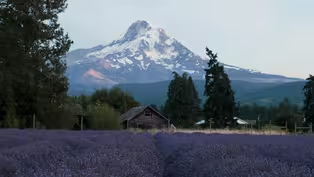
[ wind whistling ] [ shutter clicking ] MAN: When people come to our farm, they spend hours here, just taking hundreds of pictures just trying to capture that iconic view with Mount Hood in the background and the lavender in the foreground.
WOMAN: I didn't bring my ladder.
[ shutter clicking ] Want me to pose a little bit?
Stay.
MAN: That one shot that's going to be a lifelong memory for them.
GILFILLAN: For Francisco Ojeda, this lavender farm near Parkdale is part home, part business and part growing tourist mecca.
Oregon is really becoming known as a lavender destination.
The Oregon Lavender Association, they've created a map for tourists, so lavender in Oregon is actually a really growing population.
Lavender tourism?
You're not going to see the little barn, though.
Yes, lavender tourism.
And if you want a lavender vacation, you can use the map and just travel all around Oregon and the Pacific Northwest.
In fact, Oregon ranks in the top three domestic producers of the fragrant flower.
The use of lavender oil has been documented for over 2,500 years.
Cleopatra is said to have used its scent to seduce Mark Antony.
And hanging it above your door could keep away evil spirits.
Today, lavender has found its way into all kinds of products.
There's so many ways, different ways to use it, from cleaners to air fresheners to cooking.
And the medical industry is really starting to really embrace it as a way to relax the mind.
By late summer, the purple glory of these mature lavender shrubs is at its height.
The plant actually sends out a little flower, which is a beautiful little highlight of purple on top of the already brilliant lowlight of the bud.
And right after it flowers is the time that we harvest it.
Pruning and harvesting lavender at the same time is not easy, and if it's not done right, has dire consequences for the plant.
Fortunately, Jeronimo Hurtado is a master.
Jeronimo is very adept at, we call it, giving it the haircut.
He's really mastered the art of pruning it and shaping it.
The trick is you want to leave a little bit of the new growth.
Experts say to leave about 30 percent of the new growth.
And it's unlike on the other shrubs, where you can kind of cut them back hard.
Lavender isn't as forgiving.
Once the lavender is harvested, it's loaded into a big metal steambox... and stomped on.
Yeah, we say this is the Lucille Ball portion of the program where we stomp the grapes, but in our case, it's lavender.
We get our essential oils by an organic steam distillation process.
As the steam travels up, we don't want any big air pockets that would allow the steam to break through in just one area.
We want it to rise evenly throughout the whole box.
While the whole lavender plant contains trace amounts of oil, this process has a particular target.
The main oil generator are these buds here, because that's where all the oil molecules are stored inside of the buds of the plant.
The semillas, as we call them, the seeds.
[ speaking in Spanish ] Once all the lavender is pressed into the box, it's ready for distilling.
Francisco connects it up to the distiller and the steam line.
Now it's time to fire up the boiler.
In a few minutes, hot water from the boiler starts to travel up through the box.
You can actually feel the heat.
As it rises up through the box and travels through the lavenders, it's steaming open the buds, which is releasing the oils.
The oil molecules are attaching themselves onto the water molecules, which will make their way up through the hose and then across into our circulator, or cooling system.
As the vapors work their way through the box, Francisco hooks up a couple more very important hoses.
One for the oil and another for a lavender-infused water known as hydrosol.
The temperature's rising a little bit.
[ machine pops ] There was the breakthrough.
I don't know if you heard that pop.
So that is the steam breaking through the box.
As the steam vapors descend and cool, the oil and the hydrosol separate.
This lavender-infused water is a kind of wonder product.
This hydrosol is outstanding this year.
And it's used for everything from window cleaning to soothing insect bites and sunburns.
It's fantastic.
But for all the wondrous qualities that hydrosol claims, the real treasure is in that oil.
This is Melissa oil.
This is so delicate a flower that it doesn't produce very much oil at all.
Seventy-five plants will give us about a half a gallon.
But what it gives us is just pure gold.
This liquid gold ages for a year.
Then it's filtered and formulated into body oils and balms, scented soaps and essential oils so precious they're measured by the droplet.
The lavender hydrosol is also bottled into linen sprays, cleaners and air fresheners.
Back outside, the purple fields offer a feast for the eyes... and the bees.
The bees absolutely love, love the lavender.
So we have the best lavender honey that they give us as a reward.
Add in a daily sunset show of lavender in alpenglow and you get one of the most idyllic views in Oregon.
But for Francisco and the folks at Lavender Valley, this special spot offers one more gift.
She loves the way they smell.
FRANCISCO: When we see people coming onto the farm and their hustle, their energy is -- you know, they've just been traveling and they're stressed, and they completely decompress.
And you see them relax and just breathe in the atmosphere and really reconnect with nature.
And that's a magical moment for us.
[ ?
?? ]
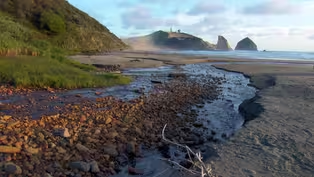
And finally, if you don't get to the coast as often as you'd like, let our photographers take you there.
Todd Sonflieth has this meditation that's only missing the ocean breezes.
[ ?
?? ]
[ gulls cawing ] JAHN: You can now find many Oregon Field Guide stories and episodes online.
And to be part of the conversation about the outdoors and environment here in the Northwest, join us on Facebook.
[ gull caws ] [ birds chirping ] Major support for Oregon Field Guide is provided by... Additional support provided by... And the following... and the contributing members of OPB and viewers like you.
Video has Closed Captions
Clip: S32 Ep9 | 2m 18s | A photo essay on riffles in the sand. (2m 18s)
Video has Closed Captions
Clip: S32 Ep9 | 6m 57s | Lavender is one of the loveliest and most fragrant flowers, and one of the most useful. (6m 57s)
Video has Closed Captions
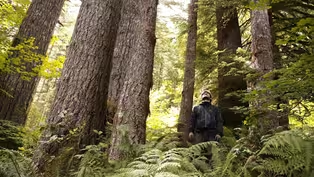
Clip: S32 Ep9 | 14m 15s | Marbled murrelets have long been a mystery to science. (14m 15s)
Providing Support for PBS.org
Learn Moreabout PBS online sponsorship

- News and Public Affairs

Top journalists deliver compelling original analysis of the hour's headlines.












Support for PBS provided by:
Oregon Field Guide is a local public television program presented by OPB