
Residents of "Wisconsin" in the American Revolution
Special | 44m 22sVideo has Closed Captions
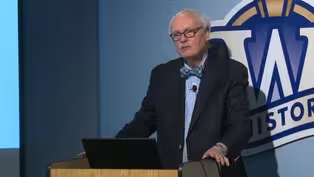
Mary Elise Antoine describes Canadians and Native people in the American Revolution.
Author and historian Mary Elise Antoine explains how and why Canadians and Native people of the western Great Lakes-upper Mississippi region were part of the American Revolution, the results of the battles in which they fought and the effect of the war in what is now Wisconsin.
Problems playing video? | Closed Captioning Feedback
Problems playing video? | Closed Captioning Feedback
University Place is a local public television program presented by PBS Wisconsin
University Place is made possible by the Corporation for Public Broadcasting.
Residents of "Wisconsin" in the American Revolution
Special | 44m 22sVideo has Closed Captions
Author and historian Mary Elise Antoine explains how and why Canadians and Native people of the western Great Lakes-upper Mississippi region were part of the American Revolution, the results of the battles in which they fought and the effect of the war in what is now Wisconsin.
Problems playing video? | Closed Captioning Feedback
Where to Watch University Place
University Place is available to stream on pbs.org and the PBS app.
More from This Collection
A collection of presentations from "History Sandwiched In" at the Wisconsin Historical Society. Authors, historians and community members share insights on regional history topics such as farm life, early transportation, sports, music and Indigenous history.
The Milton House and the Underground Railroad
Video has Closed Captions
Kevin Scannell describes the Milton House and its role in the Underground Railroad. (45m 36s)
Sears, Roebuck and Co. Houses in Wisconsin
Video has Closed Captions
Jim Draeger traces the history of mail-order homes from their origins in the late 1800s. (52m 15s)
Lumberjacks, Logging and the Land
Video has Closed Captions
Susan Apps-Bodilly explores Wisconsin's logging boom and the efforts to restore the land. (54m 49s)

The 32nd Infantry Division During World War II
Video has Closed Captions
Mark D. Van Ells tells the history of the Midwest National Guard "Red Arrow" combat unit. (58m 2s)
The History of Hmong in Wisconsin
Video has Closed Captions
Mai Zong Vue shares the history and experiences of Hmong who settled in Wisconsin. (51m 20s)
Railroads of Madison and South Central Wisconsin
Video has Closed Captions
Scott Lothes explores the golden age of South Central Wisconsin railroad history. (51m 54s)
The Norwegian-American Legacy in Wisconsin
Video has Closed Captions
Dana Kelly shares the history of Norwegian-Americans in shaping Wisconsin's culture. (48m 12s)
Obreros Unidos: Roots and Legacy
Video has Closed Captions
Jesus Salas describes his history as a migrant worker and the founding of Obreros Unidos. (54m 49s)

Wisconsin African Americans in the Civil War
Video has Closed Captions
Historian Jeff Kannel shares stories of Wisconsin African American Civil War soldiers. (52m 34s)
A History in Indigenous Voices
Video has Closed Captions
Carol Cornelius presents research on Indigenous treaty negotiations. (44m)

Milwaukee's Palace of the West
Video has Closed Captions
Matthew J. Prigge shares the story of the 1883 fire at Milwaukee’s Newhall House Hotel. (40m 30s)
Video has Closed Captions
R. Richard Wagner provides an account of Wisconsin’s gay history from 1895 to 1969. (36m 45s)
Providing Support for PBS.org
Learn Moreabout PBS online sponsorship[gentle music] - Jenny Pederson: Welcome, everyone, to "History Sandwiched In."
My name is Jenny Pederson, and I am the public programs manager with the Wisconsin Historical Society, and it's a pleasure to have you all with us.
A note that opinions expressed today during the presentation are those of the speaker and not those of the Wisconsin Historical Society or the society's employees.
It is an absolute pleasure today to introduce Mary.
She is sharing a presentation, "Residents of 'Wisconsin' in the American Revolution."
And before I hand it over, I'm going to share a brief biography of our lecturer.
Mary Elise Antoine was born and raised in Prairie du Chien.
She is a graduate of Marquette University, Milwaukee, and the State University of New York, Oneonta, with an M.A.
in history museum studies.
Mary Elise has over 40 years of professional experience working for history museums and in historic preservation.
She was curator of collections and research at Villa Louis State Historic Site and National Historic Landmark, conducting research that directed the restoration of the site.
She is past president of the Prairie du Chien Historical Society and a member of the board of the Historic Indian Agency House in Portage, Wisconsin.
Mary Elise has researched and written articles and books which document cultural minorities in the late 18th and early 19th century American society.
These include The War of 1812 in Wisconsin: The Battle for Prairie du Chien, Frenchtown Chronicles of Prairie du Chien, Enslaved, Indentured, Free: Five Black Women in the Upper Mississippi, and her most recent book, Elegant Artifice: The Women Who Forged a Legacy at Villa Louis, all published by the Wisconsin Historical Society Press.
She also authored Frenchtown Cemetery: Old Catholic Burying Ground at Prairie du Chien, 1816-1840.
She has written two books on Prairie du Chien, published by Arcadia Publishing as well.
Mary Louise continues to research and write and work at Villa Louis in the museum field.
She lives in a restored French-Canadian house in Prairie du Chien.
Please join me in giving a warm welcome to Mary Louise Antoine and enjoy the presentation.
[audience applauds] - Mary Elise Antoine: Thank you very much, Jenny.
It's an honor to be here, and I am going to enjoy sharing this topic with you.
I was asked how come I did this.
Well, as you heard, I am born and raised in Prairie du Chien, still live there.
And so much of my research focuses around the early history of Prairie du Chien.
And I spent 14 years on the East Coast, where they talk about the American Revolution all the time and then came home to realize, "Hey.
That revolution also occurred in what is now called Wisconsin."
So, I put together this program and hope you enjoy it.
So, at the time that the American Revolution was beginning to get thought about, we have this whole country here of the western Great Lakes and the upper Mississippi.
And these are the Native American nations that lived within this area, and most people on the East Coast had no idea as to who lived in, as the French called it, the Pays d'en Haut, or as the British called it, the Indian country.
So, the majority of the residents in this area were of Native American heritage.
But two small communities had already begun by 1776, and one was called La Baie.
It's now Green Bay, and it was at the beginning of the Fox-Wisconsin Waterway.
And the other small community was La Prairie du Chien, or as we call it, Prairie du Chien today.
And this was at the end of the Fox-Wisconsin Waterway.
That Fox-Wisconsin Waterway connected the Mississippi River all the way to the Great Lakes, going through all of them.
And from there, you could go into the St.
Lawrence River.
So, travel between the East Coast and what's now Wisconsin could be done.
But before we get to the revolution per se, there's a little background that shows a lot of the reasons why the American Revolution came to what is now Wisconsin.
The French had been migrating into this area since the late 1600s.
And in time, they ended up constructing three forts that were also communities.
So, not only were there men who lived there who were engaged in the fur trade, but there was a military component, there were families, and there were also other people who had supports of the fur trade, like carpenters or blacksmiths.
And in this story of the American Revolution, all three of these forts play a role.
Now, at Fort Michilimackinac, one of the men who lived there was Charles Michel de Langlade.
His father, Augustin, had married an Odawa woman, and Charles was the child of a French-Canadian man engaged in the fur trade and an Odawa woman.
He soon became very much a part of the Fort Michilimackinac community, and as he grew older, he was made an officer in the French colonial regulars.
And that is a copy of his commission from the king of France.
Well, Great Britain and France were vying for control of the lands west of the Appalachian Mountains to the Mississippi River because this was very rich fur-bearing country, and the fur trade was one of the main economies of Great Britain and of France, and the best furs came from the western Great Lakes/ upper Mississippi region besides Canada.
And the British had only 13 colonies on the eastern seaboard, and they began to try and get into the land claimed by France, which began in the Ohio Valley and spread westward and northward.
And Charles became quite involved in the confrontation that begins in what is now western Pennsylvania and New York and Kentucky.
And all of this leads to what we call the French and Indian War.
If you live in Europe, it's the Seven Years' War.
If you live in French-speaking Canada, it's the War of Conquest.
But Charles proved himself to be an able leader of men, and the French called upon him to lead Native American contingents against the British once war had been declared.
He helped defeat General Braddock at Fort Duquesne, leading Native peoples of the Three Fires Confederacy.
And along with them came his very young nephew, Charles Gautier de Vierville.
And they continued to lead Native American troops against Robert Rogers and then were involved in the Battle of Lake George in 1757.
So, when Charles returns to Michilimackinac, he is placed as second in command of the French fort there and once again is called upon, with his nephew, to help defend the French empire on the Plains of Abraham.
And at that point, he is commissioned a lieutenant in the French marine.
Well, when the war ends, the French government offers Michel, or Charles Michel the opportunity to move to France along with the other French military people who are returning to France.
And he has no desire to do so because his family and all of his connections are here.
And so, the French commander at Fort Michilimackinac puts Charles in charge of the French fort, and he is ordered to surrender the fort to the British in 1761.
And being ever the optimist or something, Charles does surrender the fort to the British, but then is placed in command of the fort until 1763 and becomes part of the British military.
And again, the reason they are asking Charles to come now onto the British side is because of his influence among the Native Americans and of the area that is around Sault Sainte Marie in Mackinac Island.
And so, he is commissioned a lieutenant in the British Indian Department.
The British Indian Department is set up separate from the British military, but is run very much on a military pattern.
And this is Charles' coat from when he was a lieutenant in the British Indian Department, along with his knife and his bag.
The coat is owned by the Neville Museum.
So, Great Britain gains control of all of the land from the Atlantic Ocean to the Mississippi River and up into what is called Canada.
And Canada becomes the 14th colony of Great Britain in North America.
And the colonists who live in the 13 colonies immediately start venturing into that land that France controlled west of the Appalachian Mountains, and they start disturbing the Native American people who live there.
And that disturbance affects the fur trade, which Great Britain does not want disturbed.
So, King George issues a royal proclamation in 1763 saying that there is to be no settlement west of the Appalachian Mountains to the Mississippi River unless someone has the permission of the governor or of even Parliament.
Those settlements that are already there can remain because all of them benefit the British fur trade.
And so, the British set up trading agreements with the Native American nations, and the fur trade continues, much as it had been initiated under the French, in the same method as under the British.
In the meantime, the colonists are getting a little frustrated.
They are not allowed to move into that rich lands west of the Appalachian Mountains.
The farmland there is much better than you're going to find in New England or New York.
And the southern colonies are depleting their land by growing tobacco on it.
Not only that, the colonists are being taxed.
And a lot of those taxes are raised, are done to raise money to pay for the French and Indian War.
So, when you hear "No taxation without representation," those taxes are paying for that war that gained North America for Great Britain.
Well, in time, the frustration rises.
And in April 1775, the Battle of Lexington and Concord occurs.
And as I said, by April 1775, there are two communities, two Euro-American communities, in what is now Wisconsin, and that is La Baie and Prairie du Chien.
Quite often, this doesn't get a lot of attention in the study of the American Revolution, but after the battles of Lexington and Concord and Bunker Hill, the United States Army, or Continental Army, as it was still called then, decides that the first major effort is going to be an invasion of Quebec.
The 13 colonies feel that they can convince the colony of Quebec to be part of their revolution, especially those French-speaking people who are Catholic and are now under the subjection of Great Britain.
And so, a two-pronged invasion is planned, one leaving from New York, going up the Hudson River through Lake Champlain to Montreal, led by General Richard Montgomery.
The second part of that invasion is led by Benedict Arnold, and it is going to go up through what is now Maine and that area to attack Quebec.
And immediately, the British military and the governor of Canada, Governor Carleton, are very familiar with Charles, and they start talking about having him become involved in protecting the province of Quebec.
As Governor Guy Carleton says, Langlade is "a man I have every reason to be very much satisfied with "and from whom his influence among the Indians of that district may be very much of use."
By 1775, Charles and his family have moved from Fort Michilimackinac to La Baie.
And so, Langlade, along with the Grignon family, become permanent settlements, settlers at Green Bay.
And it's their settlement that starts the community.
So, Charles calls upon the Native American people, with whom he has long been allied, mainly the Odawa and the Ojibwe, and he puts together a force.
And Captain Arent de Peyster is commander of Fort Michilimackinac.
Charles raises a force of 150 Odawa and Ojibwe and bring along a man as an interpreter.
You have to realize that Charles speaks French and a Native American language, but this is a British expedition, so we need someone who can speak English.
So, any orders that are transmitted go from English to French to the Native American language.
So, you always have to have an interpreter along with any expedition.
And so, in July 1775, Langlade is ordered to beat up for the Indian volunteers, meaning drum up.
And not only does he put together Odawa and Ojibwe but hundreds of Meskwaki, Ho-Chunk, Sauk, Menominee, and Dakota.
And his orders are, "You will do your best to harass the rebels "wherever you may encounter them, "and in all matters, you will conduct yourself with your customary prudence and humanity."
So, Langlade and his Native warriors go up to Montreal and in the process of this, help secure Montreal for the British in 1776.
The Continental Army's invasion of Quebec fails.
They do capture Montreal with Montgomery, but Arnold is unable to capture Quebec City.
Langlade and his Native American warriors help keep Arnold away from Quebec, and then they return and help recapture Montreal for Great Britain.
So, while all this is going on, there are men from the 13 colonies meeting in Philadelphia to write the Declaration of Independence, which is made public in July 1776.
And if you read the declaration, there are 27 grievances in there.
The grievances are somewhat general in their discussion, but part of them relate to what's been going on on the land west of the Appalachian Mountains, west of that boundary line from the proclamation of 1763.
And, of course, all the grievances are placed against King George III, even though Parliament passed the laws, but... And so, everything is written as "he," meaning King George III.
And so, one of the grievances is that he refuses "to pass others encouraging their migration hither," meaning he's not allowing people to migrate west of the Appalachian Mountains, and they can't raise the conditions for new appropriation of lands.
What this is is a complaint that land speculators, of which George Washington was one, cannot acquire the lands to turn around and sell them to other people who are interested in settling.
"He has forbidden his governors to pass laws of immediate and pressing importance."
Again, that has to do with migration to the West.
"He has kept among us in times of peace standing armies without the consent of our legislatures."
While this is something to do with the Boston Quartering Act, it also has to do with the fact that there are standing armies in the western forts, which the colonists originally requested to keep the Native Americans from attacking American settlements.
But now, they don't want that standing.
And the last one, which is grievance 27, is not very commendable, the Declaration of Independence and its people.
King George "has endeavored "to bring on to the inhabitants of our frontiers the merciless Indian Savages."
So, those are some of the grievances in the Declaration of Independence, which reflect on what is now Wisconsin.
Well, they may have written that, but it really doesn't make much difference because now that England has control of Montreal and Quebec, they decide it's about time to end this war and put those rebels in their place, and they plan a three-pronged movement that they hope will divide the colonies, divide the New England off from the rest of the colonies and take control of New York.
And one of those movements is to be led by General John Burgoyne, and he enrolls Charles Langlade and Charles Gautier into the Quebec Indian Department.
They again are to help raise Native American troops.
And one of the Native American leaders who is very pro-British and more than willing to help is Wabasha.
Wabasha is a Dakota leader.
Wabasha, Minnesota, is named for him.
And so, Wabasha and another Dakota chief travel all the way to Montreal.
And they came with him was an interpreter, Joseph Roc, who lives at Prairie du Chien.
And Wabasha tells the governor that he's heard "your summons addressed to the whole world" and he comes from "the most distant of your children" to offer the services of 15,000 warriors to the British.
And he says, "Therefore I will return when it is your pleasure "and tell them of the happiness I have in speaking with the father of the world."
And at this point, Wabasha and his companions are given a medal.
France had started this, granting medals to Native American leaders with the image of King Louis on it.
And the medals were presented almost like a contract.
"You wear your father's medal.
You are willing to trade with us, and we will trade with you."
And so, Great Britain does exactly the same thing.
But with Great Britain, it is more than just an agreement to trade.
It's an agreement to support Great Britain in its conflict against the colonies.
And so, Wabasha and the other leaders are granted these medals with an image of King George III on them.
And so, this is the British plan to win the war.
General Howe is to progress up the Hudson River from New York City.
General Burgoyne is to progress from Quebec, up the St.
Lawrence, down the Richelieu, into Lake Champlain, and then down the Hudson River.
And he would meet Howe at Albany.
And the third branch, under Barry St.
Leger, is to leave Montreal, continue up the St.
Lawrence to Lake Ontario, and then go down the Mohawk River and meet at Albany.
And therefore the colonies will be divided and the British will have control not only of New York City, but all of New England and the capital of New York.
So, the campaign for General Burgoyne begins in the summer of 1777, and the first engagement is at the Battle of Saratoga.
And as part of the British troops at the Battle of Saratoga is Charles leading Menominee and Ottawa people and Charles Gautier leading Sauk and Meskwaki.
Charles Langlade is placed as second in command of what are called Burgoyne's Indians, and it includes more than Native Americans from what is now Wisconsin but also other Native nations from the Ohio Valley.
They would continue to fight, especially the Ottawa, under Langlade's leadership until the Battle of Bennington.
But, of course, this three-pronged plan to divide the colonies fails.
First of all, General Howe never leaves New York City.
Barry St.
Leger gets as far as Fort Stanwix, and he is so inebriated he can't lead his troops.
And then General Burgoyne is defeated at the Battle of Saratoga and has to surrender his forces after the Battle of Bennington.
So, Charles-- or both of the Charles, Langlade and Gautier, return with their Native American peoples to what is now Wisconsin and the Upper Great Lakes.
And the Native Americans are a bit disgusted because there was nothing that really occurred that they could celebrate.
But the war continues, and there is a new movement.
George Rogers Clark had already gone into Kentucky.
He is William Clark's older brother.
And he goes to the governor of Virginia, Patrick Henry, and tells him, "You know, I'm very familiar with this area of Kentucky," in what's now Indiana.
And he said, "I would like permission to take this over for the state of Virginia," and not only capture Vincennes but also the communities that are in what is called the Illinois Country.
And Patrick Henry gives his permission, and also gives him a little bit of money.
And so, George Rogers Clark and his men, who were called the Illinois Regiment of Virginia, leave Virginia and progress westward.
They readily capture Fort Vincennes, and then they move on to three communities that are now in southern Illinois, Kaskaskia, Cahokia, and Prairie du Rocher, and very quietly walk in and take them over.
The residents there are all French-speaking people.
They really have no love for the British.
And so, George Rogers Clark, very quietly and calmly, gains control of southern Illinois and claims all of the land from Virginia to the Mississippi River for the state of Virginia.
And if you look at early maps, you'll see that Virginia progresses all the way across the eastern half of the United States.
Well, the British are not about to take this easily.
And Lieutenant Governor Henry Hamilton puts together a British force, again composed of Native Americans from the Ohio-Indiana area, and engages in the Battle of Fort Vincennes to try to recapture Vincennes for Great Britain and fails.
He ends up becoming a prisoner.
But that does not stop Great Britain, and they have another impetus to try and gain this area back.
Everything west of the Mississippi River is claimed by Spain, so they call it Spanish Louisiana, and in 1764, they establish a community which they call St.
Louis, or St.
Louis, which the English call Precour.
And then, in June of 1779, Spain joins not as an enemy of the United States and Great Britain, but as an ally of France.
Well, France has already come in as an ally of the United States, and so Spain is now allied against Great Britain.
And the Americans are very happy for this, because the Spanish have been able to bring goods and material up the Mississippi River, and now they're willing to sell it across the Mississippi River to George Rogers Clark and support them.
And so, with this measure, Clark decides maybe he ought to move westward and northward and start to control the rest of the northern part of the Indian country.
And so, the rumors started that Rogers' forces are building boats at Chicago to come up the Mississippi River and capture La Baie, all the land on both east and west side of Lake Michigan and Fort Michilimackinac.
In response, the new British governor, Sir Frederick Haldimand, stages another three-pronged attack plan.
Lieutenant Campbell, who is at Pensacola, is ordered to attack New Orleans.
Arent de Peyster, who is at Detroit, is ordered to attack Vincennes.
And the commander at Fort Pitt, which is now Pittsburgh, is to prevent any U.S.
forces to go to Kaskaskia or Cahokia to support George Rogers Clark.
Thirdly, Sinclair, who is now a lieutenant governor at Fort Michilimackinac, is to gather, at Prairie du Chien, troops and descend the Mississippi River and attack St.
Louis and Cahokia.
So, this military plan is begun in early 1780.
Now, in the meantime, along the Mississippi River, the fur trade continues as it had before, especially with people along the Mississippi and La Baie, because they're still far enough away from what's going on.
And one of the men who lives at Cahokia is Charles Gratiot.
A little community in Wisconsin, Gratiot Grove, is named for him.
And he is a major fur trader in Cahokia.
He has often traded at Prairie du Chien.
So, in the spring of 1780, he has a boat filled with all sorts of trade goods that he wants brought up to Prairie du Chien to trade for the furs that have been captured and processed during the winter by the Dakota and the other northern Native nations.
And he puts Jean-Baptiste Cardinal in charge.
Cardinal is from St.
Louis, but again, he's very familiar with Prairie du Chien.
He has traveled up there since the mid-1700s, when the land was still part of New France.
And he puts together a crew, and the boat is loaded with Gratiot's goods and starts proceeding up the Mississippi River.
On April 13, they dock overnight at the Iowa River.
They do a little trading there, and while there they meet two men from Prairie du Chien, Joseph Calvè and Jean-Marie Ducharme.
And again, they are both fur traders.
They know one another.
Joseph asks Jean-Baptiste Cardinal, "Where are you going?"
And he goes, "Well, I'm going to Prairie du Chien."
"Well, what are you gonna do up there?"
"Well, I'm gonna trade these goods for furs that are probably up there."
And Joseph says, "Well, how about if I go along with you?
Because I'm gonna go up that way."
And in the meantime, Joseph tells Jean-Marie Ducharme, "You get up to Prairie du Chien right away "and tell them what is coming up here, "because this boat is loaded with material that we, as part of the British forces, can use."
And so, Cardinal and Calvè continue up to the Turkey River.
When they arrive there, they are met by Ducharme and other men from Prairie du Chien.
And so, Cardinal and his men are captured as British prisoners, and things that they're carrying now are part of Great Britain's war materiel, and they all go up to Prairie du Chien.
While all of this is going on, Lieutenant Governor Patrick Sinclair receives his order from Haldimand to "reduce the Spanish posts in the Illinois Country."
So, he decides that he's going to get two forces together.
They're both gonna leave from Michilimackinac.
One is going to go down to Green Bay, through the Fox-Wisconsin Waterway to Prairie du Chien and from Prairie du Chien down to St.
Louis.
And the other one, under the command of Charles Langlade, is to go through Lake Michigan to Chicago and across the country, and he is to attack Cahokia.
And so, the plan is set in motion, and it begins in the spring of 1780.
Joseph Roc, who has been with Charles Langlade and the Dakota people for a long time, is hired as the king's interpreter.
And Lieutenant Key is the English interpreter and commissary.
Wabasha, the Dakota leader, is well thought of by both Governor Haldimand and Lieutenant Governor Sinclair.
Haldimand says he has "the zeal manifested that warrants our attention."
And so, Sinclair gives him a commission as a British general.
He finds him one "of uncommon abilities and generously attached to His Majesty's interest."
So, you have the Dakota and some Sauk and Meskwaki who have gathered at Prairie du Chien to begin the trek down the Mississippi River and attack St.
Louis.
Along with him is Emmanuel Hesse, who is a fur trader, and some Ojibwe, Ho-Chunk, Menominee, and Sauk and Meskwaki.
With Charles Langlade, you have Sergeant Phillips of the 8th British Regiment and Matchekewis and the Ojibwe.
And also with him is Chanawon.
He is a Menominee leader.
And this is his commission from Governor Frederick Haldimand.
And he is also given a British medal and a British silver gorget with the British coat of arms on them.
So, there's great respect for the abilities of the Ojibwe, the Menominee, and the Dakota to support Great Britain.
And the Illinois River expedition leaves in May of 1780 with Charles Langlade, Charles Gautier, Pierre Durand, and a variety of Native people and some Canadians.
In May of 1780, 750 to 1,000 Native Americans, along with Joseph Roc and Emmanuel Hesse and other traders and their servants, leave Prairie du Chien.
And they assume that they are going to very quietly proceed on both of the treks into the Illinois Country and St.
Louis and attack and capture both of those communities.
Well, rumor has made its way to the Spanish at St.
Louis, and the Spanish lieutenant governor there immediately commands the building of Fort San Carlos at St.
Louis.
It was supposed to originally have four towers, like you see here, but only one was built.
The Spanish have a regular army.
They also have local militia, and they also have French militia.
And they are ready to defend St.
Louis.
Not only do they have the fort.
They have outer barriers of chevaux de frise to keep anyone coming close to the fort.
And so, in May, the force from Prairie du Chien lands canoes and starts coming overland toward St.
Louis.
Jean-Marie Ducharme and the Ojibwe cross the river to go and attack Cahokia along with Charles Langlade's troops.
Some of the Dakota and the Ho-Chunk attack St.
Louis, but they are unable to take Fort Don Carlos.
And so, Hesse calls the troops back, and they leave and head north.
Langlade's force is stopped en route, so it doesn't even make it beyond Chicago, and the American force, led by George Rogers Clark, repulses Ducharme's attempt to capture Cahokia.
And so, the whole invasion fails, and people return to either La Baie or Prairie du Chien.
But they get quite concerned because when George Rogers Clark came into the Illinois Country, he demanded everybody show proof of ownership of their lands.
And the people who live at La Baie and Prairie du Chien have no proof of ownership.
They just selected lands, and they have bought and sold to one another.
And so, they go up to Michilimackinac to Lieutenant Governor Sinclair and ask for proof of ownership.
And he conducts a treaty with the Native nations of the western Great Lakes, upper Mississippi, and they sign a treaty giving Mackinac Island, La Baie, and Prairie du Chien to their residents.
So, these are sort of some of the residents that are involved in the American Revolution.
Some of them live in the area: the Native Americans, Charles Langlade, Joseph Roc, Maurice Blondeau.
Other ones, interestingly enough, lived in St.
Louis, but in time, come to make their home in Prairie du Chien.
After the war, there's really no hostilities between the residents of Prairie du Chien and the Illinois Country and St.
Louis.
And so, there's a migration up to Prairie du Chien, and a lot of the early settlers are from the Illinois Country.
So, war ends with the surrender of American forces at Yorktown.
The British are still in control, though, of Mackinac Island and Detroit and the upper Mississippi/ western Great Lakes.
And the Native Americans are quite willing to continue the hostilities.
And Governor Sinclair at Michilimackinac realizes they can't.
And so, a large council is held at Prairie du Chien with the Native American nations to explain what has happened, but the fact that the Native people are always welcome to come and visit the British.
So, with the Treaty of Paris, if you read the articles of it, it pertains very much to the concerns of the residents of the 13 colonies, the 13 states.
It has to do with government.
It has to do with the ability to fish in the Atlantic Ocean off of Canada, for trade, for the ability to move westward if they want.
There is absolutely no mention of the land west of the Appalachian Mountains, which is inhabited by a variety of Native American nations.
And this inability to address the majority of the residents of this area will be played out in the War of 1812, when the residents of La Baie, Prairie du Chien, Mackinac, and all of the Native nations of this area support Great Britain.
Thank you all very much.
[audience applauds]














Support for PBS provided by:
University Place is a local public television program presented by PBS Wisconsin
University Place is made possible by the Corporation for Public Broadcasting.