Oregon Field Guide
Ship Report, Wallowa Mule Packer, Tim Palmer
Season 32 Episode 6 | 27m 28sVideo has Closed Captions
Ship Report, Wallowa Mule Packer, Tim Palmer, Klickitat Canyon Photo Essay
Meet the woman behind the ‘The Ship Report,’ an entertaining daily radio report of all the ships that pass by Astoria. Join Field Guide for a high country pack trip with mules in the Wallowas. Tim Palmer has canoed, rafted and kayaked nearly every major river in Oregon. Enjoy a photo essay from the newly created Klickitat Canyon Conservation Area, shot on land set aside by the Columbia Land Trust.
Problems playing video? | Closed Captioning Feedback
Problems playing video? | Closed Captioning Feedback
Oregon Field Guide is a local public television program presented by OPB
Oregon Field Guide
Ship Report, Wallowa Mule Packer, Tim Palmer
Season 32 Episode 6 | 27m 28sVideo has Closed Captions
Meet the woman behind the ‘The Ship Report,’ an entertaining daily radio report of all the ships that pass by Astoria. Join Field Guide for a high country pack trip with mules in the Wallowas. Tim Palmer has canoed, rafted and kayaked nearly every major river in Oregon. Enjoy a photo essay from the newly created Klickitat Canyon Conservation Area, shot on land set aside by the Columbia Land Trust.
Problems playing video? | Closed Captioning Feedback
How to Watch Oregon Field Guide
Oregon Field Guide is available to stream on pbs.org and the free PBS App, available on iPhone, Apple TV, Android TV, Android smartphones, Amazon Fire TV, Amazon Fire Tablet, Roku, Samsung Smart TV, and Vizio.
Providing Support for PBS.org
Learn Moreabout PBS online sponsorshipMajor support for Oregon Field Guide is provided by... [ ?
?? ]
MAN: My rappel!
MAN: Oh, my gosh, it's beautiful.
MAN: Good morning, everybody.
Woo!
Let's do it again!
MAN: Nicely done!
MAN: Oh, yeah!
Fourteen and a half.
Yes, that was awesome!
[ people cheering ] There you go, up, up... ED JAHN: Tonight, on Oregon Field Guide: [ horse snorting and clomping ] To get to some of the highest and toughest to reach places up in the Wallowa Mountains, sometimes it's best to bring a little help.
C'mon, mules.
Then, dip a paddle with guidebook author Tim Palmer as he reflects on the wonder of Oregon's rivers.
PALMER: Just you and the river, and there's a certain magic in that.
Then we close with a look at the natural beauty of Klickitat Canyon.
But first, we head to the Oregon Coast.
[ seals barking ] If you've ever been to Astoria, you can't help but notice that on the horizon, always within view, are these huge ships -- 6-, 7-, 800 feet long.
And you might've wondered what are they carrying, where are they headed, what far corner of the planet did they come from?
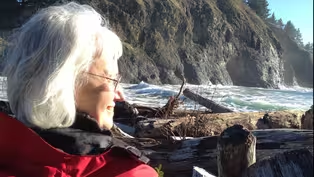
Well, every morning, Joanne Rideout answers these and all your other maritime questions for something she calls 'The Ship Report.'
[ gulls cawing ] WOMAN: It's time for 'The Ship Report,' the show about all things maritime -- I'm Joanne Rideout.
We have 16 vessels on today's Columbia River ship schedule.
Our first arrival on the river is the Sunny Young.
She's a bulk carrier arriving from South Korea, headed for Astoria's anchorage.
She will ultimately go up to Kalama... ED JAHN: If you live in Astoria, you've probably heard her voice.
It's there like a friend, bringing news of the sea just before 9:00 every morning.
ITB tug Island Tugger, there's a pretty cute name.
The voice belongs to Joanne Rideout, and her show, 'The Ship Report,' broadcasts from Coast Community Radio, KMUN.
She's arriving from Vancouver, B.C., heading for Portland...
Working out of an old converted brothel that looks over town, Joanne's daily musings on ship traffic, weather, and maritime life are now the most popular radio show on KMUN.
Not bad for someone who arrived as a curious newcomer 15 years ago.
I moved here from the desert Southwest, you know, and so here I am in Astoria, all this water, I'm working in a radio station that's up on the hill in an old house with a big picture window, and I see the ships going by.
Because I was the news host of 'Morning Edition,' I started inserting in one of the music beds a minute of what ships are coming and going.
It's time for 'The Ship Report,' the show about all things maritime -- I'm Joanne Rideout.
I just sort of waited to see what the reaction would be, if people would say, 'Why are you doing that?'
or -- and people liked it.
[ barking softly ] You might think that Astorians already live and breathe maritime life.
There is plenty of fishing, but Astoria isn't actually a big port town.
Most of the large ships are just passing by... headed to larger places like Longview or Portland.
And so the ships drift by like oversized impossible-to-ignore strangers.
Most of the houses face the water.
People are always looking at the river one way or another, and I think I'm just sort of tapping into that sort of curiosity that people have.
It was that curiosity that got Joanne talking to captains and ship hands and sent her digging through arcane maritime websites in search of ways to demystify that world.
That is a handysize bulk carrier.
It's about 600 feet long.
It is the most common ship that you see on the river, and they're also referred to colloquially as stick ships because of those cranes that are standing up.
Those are the ships that carry the most common cargos on the river, which are the bulk cargos, like when you go to the supermarket and buy bulk cereal.
Astoria is an ideal ship-watching town.
The contours of the Columbia River channel bring even the biggest ships within 100 yards of the city's public riverbank.
You can't get much closer than this anywhere in the world.
All of a sudden this big thing is in your field of view, and you're sort of transfixed.
When you look at this, you think, 'My God, this thing is as big as a building!'
You just stop and you go, 'Wow, what is that?!'
But the best view is still out on the water.
That's where Joanne has made many friends in the maritime business.
When I get on a boat, I just light up.
I'm one of those people that I'm in my happy place when I'm on something that's floating.
[ giggles ] We're going to get sort of in mid-channel... Captain Robert Johnson is a Columbia River bar pilot.
He's mentored Joanne over the years and helps her navigate the ins and outs of the shipping business.
This ship is coming in from sea -- I believe it's coming from Japan -- and going to Anchorage.
The Momo Glory is about 600 feet long, and yet it's only half the size of the largest carriers.
But even though this ship arrives empty, it still takes miles of river and 15 tons of chain and anchor to bring it to a stop.
RIDEOUT: It's quite a feat to bring a ship in here and bring it in safely.
These things are as long as a building, and yet they have no brakes.
So right now, what's happening?
He's backing the engines...
I like to ask every dumb question.
How much chain you put out has to do with the depth of the water, right?
I come at it from the point of view that I'm not a professional mariner.
Wow!
How fast is sea speed in this kind of a vessel?
I tend to look at things in very simple terms and say, 'What is that thing?
Why are you doing that?
What happens when you do this?
What could go wrong?'
Joanne has learned a lot from Captain Johnson.
He spent a lifetime captaining these massive ships before becoming a bar pilot.
Now, as a bar pilot, he's taken on one of the most hazardous jobs in the world.
All ships entering and leaving the Columbia River need to be boarded by a bar pilot, who then takes control of the ship to help the mostly foreign crew navigate their vessel across the extremely treacherous stretch of water where the Columbia River meets the sea.
To board those ships, bar pilots rappel onto them from a helicopter... JOHNSON: Good morning, gentlemen!
or climb steep rope ladders dangling from ships as they steam across the ocean.
Pilots board over 1,500 ships a year in this way.
It's a dangerous line of work that Joanne made sure to report on firsthand.
I think that might have been the first time I met Joanne -- I got off a ship in the middle of the night, and here was this lady sitting there, and, you know, 'What is she doing out here, and especially what is she doing out here at 2:00 in the morning?'
Well, she knew the boat operator, and he'd invited her to come for a ride, and she'd taken him up on it.
So that's probably 12,000 horsepower... That 'thump, thump, thump' is the propeller where it gets a little air.
Joanne once spent 10 days living aboard a bulk carrier with an all-male Ukrainian crew.
She's reported from carriers, tugboats, and pilot boats.
Wow, well, you're tough.
She's not afraid to get her boots wet in an effort to remind listeners that $13 billion in trade move up and down this river and nearly 90% of everything we buy comes from ships you may have never given any thought to.
RIDEOUT: We would not have most of the possessions we have in this country if it weren't for vessels like that.
The thing I find quite fascinating about the maritime industry in general is that it's so invisible.
When the ships go by, they look like... almost like giant beasts that have swum into the river because you don't see any people on them.
But actually there are pilots onboard and there are officers and a whole bunch of people that are making sure that that ship gets safely from one place to another.
It kind of is like what it would be like to touch a whale or something.
You know, when you touch the side of the ship, it's like a living thing.
Yeah, well, they are living things to me.
Yeah, yeah, they are to me, too.
Absolutely.
The mikes are live.
I'm here in the studio with retired mariner Terry Wilson.
Well, I remember when I... RIDEOUT: People, you know, what I have found is that when you display genuine curiosity about what someone's doing when they really love what they're doing, they love to talk about it.
And they lost a lot of their container.
The ship was rocking 35 degrees.
So have you ever just plain gotten thrown out of your bunk?
Oh, yes.
- Really?
- Oh, yes.
RIDEOUT: Most of these folks really operate in obscurity, and it's really a gift when someone tells you their story.
That's part of what I love to bring to it, is to help people realize that even though you don't know it, those folks play a big role in your life.
You've been listening to 'The Ship Report,' the show about all things maritime -- I'm Joanne Rideout.
Thanks for listening.
Have a great day.
[ ?
?? ]
[ gear jangling ] I think that some of the best backpacking in the entire West can be found right in Oregon's own Wallowa Mountains.
But if you've ever been there and you've traveled through those mountains with everything on your back for days at a time, you know that it can be pretty tough.
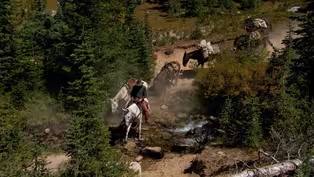
Well, Oregon Field Guide photographer Michael Bendixen found one man who helps travelers get into the high country a different way, and his pack mules are part of a long Oregon tradition.
Come on, girls.
Hyup, hyup.
My name is Steve Morris.
I'm a mule packer.
I fell in love with the mountains when I was young and met my first packer when I was 18, and it just fit.
Between the horses and the mountains, it was just a natural fit for me.
And kind of said, yep, that's what I'm going to do.
Been doing it pretty much ever since.
30 years now.
[ wind whistling ] This country's pretty special.
Yeah, the Eagle Cap's the biggest wilderness area in the state of Oregon.
It's got a little over 360,000 acres.
[ horse snorts ] Come on, girls.
Hyup, hyup.
When I started packing, I worked for outfitters all over the West here.
And I've never seen the diversity in a wilderness area that I see here.
Yeah, I'm pretty sure there's places out here people have never set foot.
And there's a whole bunch of country I haven't seen.
[ Morris sucking his teeth ] Come on, mules.
[ grunts ] We can cater to anybody from the non-rider who's never rode before to people who have rode quite a bit.
Yeah, we're kind of a small outfit.
It's just me and my daughter who pretty much run the thing.
She helps me pack and helps me with the full-service trip.
Right now we're trying to get these two to match in weight.
Not get too heavy and not get too bulky, so.
They can carry 120 pounds no problem.
They can carry more, but we try to keep it at that because they're working every day.
What I want to do is rock it and make sure it's rocking center.
And it's rocking nice, so.
[ whistles ] It's kind of unlimited in what we do.
WOMAN: Come on!
MORRIS: Getting gear that people can't carry up the trail where they need it to go.
I think we did five mule loads for a family.
Two people rode, and five or six of them walked in.
We can drop you off, leave you there for a week, come back and get you.
Or we can drop you off and you can walk out.
Or you can walk in if you don't want to ride, and we can drop your gear and meet you in there.
I do quite a few of those, actually.
Backpackers will kind of hike in here, and it takes all their energy just to get here.
So they get walked in, set up, and then all they do is want to sit down and rest.
Well, we bring you in, you're ready to go explore where you just worked to get to.
So it's a way better deal than hiking, as far as I'm concerned.
I've never been much of a walker.
I'd rather ride if I can.
You don't have to watch where you put your feet, so you can look around and you notice a lot more.
Plus, you're about 3 feet up off the ground higher, so, 4 feet, 5, 6.
Depends on who you're riding, yeah.
So you get a hell of a better view.
[ wind whistling ] [ gear jangling ] We've got a lot of people who have never been in the mountains, so they're a little nervous about it.
Older backpackers that have been backpacking for years, but they're tired of carrying all that extra weight, so we pack it up for them.
I'm starting with the bottom.
A lot of guys want to come in here and hunt, but they don't have the equipment or the stock to do it, so that's where we come in.
It's got to be fairly tight, because everything always loosens up on you.
Nothing better than a tight rope.
It's more of a traditional deal.
They've been doing it for I don't know how long.
Way back into mountain man days.
Everything's got to balance.
We want to rock it, make sure it's going to ride.
Your loads have to match.
It's not fair to have one side hanging down on him as he's walking.
See, you roll a load on some of these trails, it's adios, they're gone.
It can get ugly.
You don't want bad loads.
It's an old part, I guess.
Come on, down the trail.
When you're riding, you're constantly listening and you're checking them about every 5 or 6 minutes.
You want to make sure everything's riding right.
As soon as something starts to shift on you, you'd better get off and fix it.
We try to rotate them around a little bit so we don't overwork them.
[ horse snorts ] Our stock's got to last all season and be fresh and workable in November as fresh as it is in June.
[ horse snorts, Morris sucks his teeth ] If you were working that hard every day, you'd want to lighten your load a tick, too.
And they're my friends.
I don't want to rub holes in them and all that good stuff, so.
[ gear jangling ] Usually we've got so many miles to cover, even stopping to tie up for a few minutes is kind of out of the question.
We're pushing to get out by dark.
I hate riding in the dark if I can help it.
And it's always, always go, go, go.
If something goes wrong, you're the only one that's going to get it right.
You can only count on yourself.
Come on, mules.
A guy gets to know himself pretty well.
You're sitting that long thinking about things, you know, and it's amazing how fast the days go.
But you look around here, and who's got an office view like this?
It's amazing.
Because your scenery's changing every day.
Every few minutes, everything's just rolling by, so.
You never know what you're going to see around the next bend.
[ eagle cries ] [ wind whistling ] [ sizzling ] Wilderness is open to everybody.
And if you physically can't get in, there needs to be a service to get you in.
So that's why we actually operate.
We've got to respect the rules in the country, and hopefully we make it a little better when we leave than when we came in.
And when you're doing it, you get sore and tired.
It's kind of a weird deal.
It gets in your blood.
And as soon as you get rested up, you're ready to go back.
Odd thing.
And when it's all done, hopefully you've got some stories to tell.
Come on, mules!
[ ?
?? ]
[ water roaring ] Some of North America's greatest rivers are right here in Oregon.
That's one reason Tim Palmer decided to make his home here.
He's the author of over 22 guides to rivers and wilderness.
We were lucky enough to catch up with him on a paddle to learn about what it means to live on river time.
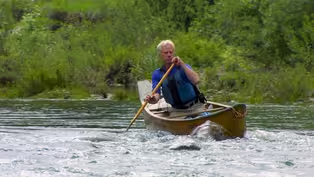
[ traffic roaring ] ED JAHN: You can catch glimpses of the South Umpqua River while racing along the interstate... [ birds chirping ] or you can see it Tim Palmer's way.
TIM PALMER: You can drive the highways.
Driving along, you look through the windshield.
A lot of what you see is the pavement out ahead, landscape beyond.
That's the view from the car.
When you're in the canoe, what you see is mostly water.
And then you see the shorelines and then you see this gorgeous sky beyond.
It's a totally different view of Oregon.
And to me, it's the only way to see it, because this is the natural way.
You know, this is the path of the water, it's the path of the ages, it's the path of the explorers.
It's my path.
Tim's about the closest thing there is in Oregon to a river evangelist.
Born not far from the Ohio River, he was raised among rivers at their most polluted.
Yet the grace of his paddling tells you that rivers became a big part of Tim's life.
And it's a passion he doesn't mind sharing.
[ birds chirping ] I think we often think of river sports as the province of the skilled angler or the experienced boater, but in fact rivers are for everybody.
Here's a fact: most Oregonians live within just a few miles of a river.
And many of the rivers we take for granted are in fact exceptional.
We have more free-flowing rivers.
We have more long river trips that you can do.
We have 10 rivers of epic length that you can run a river trip on in Oregon.
That's more than any other state in the West.
Tim's four-day trip on the undammed South Umpqua began in the wilderness, passed through farmlands, and eventually flowed through a city of over 20,000 people.
We've got the last of the I-5 bridges.
Number five.
But here, even in the heart of downtown Roseburg, Tim had the river largely to himself.
Along this river, we see houses like what we have here on the left.
That's actually about the most I've seen on the trip so far.
[ insects buzzing ] Celebrating the beauty of overlooked rivers like the South Umpqua is something Tim emphasizes in his guide books.
But writing books about rivers has also given him the chance to dip his paddle in some of the biggest, the wildest, and longest rivers in America.
He's paddled about 400 rivers by his estimation.
Still, he speaks of Oregon rivers with a special fondness.
One of the really amazing things about Oregon's riverscape is the diversity.
MAN: Keep going!
Nice!
Keep forwarding!
PALMER: We have just all kinds of rivers in terms of climate, in terms of landscape, in terms of whitewater, wildlife, fisheries.
And in a state where hiking permits, campground fees, and park passes can add up quickly, Tim reminds us that many rivers don't cost a dime.
On many of our rivers, you can go without worrying about a permit.
It's usually public land.
So rivers really offer that opportunity, which is becoming kind of a rare thing in today's world, where everything is so built up or so regulated that you just don't have the opportunity to be wild and young and free again and to pretend you're Huckleberry Finn going down the Mississippi River.
On a river, there's often no need for a campground reservation.
Solitude can be as easy to find as a sandbar.
It can seem like pure escapism, but rivers also bring out the fighter in Tim.
He's a vocal advocate for river protection, but his approach is more reflective than combative.
To me, the connection to every natural landscape involves three fundamental emotions.
And the first is a sense of love of that place.
The second big emotion is a sense of outrage when we realize what's happening to these places unnecessarily.
It may be a dam that's built even though it's not needed or development that occurs right next to a river when it could just be set back a little bit from the shoreline, when we realize that there's pollution that could be cleaned up.
But it's not something we can live with.
For that, we need a sense of hope.
And that's the third great emotion that I believe is essential for people to get in the natural world.
A sense of hope that we can do a better job.
We paddled with Tim for just a few sunny days on a river and saw just a handful of other people.
It may be that places like this offer the break many of us are looking for and maybe even need.
All you do is dip that paddle in and pull it back thousands of times a day.
And for some people, this might seem boring, but to me, it's a totally meditative experience.
No cell phone, no conversation, no talk, no people, no nothing.
Just you and the river.
And there's a certain magic in that.
[ ?
?? ]
One of the reasons that Oregon Field Guide exists is to give you a chance to catch your breath and take a break with some scenes of nature.
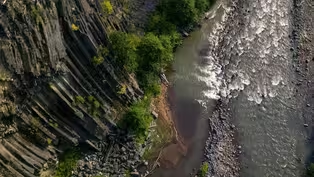
With that in mind, Oregon Field Guide photographer Brandon Swanson brings you this photo essay from Washington's stunning Klickitat Canyon.
[ crickets chirping ] [ ?
?? ]
[ water rushing ] [ water rippling ] [ waterfall roaring ] [ oars splashing ] [ ?
?? ]
[ gear jangling ] You can now find many Oregon Field Guide stories and episodes online.
And to be part of the conversation about the outdoors and environment here in the Northwest, join us on Facebook.
[ water rippling ] [ wind blowing ] [ gear jangling ] [ horse clomping ] Major support for Oregon Field Guide is provided by... And the following... And the contributing members of OPB and viewers like you.
Video has Closed Captions
Clip: S32 Ep6 | 1m 42s | Scenes from the newly created Klickitat Canyon Conservatiuon Area. (1m 42s)
Video has Closed Captions
Clip: S32 Ep6 | 8m 4s | A simple broadcast of the comings and goings of ships passing Astoria has evolved. (8m 4s)
Video has Closed Captions
Clip: S32 Ep6 | 6m 17s | Tim Palmer has canoed, rafted and kayaked nearly every major river in Oregon. (6m 17s)
Video has Closed Captions
Clip: S32 Ep6 | 6m 51s | A high country pack trip with mules in the Wallowas. (6m 51s)
Providing Support for PBS.org
Learn Moreabout PBS online sponsorship

- News and Public Affairs

Top journalists deliver compelling original analysis of the hour's headlines.













Support for PBS provided by:
Oregon Field Guide is a local public television program presented by OPB