Oregon Art Beat
Author Renée Watson, Indigenous punk band 1876, painter Bhavani Krishnan.
Season 27 Episode 5 | 28m 39sVideo has Closed Captions
Author Renée Watson, Indigenous punk band 1876, painter Bhavani Krishnan.
Newbery medal winning author Renée Watson teaches girls to be their boldest selves. Indigenous punk band 1876 rocks Portland and beyond. Hike the Tillamook forest with software engineer turned painter Bhavani Krishnan.
Problems playing video? | Closed Captioning Feedback
Problems playing video? | Closed Captioning Feedback
Oregon Art Beat is a local public television program presented by OPB
Oregon Art Beat
Author Renée Watson, Indigenous punk band 1876, painter Bhavani Krishnan.
Season 27 Episode 5 | 28m 39sVideo has Closed Captions
Newbery medal winning author Renée Watson teaches girls to be their boldest selves. Indigenous punk band 1876 rocks Portland and beyond. Hike the Tillamook forest with software engineer turned painter Bhavani Krishnan.
Problems playing video? | Closed Captioning Feedback
How to Watch Oregon Art Beat
Oregon Art Beat is available to stream on pbs.org and the free PBS App, available on iPhone, Apple TV, Android TV, Android smartphones, Amazon Fire TV, Amazon Fire Tablet, Roku, Samsung Smart TV, and Vizio.
Providing Support for PBS.org
Learn Moreabout PBS online sponsorshipSupport for Oregon Art Beat is provided by Jordan Schnitzer and the Harold & Arlene Schnitzer Care Foundation Endowed Fund for Excellence... and OPB members and viewers like you.
Funding for arts and culture coverage is provided by... [ ♪♪♪ ] I have a voice.
STUDENTS: I have a voice.
My voice is powerful.
STUDENTS: My voice is powerful.
My voice can change the world.
STUDENTS: My voice can change the world.
Go change the world, young people.
Two, three... [ shutter clicks ] [ all laugh ] The first thought that came into my mind when I saw Renée Watson was "author, Black excellence.
Amazing."
RENÉE: It is such an honor to write for young people especially.
Reading is an intimate thing.
And they're spending quite a bit of time with me when they're reading my books, and so it means the world to me that adults trust me to come into their homes really and to whisper into their child's ear a story.
[ ♪♪♪ ] When I was a child, going into the library, I remember always wanting the sticker books, because those felt like the special books.
I didn't really even understand that those were awards.
To have books out in the world that have those stickers is an honor.
Portland raised me.
And now I live in New York City and in Portland.
I was in the second grade at this school in Mrs.
Tupper's class.
I wrote a 21-page story at home.
[ laughs ] And I brought it to school, and Mrs.
Tupper was like, "Wow, I think you're gonna be a writer one day."
What were some struggles from being a Black woman when you were writing the book?
RENÉE: So some of the struggles that I've had is to balance our stories with joy.
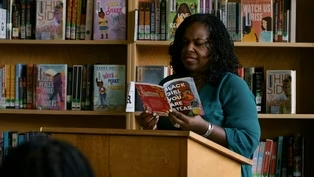
This is from the book "Black Girl You Are Atlas."
"I'm from that side of town where the media only comes for blood shed, blood wasted, never for blood restored, celebrated or regenerated.
I'm from hopscotch and double Dutch, from hide-and-go-seek and Pac-Man."
You'll notice with most of my covers that there's a dark-skinned Black girl on them, And so sometimes I have to also fight for that.
I used to be told way, way back that books with dark-skinned girls and natural hair don't sell.
And so I'm so thankful that things have gotten a lot better in the industry.
And so now I don't have to fight as hard.
RENÉE: How you doing?
GIRL: Good.
Thanks for being here today.
Thank you.
What do you like to do?
I do track, and I like to draw too.
Nice.
An athlete and an artist.
I love it.
Renée stands out as a writer because of her incredible compassion.
I used to think I wasn't pretty, but she taught me, like, how it's like we are beautiful and we need to, like, stand up for ourselves.
One more.
We will be meeting each other again one day, I am sure.
The advice that I took was "Just be you, be comfortable in your skin.
If you fall, get back up."
RENÉE: I'm inspired by my family, my community, the young people that I have taught.
And I want them to feel seen in my work.
[ girl reads on-screen text ] "I love, love our bounce back, our clap back, our backbone, our backstory, our comeback.
We go way back.
Our history dripping and damp from ocean waves.
I mean, I love our resistance, love our resilience.
I mean, I love us loving us."
[ ♪♪♪ ] My family was economically poor.
We were wealthy in many other ways.
We had a lot of love, we just didn't have a lot of money.
If it was a friend's birthday and I wanted to get them a gift, I couldn't afford to do that.
So I used to write people poems.
People would come back to me and say, "Oh, Renée, your words moved me.
I read that poem and I cried."
And I was like, "What?"
And that's when I started to feel like the power of words are naturally given to me and I want to use that to make a difference in the world.
My first early works were not published until I was in my 30s, first written as short stories in high school.
[ both laughing ] Oh, goodness.
So it is really good to see you.
Which way are we going to go?
She was able to raise the consciousness of other students in the classroom through her writing.
And Renée always carried that kind of wisdom with her.
You were teaching us the work of looking out at the world, critiquing it, but also celebrating it.
[ ♪♪♪ ] I don't think I would survive without my art.
Even at an early age, art was the thing that saved me.
Writing for me has been how I process what's happening in the world.
[ ♪♪♪ ] Any time I'm around books, I am inspired to write.
My writing ritual is to ask my character questions: Who do you love?
Who loves you back?
What do you want?
What is in the way of what you want?
When is the last time you cried?
And what gives you belly-aching laughter?
When I know those answers, I have a little plot.
I love those moments when characters surprise me, when they make me push past my own stereotypes, my own assumptions.
But I need to laugh, I need to cry as I'm writing it if I want my reader to be feeling anything.
When I was writing "Piecing Me Together," I was struggling a bit with what is Jade's big question?
She feels safe and nurtured when she's in her community, and it's not until she goes out into the world where she starts to feel broken.
I really identify with Jade.
I think I cried through that whole chapter of just realizing that especially girls have that tug of war of being seen and unseen, being whole and broken, because of our bodies, all the beauty issues.
[ girl reading on-screen text ] RENÉE: I love Portland, but there were times when Portland broke my heart.
I am Black, and I'm in a class of all white students, so how can I not stand out?
I am big.
How can I not stand out when I'm with a bunch of thin people?
So in some ways I was hyper-visible.
And then I was invisible because they didn't want to hear the girl from NE Portland speak.
Sometimes the world we live in, heh, is not the world we want, but when I'm writing, I can right wrongs, I can change the ending.
I feel very powerful as a writer to push us to dream and to be better and bigger than what we are.
Be bold.
Be brave.
Be beautiful.
Be brilliant.
ALL: Be your best.
MAN: Hey, we ready?
CROWD [ cheering ]: Yeah!
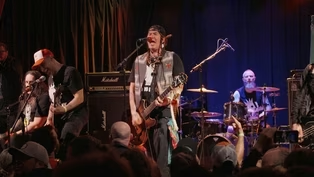
[ bass drum beating, guitar strums ] What's going on, everybody?
We are 1876, from right here, the war-torn streets of Portland, Oregon!
[ crowd whooping ] [ ♪♪♪ ] My music is intentionally made to help people identify themselves somewhere because I didn't have that identity growing up.
I never really saw mixed NDNs on TV.
Everyone wants a history-book Indian.
They don't want what's looking them in the face.
AUDIO ENGINEER: Oh, yeah, can we get--?
[ electric guitar plays rock riff ] MAN: I'll figure it out.
GABE: One of the presidents said that: "Indians in America are the thorn in the side of American government."
Yeah.
[ chuckles ] We are!
[ playing rock riff ] The thorns on a rose stem protect the beauty of the rose.
That's what we are.
This is our culture.
This is our beauty.
ENGINEER: Good?
My name is Gabe.
I'm also AKA'd as "Mr.
Steal Your Girl Some Horses."
I play in the band 1876.
I'm the creator of the band.
And I'm Northern Cheyenne on my dad's side, Blackfeet on my mom's side.
On our pow wow drum, we have Joe.
He's my brother.
He's Northern Cheyenne and Blackfeet.
And then we have Danny, who's Comanche.
On guitar we have Chris Del Rio.
He's from L.A.
He's a lot of energy on-stage.
Our drummer is Luke.
He works for the Puyallup Tribe.
He teaches at their school.
So he's very familiar with, like, NDN culture.
By the way, "NDN" is short for Indigenous.
If people get upset, like, it's N-D-N.
Indigenous.
Jake is our bassist.
He's not NDN at all.
[ laughs ] We have a running joke that he's a blue man, like, from the Blue Man Group that we picked up and washed off.
[ laughs ] I would never say this to his face, but he's, like, one of the best things that's happened to this band.
Check, check.
My name's Jake!
♪ I got money in the bank ♪ Five dollars!
Kinda!
I had money in the bank.
But it went away on account of everything costing a million dollars now.
Check, check, check, check, check.
How does everybody feel up here?
GABE: I'm good.
Check, big guy.
This photo, this is my dad's grandma, Emma Roland, on the Cheyenne side.
I have all these photos of my family, chiefs from my tribes and things like that.
Sometimes when I get stuck, I'll just look at those photos and, literally say out loud, "All right, what do we want to say?
What do you guys want me to say?"
[ electric guitar playing rock riff ] [ band warming up ] Eight count, right, for this one?
GABE: Yeah.
[ singing in Native language ] So 1876, everything I wanted it to be, was about unification, because no one's leaving here.
[ laughs ] Like, NDN people aren't going to go.
We're the only people in this country who can say that we didn't run from our home.
I want to help teach about my people.
Help teach about who came here before everybody else was here.
But it's not in a way to, like, wag a finger.
It's more like if you know the truth and I know the truth, let's move forward.
Like, "You know everything that I know now."
All right, sounds like a punk set.
JAKE: We've got a lot of loading to do!
JESSIE: How long are you guys on tour for?
Two weeks.
Two weeks, yeah.
Just two!
It's 14-- 14 days, 14 shows.
I feel like it's ridiculous.
Perfect.
As far back as you can get it.
I did close it, didn't I?
Idiot.
[ laughs ] I do work in EMS.
That came from going to Standing Rock.
There was a lot of chaos that weekend that I was there.
People were getting shot with water cannons and it was, like, freezing.
And then they were getting pelted with bullets while they were trying to run away.
And I remember just thinking, like, "I can't help anybody."
Like, "There's nothing I can-- I don't offer anything here."
And so I never wanted to feel like that again.
And everything in my life brought me to, like, wanting to help whenever, however I can.
And the music is a part of that.
[ ♪♪♪ ] My mom put roses on all of our cradleboards, so I'm beading a rose to put on my baby's cradleboard now.
Everything that punk rock is supposed to be about is what we are.
We tell the truth in our music when we speak.
That's punk.
Everything punk rock tells you about your fashion sense and all that stuff, it's about self-expression and DIY.
We do everything ourselves.
The leather that I use right now, I tanned.
My dad, my brother, and I, we made this drum.
Punk rock, it's just in my blood.
So 1876, the band name, it comes from the Battle of Greasy Grass, which is also known as the Battle of Little Bighorn.
That's when the Sioux, the Northern Cheyenne, Arapahos, Blackfeet people, Oglalas, Hunkpapas, we fought the 7th Cavalry.
Custer himself said there are not enough Indians in the world to stop the 7th Cavalry.
That's his exact words.
And we did.
And we did it through unification.
That's why I named this band 1876, because it's a message to NDN country.
We have to stick together.
We have to put our differences aside.
We have to have a common goal.
[ indistinct chattering ] GABE: Yeah, yeah.
Well, they're going to get unfolded.
Should we just--?
Dude, we don't have enough time.
We don't.
All right, let's do it.
Let's do it.
Here, Danny.
Got a half hour till doors, so we gotta bust these all out.
Take one side and fold it until you see the ink.
Once you see the ink, stop.
Fold the other side.
Stop.
So, like, as NDN people, this is our home, and we are the only people who can say that.
When you're home, you not only deserve but should be everywhere in your home.
If you're a city NDN who wants to go to the rez, go.
If you're a rez NDN who wants to move to the city, go.
We belong in every corner of this country.
Everywhere, we should be.
GABE: 1-8!
BAND MEMBERS: 7-6!
GABE: 1-8!
7-6!
1-8!
7-6!
You should know that this month, November, is Native American Heritage Month.
We, as NDN people, we are always spoken over and we're not taught about.
And when we try and teach people, they don't want to listen to us.
And if you're an Indigenous person, no matter where you're from in this country, the one thing that we need to teach you as NDN people, is no matter what, never stop singing, never stop dancing.
When these [ bleep ] try and stop you, dance on them, all right?
[ band playing punk music ] ♪ Oh, tribes And tribulations ♪ ♪ Whoa-oh-oh, tribes And tribulations ♪ ♪ Existence... ♪ Working in EMS, working in health care in general, like, you see a lot, you smell a lot.
[ laughs ] Uh, and one of the things that I've seen that probably not a lot of people have seen is, like, the fear in someone's eyes when they're dying, like, when someone knows this is it.
I've seen that.
That look in their eyes, that fear.
And when I play shows, I like to scan the room and make eye contact with people, because that's life.
And our pow wow drum is the heartbeat of our people.
That's what it's meant to be.
And now I'm looking in your eyes and I'm seeing life.
♪ Existence, resistance ♪ ♪ Resilient we stay ♪ ♪ Whoa, tribes And tribulations ♪ ♪ Tribes and tribulations!
♪ Thank you so much, Portland!
Before we get out of here, we're going to sing it all together, all right?
On the count of four, we're all coming in together!
One, two... One, two, one, two, three, four!
♪ Oh, tribes And tribulations ♪ ♪ Oh-oh-oh, tribes And tribulations ♪ ♪ Existence ♪ ♪ Resistance ♪ ♪ Resilient... ♪ [ band continues playing ] We're at the Tillamook State Forest on the way to the coast.
I think we found this place like two years ago.
I was just driving with a friend to the coast.
I just love that it's by the river.
And different seasons, you get to experience different things, different colors.
I've been here in winter a lot, and that brings on its own beauty with the bare trees.
It's just like really exciting to come here every time, because I don't know what I'm going to find.
I'm Bhavani Krishnan, and I paint landscapes, figures, still life.
I love to come out and paint in nature.
[ ♪♪♪ ] Oh, wow, this is so beautiful over here.
I just love that I could just look any direction, and it would make a good painting.
I used to be a software engineer, and about eight years ago, I just started painting as a hobby.
And then very quickly, I became more and more passionate about it.
And so about five years ago, I transitioned into painting full time.
For me, it was just, like, how many people get to find their true passion?
I just felt like I had to go for it.
I had to give it a shot.
I was born in Switzerland, but we moved to India like when I was 2 years old.
I always feel like my love for mountains comes from me being born there.
I don't know, like -- I don't know if it make sense, but I just feel that.
[ laughing ] Being out in nature, it's always been a way for me to clear my head.
All the time while growing up, I sought out groups that would go hiking.
I remember there being lots of waterfalls, and we would just jump into the water, and it was a lot of fun.
That's how I developed a deep connection with nature.
Look at that water.
It's so golden, with all the reflection off the trees.
It's just beautiful.
When I look at a scene, I kind of see in terms of shapes and colors.
So it's kind of like a puzzle piece, where different shapes fit together.
I try not to be very logical about it, but just use nature as a jumping-off point.
[ ♪♪♪ ] Especially when there's a lot of green in the landscape, the complementary color will help pop it.
I like to be very loose and expressive with my painting.
When I pick up the brush, I don't even know exactly what I'm going to do with it, but I'm just going with that pure instinctual feeling.
And what happens is I get all these marks on my canvas that are quite -- quite unexpected, which you cannot produce if you're just thinking in a very calculated manner.
If I can use minimal strokes to describe something, that's always, like, way more exciting.
I came to Oregon for work.
The very first time I came here was to interview with Intel, and I saw Mount Hood from the plane.
I almost instantaneously fell in love with it.
[ ♪♪♪ ] I love to paint along the Columbia River Gorge.
I think that's just a really beautiful area.
I just love places that are open and natural.
I love going up to Mount Hood, especially in winter to paint snow.
I like coming here to Tillamook State Forest.
The color of the river, the color of the trees or the textures I see, each of them are beautiful in their own way, so I just like coming back here in different times of the year to try and capture them.
When I'm out on location, time just flies by.
Nothing seems to bother me.
It's kind of a euphoric feeling where things are happening organically and you're not forcing anything.
When I first started, I learned a very realistic style of painting where the most important thing was to make something look three-dimensional, and that was what was driving me.
But now, recently, I've found that I need to say something that's a little bit beyond that.
[ ♪♪♪ ] I don't want to just copy a portrait and get an exact likeness, but try to -- I don't know, like, just try and capture something about their personalities.
So basically everything is already blocked in and everything is sort of in there, but I'm just trying to refine some of the colors, add some complexity.
There was like sunlight on the river, so I tried to capture that.
Towards the end of the painting, I like to step back more often because sometimes you can keep going and ruin it.
So it's a good idea to just step away, get a fresh perspective, and see if you're actually done.
Up close, it's kind of a big mess, but when you step back, everything's sort of -- you can see trees, the river.
It sort of all comes together.
Yeah.
I think I'm done.
Yeah.
I think so.
[ laughs ] [ ♪♪♪ ] I would hope that people would have an emotional response to my painting... that they feel something, that they would be moved by my painting.
Because when I look at art, that's what I feel.
I'm moved by paintings that make me feel excited or invigorated, and that's what I hope to transcend into my paintings.
Uh, but like I said, we are from right here, we are the world's only pow wow punk rock band.
Tonight we have PBS here recording, so you've gotta make us look [ bleep ] cool, all right?
[ crowd cheering ] You guys gotta go crazy.
'Cause PBS-- PBS is punk rock.
That's the only way we're gonna get our news, all right?
We are here to get you guys warmed up for the Subhumans, and the way that we do that is you gotta get your hands up and start clapping along to this beat right here.
[ drum beating rhythmically ] [ all singing in Native language ] To learn more about Oregon Art Beat, visit our website... And to see what we're working on now, follow us on Facebook and Instagram.
♪ With a song from the stars In the sky ♪ ♪ We were born From a land undefined ♪ BAND: ♪ We are the outsiders!
♪ ♪ Just like the tides With the moon we will rise ♪ ♪ Claimed by tribes But we claim the night ♪ BAND: ♪ We are the darksiders!
♪ ♪ Deep in our bones Find the marrow of the stones ♪ ♪ That had chose to never Give in to the river ♪ ♪ We are the balance To the callous ♪ ♪ Waiting for us in the night ♪ ♪ We are the melodies carried By the whistles in the night ♪ ♪ We all submit, we all submit We all submit, we all submit!
♪ [ band resumes singing in Native language ] Support for Oregon Art Beat is provided by Jordan Schnitzer and the Harold & Arlene Schnitzer Care Foundation Endowed Fund for Excellence... and OPB members and viewers like you.
Funding for arts and culture coverage is provided by...
 New
NewVideo has Closed Captions
Clip: S27 Ep5 | 9m 19s | The Indigenous punk band 1876 rocks Portland and beyond. (9m 19s)
 New
New2026 Newbery Medal Winner Renée Watson: Inspiring young Black readers to step into their power.
Video has Closed Captions
Clip: S27 Ep5 | 7m 44s | Portland Newbery Medalist Renée Watson inspires girls to be their best and boldest selves. (7m 44s)
Providing Support for PBS.org
Learn Moreabout PBS online sponsorship














Support for PBS provided by:
Oregon Art Beat is a local public television program presented by OPB