
How is Climate Change Impacting the Nation's Largest Food Producer?
Season 7 Episode 4 | 23m 26sVideo has Closed Captions
SoCal farms face increasing food insecurity and inequity amid climate changes.
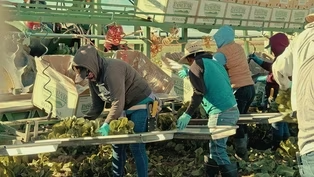
Climate change is intensifying pressure on California agriculture as water scarcity, heat, pests, and extreme weather strain farms across Southern California. Deepening existing food insecurity, some farmworkers are unable to afford the food they grow. This episode examines inequity, the programs addressing it, and the farms testing new agricultural technologies to secure food access for all.
Problems playing video? | Closed Captioning Feedback
Problems playing video? | Closed Captioning Feedback
Earth Focus is a local public television program presented by PBS SoCal
How is Climate Change Impacting the Nation's Largest Food Producer?
Season 7 Episode 4 | 23m 26sVideo has Closed Captions
Climate change is intensifying pressure on California agriculture as water scarcity, heat, pests, and extreme weather strain farms across Southern California. Deepening existing food insecurity, some farmworkers are unable to afford the food they grow. This episode examines inequity, the programs addressing it, and the farms testing new agricultural technologies to secure food access for all.
Problems playing video? | Closed Captioning Feedback
How to Watch Earth Focus
Earth Focus is available to stream on pbs.org and the free PBS App, available on iPhone, Apple TV, Android TV, Android smartphones, Amazon Fire TV, Amazon Fire Tablet, Roku, Samsung Smart TV, LG TV, and Vizio.
Providing Support for PBS.org
Learn Moreabout PBS online sponsorshipNarrator: Nearly 2 million Californians living in the richest state in the country are fighting to put food on the table.
California is the largest food producer in the United States, farming about 20% of the nation's milk, over a third of vegetables, and over three-quarters of the country's fruit and nuts.
But its bountiful harvest isn't equally shared.
Farm workers and families often making minimum wage now struggle with the skyrocketing costs of fresh food and the impacts of climate change.
Few aid options are available to predominantly immigrant farm workers, so organizations, community members, and researchers alike are searching for ways to feed the people who feed us.
[Click] Announcer: This presentation is made possible in part by... a grant from the Orange County Community Foundation.
I'm going to divvy out the envelopes for the different stores, and then you're going to build a team of people and go visit these stores and try to build a menu.
Narrator: Students in the agricultural program at Cal Poly San Luis Obispo are tasked with a set budget, a specific store, and have to put together a nutritious meal for a family of four.
Professor: Jeff, there you want to-- Oops, sorry.
You want to pass that back over there?
Another slow food bank.
These students, some of them, their parents work in the fields.
They can get scholarships to come to Cal Poly, and their children will be working in agriculture, but they're reworking in management.
You know what, if you haven't been doing the shopping for your family, you'll find out it isn't quite that easy.
Remember, folks, it's how far the food traveled, not you traveled.
How do you build a balanced meal at a place like this, when this is your access to food?
Narrator: Farming families in California rank amongst the most food insecure in the state.
According to research, over one-third of farm worker households in areas like Fresno and Salinas experience food insecurity.
And a staggering 93% of indigenous farm workers report household food insecurity.
In the Central Valley, poverty rates can reach over 27%.
For low-income families with children statewide, approximately 20% reported very low food security in surveys from 2018 to 2020.
I think farmers throughout history have faced those cycles where they need to be creative, they need to be more efficient in what they do.
And there are times when, yeah, farmers will realize that.
Those that realize those times are the ones that will continue to survive.
In San Luis Obispo, we've got not even 300,000 people that live here.
And, right now, more than 31% of those people struggle to afford the basic cost of living.
That means that they are regularly struggling or unable to afford housing, fuel, childcare, and, importantly, food.
San Luis Obispo and Ventura are Central Coast counties.
Those two counties have a large agricultural industry, but, actually, food insecurity in those two counties is higher than the state average, 4.7% for the state.
When we talk about food insecurity, what we really mean is people who are unsure where their next meal is coming from or are unable to provide food for themselves.
What we know in SLO County is that college students in particular have incredibly high rates of food insecurity.
And so, not only are we so honored to have our local colleges as part of our food distribution network, where we deliver food to fill those pantries and have pop-up distributions on campus, but we also take really seriously the opportunity we have to educate people who maybe are out in a different community for the first time.
This movement of the Unemployed Cooperative Relief Association started... Narrator: The modern history of the U.S.
government's efforts to combat food insecurity can be traced back to the Great Depression.
Massive unemployment and widespread hunger coincided with agricultural overproduction, leaving farmers with a surplus of crops they couldn't sell.
This led the Roosevelt administration to launch federal programs to purchase surplus food, distribute commodities, and pilot an early version of food stamps in 1939.
By the late 1960s, charitable organizations like food banks began to emerge, aiming to fill the gaps left by government assistance.
In the decades that followed, access to food assistance has fluctuated in response to shifting policy and economic pressures.
So, historically, we were serving in the high 20s to low 30,000 people on average every month, here in San Luis Obispo.
When COVID hit, there was a huge sea change.
There was tremendous unemployment, but there were also things that came in, like expanded money for people to be able to buy groceries.
There were enhanced child tax credits.
Man: How are you guys?
All: Good.
Man: Good, how can we help you?
Um, we're looking to get some food.
Man: Yeah.
We are tasked with coming up with basically a meal that we're going to track from all over the world, where it came from and calories, nutritious value, stuff like that.
Man: Yeah, Absolutely.
So, for each household, we offer one produce bag.
We offer one unit of shrimp and then some shelf-stable groceries.
Did you guys want to do all that?
Owen: Uh, yeah.
Girl: Yeah, sounds good.
Narrator: The UCLA Center for Health Policy Research has been conducting a decades-long health survey in California.
I'd like to see what it is for California... So, this is for all adults... Jacob: Yes.
Woman: ...in California.
That 4.7%, almost 5%, are going to bed hungry.
Jacob: Mm-hmm.
We're slightly higher than the rest of the U.S., which is kind of shocking, because we're purportedly, like, a very wealthy state.
California Health Interview Survey, or I'll fondly call us CHIS, is the nation's largest ongoing population health survey.
We interview about 20,000 households each year.
We've been doing this since 2001, and we provide the definitive snapshot each year of what Californians are experiencing in terms of access to health care, but also their well-being and what's happening in their neighborhoods as well.
You know, somebody loses their job, and they don't have their paycheck anymore to ensure that there's a meal at the table every night.
But if you drill down, as our data allows us to, for different counties, that we're seeing as high as 12% food insecurity.
We've established associations, some patterns of what we call these social drivers.
I think then what policy makers then ask is, "I want to know what's going on in my county, my congressional district, what's going on here."
So, our data serves the people of California and serves the people in terms of ensuring that their health is addressed, it's improved.
Now, let's look at Fresno County, because it might be a different story for a primarily food-growing area.
Jacob: I find it just to be very interesting that it's such an agricultural hub, and it's, like, a lot of food coming out of there, and it's, like, the food insecurity is high.
Narrator: Prolonged droughts, extreme heat, and increasingly frequent floods have damaged fields and forced temporary shutdowns of harvest operations.
Between 2020 and 2022 alone, climate-related drought conditions cost the state's agricultural sector an estimated $2 billion and nearly 20,000 jobs.
For farm workers, many of whom are paid by the hour or per yield, this led to suffering reduced work hours and dangerous heat waves.
But there are farmers and organizations that are working to address food inequality and climate change.
My dad used-- worked here for this company for, I believe, 32 years.
I guess you could say I followed in his footsteps.
You guys, check the filters, see if they're clogged up.
Edgar: Climate change, it is a reality, and I'll tell you why.
Usually, plants, since they're living creatures, they respond, right, to rain, wind, sun, and all of these factors.
The cycle of life of a tree and the production of a tree responds to all of these environmental conditions in a way that-- for example, flowering cycles.
When a tree flowers, back in the days, our grandparents used to write on a calendar the first day of rain, the first day of a freeze or temperatures reaching X, Y, and Z. And pretty much every year, it happened the same way.
"By March 15, we will be planting, by August 15, we will start our harvesting," and so on.
So, plants are cyclical.
Nowadays, sometimes those flowering cycles are not the same anymore as they used to be, because they're responding differently to climatic conditions.
For example, the droughts, the droughts that we've had in California, we've had to accommodate and shift our irrigation cycles, the amount of water that we provide to our trees, and so on.
So, definitely, you know, if there's somebody feeling climate change-- our farmers.
Narrator: The state of California passed Prop 4 in 2024, which allocated a $10 billion bond toward environmental projects, with over a quarter dedicated to climate-resilient, sustainable agriculture, food-system infrastructure, and farmworker well-being.
Responsible water mitigation and the availability of funding for new technologies to small farmers included in the measure stood alongside efforts to fund farm worker housing, affordable drinking water, and local food infrastructure.
Nowadays, farmers have a very interesting arena in terms of technology.
We here at Limoneira, we've been very open to start seeing what technologies out there could help us create those platforms for our labor force to be more efficient.
For example, water use.
We now have included platforms here that we can measure exactly what the transpiration rate of a plant is.
Angel: When I first started on the farm, I was in charge of irrigation.
From there, I started spraying for weeds, and then, little by little, started moving up.
And I became a lead man.
My responsibilities of being a lead man is to make sure the ranches are well-maintained.
If you see anything that doesn't look good, that's out in the view, like, to take care of it and just make sure everything's running good.
Irrigation, be on top of everything.
How do we cope with harvest in the future, and how do we maximize the use of the land?
And so, one thing is we have to create the new forms of how we are going to include robotics into, for example, harvesting.
And it's not really creating a conflict with labor.
It's basically setting up a stage for a different type of labor in the near future.
Angel: It just helps you spray the exact amount.
It doesn't overspray.
You don't have to be driving it.
Everything's recorded already.
Like a robot, it works on its own.
Man: The old-school farmers are afraid to it, because they don't understand the new technologies and how to really approach technology.
For farmers and workers in general, it's a huge opportunity for them to grow and learn other stuff.
And that gives them value.
I really like to teach them new stuff, like this drone stuff or autonomous tractors or whatever.
And it's gonna give them tools.
I mean, not just for us right now, but in the future, it's gonna open doors to them to grow.
Technology in modern farms gave us tons of data that we don't have back in the day.
So, for example, if we're going to spray with the data we acquire with the drone, we know for a fact the amount of water we have to spray or product we have to spray.
In terms of use of fertilizers or pesticides or, you know, chemicals, we are on point.
We are producing food for people, right?
And that takes really good care, and we need to be really good in what we do, because we're feeding the world.
One of the things that we've been seeing is that younger generations don't seem very interested in farming.
So, how do we create a platform that attracts younger generations to farming?
So, by the inclusion of autonomous tractors, by the inclusion of technified irrigation systems, drone usage, data platforms.
One interesting thing that we do here at Limoneira is, for example, all of the green waste generated by our households in Ventura County that get picked up are brought here to our farm.
And we have a 20-acre site where all of this green waste from landscaping, clippings, and so on are turned into compost.
And then, all that compost is used here on our farms.
And all of this, I think more people is gonna be interested, or more younger generations are gonna be interested, in farming.
Limoneira, because of the setting of this company, right, a lot of our working force, it's been here for 20, 30 years, you know, working in these farms, living on the farm.
If you are in a place where you feel, you know, good, that you feel that you're being well-treated and so on, you want to stay there.
So, now, we are going through a cultural change, right?
As we continue to include more technology in what we do, we have to be able to also work with our working force to, you know, generate spaces for them also to be curious and to wanting to continue to farm with us.
We provide food to thousands of people who are food insecure, and we get food from a variety of different sources, and we bring it in, we store it, we sort it, and we distribute it through a network of 174 different nonprofit partners who are feeding those who need food or be able to provide them with the services that they need, with non-grocery items, such as diapers or feminine hygiene products-- All of that goes to help our neighbors in need.
Last year, Food Share served 267,000 individuals in Ventura County.
A large portion of the number of people that we are serving are our farm workers.
Ventura County is a huge agricultural community, and we have a lot of farm workers who come in.
Some are migrant, and some live here full-time, because the beautiful weather that we have allows us to be able to farm year-round.
The food process is actually quite amazing, that we get food from a variety of different sources.
One is that we're collecting from grocery stores, from our retail partners.
So, every day, there's food that they no longer can sell, but it's still good.
Man: We had no rescue, right?
Man 2: No.
Man: Okay.
Narrator: The food from each day's rounds will move in a short amount of time back to the warehouse so it can be packaged and distributed to local food pantries.
[Honking] It's a daily process that cycles food to people who might not have access to quality meals.
Monica: We also get other donations from farmers.
We're getting from the Port of Hueneme.
We're getting from people's backyards.
But then we also get food drives.
Last year, it was nearly 20 million pounds of food that came in and out through our network of pantry partners.
It's quite amazing what we're able to accomplish with such a small workforce.
Paid staff, we're about 40 employees full-time, but it's our volunteer workforce of 4,400 volunteers helped us last year.
So, they provided over 40,000 hours of service to us, and they're the ones who are doing all of this.
They're doing all the beauty of helping us pack boxes and sort food.
♪ Girl: We got... Boy: Yeah.
We got the noodles... Noodles.
The potatoes, the veggies.
The chicken broth, right?
Mm-hmm.
And also the frozen broccoli.
Frozen broccoli.
Frozen broccoli.
What do you think was, like, most surprising for this, like, project for you?
I mean, the one thing that's, like, surprising is the fact that we got all this for, like, under eight bucks.
Julia: Mm-hmm.
And especially for it to, like, be an actual meal for, like, four, a family of four.
A nutritious meal too, at least.
I was surprised that we could-- you can represent all food groups.
Like, you have your carbs, you have your veggies, and you have your source of protein, all under $8.
Julia: Yeah, it's pretty cool.
As the students work through this problem, I want them to understand the nutritional value of food.
I want them to understand where their food is coming from, that it doesn't always just come from down the street or from somewhere in California.
I want them to understand that, "Oh, wait, I don't have a grocery store a mile away from my house."
I want those students to understand that it is an international market, that they're going to be part of the process of bringing in food and feeding the world on a global market.
It's not a secret that living in California is very expensive and more and more difficult for people to be able to afford housing and to be able to afford going to the supermarket, and so on.
We provide housing to our working force at a lower rate than the market.
We provide health care for all of our employees.
We believe that, you know, we have to do right, and you have to provide benefits for people.
You have to create those spaces for them to be dignified with all of these needs-- you know, health, access to education, access to entertainment.
We have to provide those spaces.
We have to be able to treat our working force with dignity.
Being a steward of the land, it means many things.
How do you preserve your land?
How do you take care of it for future generations and for future production for the world to feed?
Farmers are facing many challenges, because, at the end of the day, is, how much is that true cost of putting that lemon or that orange on a shelf?
Narrator: Rising living costs, limited access to affordable food, and the impacts of climate change have made basic needs harder to meet.
But food assistance programs, climate-resilient farming, and new models for worker support are beginning to take shape.
As the state moves forward, these developments offer a chance to build a more stable and inclusive food system, one that can bring food to the table for the people who grow it.
♪ [Birds chirping] Announcer: This presentation is made possible in part by... a grant from the Orange County Community Foundation.
How is Climate Change Impacting the Nation's Largest Food Producer? (Preview)
Preview: S7 Ep4 | 30s | SoCal farms face increasing food insecurity and inequity amid climate changes. (30s)
Providing Support for PBS.org
Learn Moreabout PBS online sponsorship
- News and Public Affairs

Top journalists deliver compelling original analysis of the hour's headlines.














Support for PBS provided by:
Earth Focus is a local public television program presented by PBS SoCal