
“Memorializing the Hibakusha Experience,” “The Classic King,” Dr. Funkenstein
Season 11 Episode 3 | 26m 46sVideo has Closed Captions
A look back at some of the stories that stood out to our One Detroit team this year.
We’re taking a look at some of the stories that stood out to our team this year. We’ll go behind the scenes of the play, “The Classic King,” directed by actor Jeff Daniels and sit down with funk legend George Clinton for a conversation about Detroit’s influence on his music. Plus, we’ll visit an exhibition commemorating the 80th anniversary of the atomic bombings in Japan.
Problems playing video? | Closed Captioning Feedback
Problems playing video? | Closed Captioning Feedback
One Detroit is a local public television program presented by Detroit PBS
“Memorializing the Hibakusha Experience,” “The Classic King,” Dr. Funkenstein
Season 11 Episode 3 | 26m 46sVideo has Closed Captions
We’re taking a look at some of the stories that stood out to our team this year. We’ll go behind the scenes of the play, “The Classic King,” directed by actor Jeff Daniels and sit down with funk legend George Clinton for a conversation about Detroit’s influence on his music. Plus, we’ll visit an exhibition commemorating the 80th anniversary of the atomic bombings in Japan.
Problems playing video? | Closed Captioning Feedback
Where to Watch One Detroit
One Detroit is available to stream on pbs.org and the PBS app.
Providing Support for PBS.org
Learn Moreabout PBS online sponsorship- Coming up on a special episode of One Detroit, we're taking a look at some of our favorite stories from the show.
We'll go behind the scenes of the play The Classic King, directed by actor Jeff Daniels, and funk legend George Clinton sits down for a conversation about Detroit's influence on his music.
And we'll visit an exhibition commemorating the 80th anniversary of the atomic bombings in Japan.
It's all coming up next on One Detroit.
- [Announcer] Across our Masco family of companies, our goal is to deliver better living possibilities and make positive changes in the neighborhoods where we live, work, and do business.
Masco, a Michigan company since 1929.
Support also provided by the Cynthia and Edsel Ford Fund for Journalism at Detroit PBS.
- [Second Announcer] The DTE Foundation is a proud sponsor of Detroit PBS.
Through our giving, we are committed to meeting the needs of the communities we serve statewide to help ensure a bright and thriving future for all.
Learn more at DTEFoundation.com.
- [Announcer] Nissan Foundation and viewers like you.
(upbeat music) Hello, I'm Zosette Guir, Manager of Content Operations and Production for One Detroit.
In this special episode, we're sharing some of the stories that stood out to our team this year.
First up is a story I found quite compelling about an exhibition at Oakland University called Memorializing the Hibakusha Experience.
It focused on the survivors of the atomic bombings in Hiroshima and Nagasaki.
Their experiences were conveyed through an array of photographs, poems, and other artifacts.
Contributor Toko Shiiki talked with Professor Claude Baillargeon, who curated the exhibit, which brought lessons from the past into the present.
(soft electronic music) Ground Zero, Hiroshima, Japan, filmed by the U.S.
military in 1946, only months after the first atomic bomb was dropped.
- There are survivors who wanted the world to know what happened to them and others like them.
Even though many people did not want to be recognized, they said, please take our pictures, show the world so we do not repeat the evil.
- [Zosette] Oakland University's Art Gallery in Rochester.
Claude Baillargeon is a professor of art history.
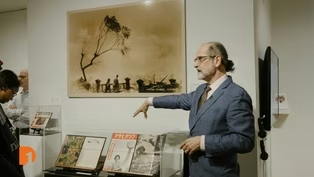
He's giving a walkthrough of an exhibition called Memorializing the Hibakusha Experience.
Hibakusha refers to the survivors of the atomic bombings in Hiroshima and Nagasaki in 1945.
- [Announcer] Just 50 seconds later, 15 miles from ground zero, the Enola Gay is rocked by the blast.
- The significance of memorializing the Hibakusha experience, I think, has a lot to do with our current geopolitics.
I do believe that a lot of people think that the threat of nuclear war is a thing of the past.
People think that since the end of the Cold War, maybe this is no longer relevant.
But I think it is even more relevant today than it has been in recent past.
So, that is one of the reasons why this exhibition, I think, is very significant today.
I do want to bring your attention to these two magazines that are here.
Very, very significant.
- [Zosette] Published accounts of actual atomic bomb survivors' experiences.
In the U.S., the New Yorker published a story in August 1946, a year after the bombings.
Up until then, coverage of the bombs didn't focus on the human cost.
The Radiation Effects Research Foundation estimates up to 246,000 died from the blast and the radiation poisoning that followed.
- This truly was the first time that the American people read about the people who were on the ground.
Up until that point, it's all been about the mushroom cloud and the physical destruction of the city, right?
But in this case, it begins, "A Noiseless Flash."
- [Zosette] The article tells the stories of six survivors.
Then the world began to learn more.
In Japan, a press code prohibited reporting about the survivors' experiences.
It was lifted in 1952.
- There was no poetry, no art could be made, no literature.
You could not talk about it.
This magazine on this side, called Asahi Graph, is published on August 6, 1952.
- [Zosette] Seven years after the bombings.
- This is the first time that the Japanese people actually saw images of what happened on the ground.
These are probably some of the most difficult pictures to look at in the exhibition, because at the time of these three photographs, these people were alive, but they died within hours or a day.
- [Zosette] The exhibition is in partnership with the Peace Resource Center, established in 1975 at Wilmington College in Ohio.
It preserves a collection amassed by an American anti-nuclear activist, devoted to the cause of the hibakusha.
- You've got photographs by famous people, you've got photographs by anonymous amateur photographers.
You've got books that do not exist in the United States, or some of them you can find two copies or something.
Then they've got all this archival material.
They have relics.
They have examples of hibakusha handicraft.
- [Zosette] And Baillargeon had some other artists add their work to the exhibition.
- I ended up adding five contemporary artists whose work is also inspired by the nuclear experience.
We're also concerned with the state of affairs on a global stage and wanna make art that speaks about the memory.
I do hope that this exhibition will travel further.
Looking back at the island of Bikini.
So here's another one of these photographs.
- [Zosette] Professor Baillargeon's class, Visual Representations and the Nuclear Experience.
This session's about Bikini Atoll in the Pacific.
After the war, this was a nuclear weapons test site for the U.S.
government.
- If you look at the file name of this, it gives you the date, and at the end it says secret, right?
These images were all completely unavailable until several years, decades in fact, after the bombing.
- The things that we talk about in here, the things that I learn about, that I just, I would have never known.
And it's disturbing, really, to know that maybe if I had not taken this class, that I would just walk around without any of that knowledge.
- My courses are about visual culture.
In the course, Visual Representations and the Nuclear Experience, we have photographs that come from victims, that come from survivors, that come from the military, that come from artists, and the list goes on.
I'm interested in the totality.
How can we look at all forms of imagery that actually look at the nuclear era?
- We were told very little about the actual bomb, but we were told right after that it was for the good to end the war.
So we were kind of told it was okay.
All of the information that I have and the knowledge I gain, it doesn't just stay with me in this class, it makes me wanna talk about it.
- You know, with how depressing and how dark and how ugly everything is, I think it's even more important to leave with hope and to leave having faith that we can come out of this, and we can be better.
We need to take what we've learned, and we need to be more loving, we need to be more empathetic.
Don't let this hold you down, but let this kind of carry you forward.
I think that's a point for everyone to feel.
- We are there to look with compassion and empathy about what happened, so that, hopefully, they will contribute to a better world going forward and not repeat the evil.
- Knowledge is power, and it's very important to know.
- Knowledge is power.
- Yeah.
- Mm-hmm.
Thank you for that.
- I'm Chris Jordan, editor and producer for One Detroit.
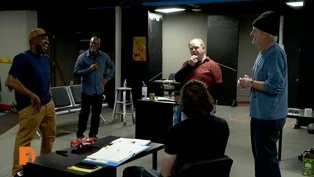
One of my favorite recent stories was my behind-the-scenes piece about the Purple Rose Theatre Company's play The Classic King, which ran earlier this year.
The play was developed at the theater, and directed by Purple Rose Theatre Company founder and artistic director Jeff Daniels.
We filmed a rehearsal for the play, getting a unique look at Daniels' creative process, and how the theater company workshops and develops an original production.
Check it out.
- Ginormous guy on a hog just landed in the truck aisle.
Eye patch, beard down to his navel.
- Box not in too good a shape.
- Neither is the biker.
- Don't all jump at once.
- [Chris] The Purple Rose Theatre Company's rehearsal space in Chelsea, early January.
A rehearsal for The Classic King, a new play by Richard Johnson, directed by Jeff Daniels.
The play follows the staff of a struggling car dealership in Detroit.
- They're just trying to stay afloat.
They've got 30 days to do it.
The bank's put some pressure on the dealership, and it's four guys trying to get through the month.
- You know, you miss 100% of the shots you don't take.
- You gonna pay danger money?
- Ah, good, do it again.
Really good, really good, really good.
- [Chris] Playwright Richard Johnson had a long career in automotive journalism as the print editor of Automotive News.
After he retired, he decided to write a play set within the industry he'd spent his career covering.
- I always thought the industry was fascinating.
I mean, not just, you know, designing and selling cars, but just the way people talked.
I used to be at dinners, at industry events, and hear guys talking, wanting to throw a tape recorder on the table just so I could capture it, because they had their own way of speaking.
And when I retired a few years ago, so, I thought it would be fun to try to work this into some kind of drama setting.
I had thought that the history of the Ford Motor Company would make a good play, and I was dumb enough to actually attempt to do that.
You had great characters, Lee Iacocca, and Henry Ford II, and Robert McNamara, and great cars like the Mustang, and I thought, there's a story here.
My ex-boss at Automotive News, great guy by the name of Peter Brown, who's on the board of the Purple Rose, said, it's pretty good.
He liked it, showed it to Jeff.
Jeff immediately said, there's no way in heck that this is going to work on a stage because it's so long, it has maybe 30 characters and 100 scene changes and the whole thing.
- He's a producer.
- But he said, come on in, lets talk about some other ideas.
And it was in those meetings with Jeff, together we came up with the idea of a used car dealership.
Very focused, one stage, four characters, much easier to do.
- And so this play was very much developed at the Purple Rose?
- Oh, absolutely.
- Had a buddy at the Harley shop down the street, called him, they bid on it, boom, deal!
Only motorcycle I've ever rocked!
- Nice work, Braden!
- [Braden] Thanks, Mike!
- Beginner's luck.
- I'll take any kind of luck I can get.
- I play Mike, who is the owner of the dealership.
He's at his wit's end, trying to keep the place afloat.
He is beating back the competition, the large, pervasive competition, and doing all that he can to rally the troops.
- I play Jerry Flanagan.
He's been working with Mike, for Mike, at Starlight Classic Cars since he was a kid.
Selling cars runs in his family, it's in his blood.
His dad did it, his grandfather did it.
So this is the world Jerry is comfortable in.
See you then.
Got a live one!
- So do we.
- At what stage do you guys as actors come into the process of workshopping and developing these original plays here?
- Pretty early on, yeah.
We've done readings of Rick's play.
Probably a little over a year ago he would rewrite, we would do other, I don't know, we did a handful of readings so that Rick and Jeff could hear it out loud, do a bunch of rewrites and that.
So we were involved pretty early on.
Rick's constantly working stuff, we're working stuff, seeing what lands, what doesn't, and making adjustments every minute of the day.
- Listening and collaboration is so important and it's, you see the work grow as we put it up, go through iterations, have the feedback.
I had an idea who Mike was and then showed up in the room and threw it all away.
(laughing) One of the important things is that allowing yourself, you listen to your scene partner and allowing that to inform some of your choices.
He did it, he did it, he did it.
Is this the high five?
- [Off-Screen Speaker] This-- - Yes, yes.
- [Off-Screen Speaker] It is.
- Yeah-- - Great.
- Nice work, Braden!
- Thanks, Mike!
- Boom, high five like that, like that.
Boom, you can go, you can do whatever you want.
Then hit it with-- - I'll take any kind of luck I can get.
- Boom, don't take that for... That ain't casual, that's a, no, you're wrong.
I need all the luck I can get.
- It's alive, the material is, is alive.
- Yes, it's that.
Owed them a business and... (low talking) And walk right into that, with the beginner's luck thing.
And then hit him with that, and then get your offense.
- That's the amazing thing about Jeff, who will, the vision he has when he watches these guys rehearse, well, here's 15 ideas of how you could do this better, and he just rattles them off.
He's so good at that, and it's, again, one of the many things I'm amazed about as I watch this process.
- He'll watch us throw, you know, a dozen behavioral ideas in one moment, and let, gives us the freedom to do that, and then says, yeah, just pare it down, make it about this, that, and the other thing.
He's so good at simplifying the complexities that, that, at least I tend to bring in when I'm working.
Just the wealth of experience and knowledge, having that in the room is, is so helpful.
It's a love letter to the, the car enthusiasts, really, at the end of the day.
It's a celebration of that world and that community.
Even if you don't know a lot about cars, if you're from Michigan, you're gonna understand, just because our car culture here in Michigan is, runs deep.
You know, first and foremost, it's really funny, these guys, how they interact is hilarious.
The world that, when you walk into the theater, you're stepping into this very vivid world.
- It's one act.
It's a bullet train.
There's a lot going on.
It's a great story and wonderfully executed.
(group laughing) - Good, one more time.
Really good.
- Hi, I'm Cecilia Sharpe.
One story that stood out to me reflected on the rich history of United Sound Systems Recording Studios in Detroit.
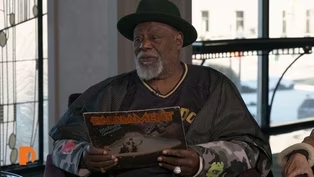
Funk legend George Clinton and Grammy Award-winning producer Maurice "Piranhahead" Heard spoke about their time at the iconic studio.
During the conversation, I showed them four albums that Clinton recorded at United Sound.
They shared incredible backstories and behind-the-scenes moments.
The trip down memory lane gave even more context about the magic of United Sound Studios and the funky music created there.
(soft electronic music) You made United Sound your home for about 20 years.
Studio A became the P-Funk Lab.
- Yep, mm-hmm.
- What made United Sound Studios so special that you stayed there so long?
- I don't know.
The sound, I mean, it's just the sound.
In the history of people that recorded prior to us, I mean, it went back to the '40s and stuff.
They did radio commercials.
So they were pretty much the sound of radio throughout the country.
You didn't know it, but that was the studio that did most of the commercials for everything between here and Chicago.
General Motors, Fords, everybody did their commercials there.
So it had a relationship to radio that people didn't even know.
Not only that, Motown recorded there prior to their own studio.
And when they couldn't get into their studio, United was their choice.
And it had the same kind of vibe as Motown had.
It had a little more bottom though, but it had the same vibe.
Especially when we came there and with Bootsy.
Bootsy had a bass that had... (Maurice laughing) Each string on the bass had its own output.
United, we had a special sound that no matter what we did, I mean, you can just walk in there not thinking something was anything.
And when you finish, like "Atomic Dog," that was the track being played backwards.
I just get on it and start talking.
- Yeah.
- And next thing I know, it had that magic on it that no other place could do.
- Piranha, I want to get your take.
What was your intro into United Sound?
- It was around '82, '83.
I was, you know, dinking around on the East Side, you know, learning to play with cats in the neighborhood.
You know, we were staying out of trouble because it was a lot of trouble that you get into on the East Side of Detroit.
Bootsy had this group called Godmoma.
It was a lady named-- - Oh yeah.
- Cynthia Girty.
- Cynthia-- - And Tony.
And she grabbed us.
It's like, I'm gonna take you to see a studio.
She was working for Don Davis at the time.
And we went over there and I think it was Greg Ward or Jim Vitti who said, "George isn't here yet."
So Don was like, "Yeah, just go down there and just check the studio out."
Vitti was showing us around and things like that.
I think you and Shawn came in.
After that, I was just like, wait a minute.
I just met this guy who owns a bank and runs a music business.
And Dr.
Funkenstein.
That's what I want to do.
You realize you can do whatever in a studio.
I mean, like, whatever you want to do.
You know what I mean?
How y'all used to do them claps.
- Oh, yeah.
(Maurice clapping) - Live claps.
- Live claps.
- Live claps.
- They thought it was a machine.
- And we would do it for 10 minutes.
I mean, you didn't, nowadays you can do two, four bars, two bars and loop it digitally.
No, back then you had to do it, "Flashlight," you had to do it for like seven minutes and your hands can't get tired.
- You got to maintain the energy.
- So only certain people could do it.
You can't miss one because it sounds... Had to be constant, and that's what, "Flashlight" was the beginning of it.
- Yeah.
- I want to jump into showing you an album.
You take it and tell me your United Sound memory.
- OK, yeah.
- [Cecilia] I noticed that also the hand clappers did get credit on these albums.
- Oh, yeah.
Yeah, we gave hand claps credit.
- Yeah.
- You know, so I was into R&B DJs at the time.
Mothership Connection.
I was trying to do an album with one storyline all the way through.
We did it on Motor Booty Affair.
Most of the songs relate to the same story.
We got thrown off track on this one because some of the tracks sound so good, we had to put them in there anyway.
Then, well, of course, "Tear the Roof Off the Sucker."
(Cecilia laughing) And what was good about that, we were able to get it on CKLW here.
If we take off, "Tear the Roof Off the Mother Sucker," CKLW said, "We'll put it on if you take the 'Tear the Roof Off the Mother Sucker'."
And once we did that, it was all over.
- Yeah.
- Biggest memory from this album?
- The Clones of Dr.
Funkenstein.
Wow, this is a good one.
I got on a plane in Dallas, Texas.
And when I got off, I had to get on a train.
It was the first day they used the train to go from one terminal to the next.
- [Cecilia] Yeah.
- [Maurice] Yeah.
- When I got on there, there was a book on the seat of the train.
And it said, The Clones.
Faces, two faces, one face in the same person.
I thought the book came with the train.
You know, it was the first day of the train.
It just made sense.
So I opened it up and it was talking about, Steve Swanson and this doctor was cloning salamanders, taking one and making hundreds of them, that you will be able to eventually one day be able to clone people and blah, blah, blah.
Then I realized this sounds like it's serious.
And so when I got to Portland, Oregon, I went to the library, because I'm trying to find different concepts that just sound interesting.
I go to the library and asked them, was there anything on cloning?
The lady told me, she said, due to the Freedom of Information [Act], we're not allowed to give books out, books on those.
It was taboo at the time.
So that, of course, as soon as you say taboo, you really got me going.
- Yeah.
- But, you know... - She said, "You can actually get a book called Chariots of the Gods."
- Wow.
- Or The Island of Doctor Moreau."
- I got Chariots of the Gods.
And the whole album is this.
- Wow.
So the concept was based upon stuff that you read that was science fiction.
- It was science fiction.
- Yeah.
- OK, this... Oh wow, that's deep.
See, now that's the way we dressed in school.
When I was in school, tailor-made suits.
- [Cecilia] OK, the tailor-made suits.
- [George] You know, all of that.
- [Maurice] Just slick.
- A friend of mine, he was trying to show how much he could be deep with us, and he was just getting with us.
So he just wrote on a note, entelechy.
- Aristotle.
- It had a nice ring to it, but what does it mean?
He said, entity reaching its maximum potential as opposed to something.
And I said, as opposed to placebo?
He said, "Sounds good."
(Cecilia laughing) So, that became Funkentelechy Vs.
the Placebo Syndrome.
"Flash Light" is the weird one because that was-- - Oh, man.
- Bernie playing bass on the synthesizer as opposed to Bootsy playing bass.
- That was the first time that happened.
- First time that happened.
- First time that ever happened like that.
- And... (George harmonizing) - Jewish melody, right?
- That was... - Bar Mitzvah.
- My friend's Bar Mitzvah.
I remember this Bar Mitzvah.
(harmonizing) He was like... - And it just came back to you during that moment.
- That's crazy.
- It's just, okay, that fit that.
And we lived right down the street, went to school together.
His mother... "George, Myron, come in for soup and sandwiches."
Your Bar Mitzvah.
(laughing) I didn't know what a Bar Mitzvah was, but that was his thing, I said, okay.
So when I finally said it in a magazine maybe a couple of years ago, it went viral.
- Last one.
- [George] Okay, this is a-- - Last one, yeah.
- This is a good one.
'Cause see, this is 1982 going into '83.
- [Maurice] Wow.
- [George] This was the first one that I did under my own name.
- [Maurice] Oh, man.
- So I did this record under George Clinton.
- The first time you used your name?
- The first time I used my name, period, on a record.
We put out "Loopzilla" first.
- [Maurice] Don't touch that radio.
- People loved it!
- Bad record.
- So immediately, "Atomic Dog" took off without even saying anything.
- Yes.
- That went crazy.
It was all over, to this day, it's still like that.
- It is.
- One of the first people to play that was The Electrifying Mojo.
And when we heard it, you know, it was like, yo, what was that?
That whole thing, I mean, it was such a jam because of the backwards drum thing in there.
(George and Maurice mimicking backwards drumming) - What was going on with that?
- Yeah.
- Tape was on backward, we were putting an effect on it.
And I'm into my own, I was getting high at the time.
I didn't know what I was doing.
I busted in there and started rapping, thinking they were trying to record without me.
- You weren't about to miss your spot.
- Wasn't about to miss my spot.
- And once I got in there, I didn't know what to talk about.
So this is a story of famous dogs.
For the dog that chases its tail, will be busy.
I'm trying to think of something to say.
- Yeah.
- "And why must I feel like that?"
And I did it just like that.
And they left it like that and sang harmony around it.
- Wow.
- But you know what I mean?
It was just like one of these things, man.
Y'all had such a magic.
- All recorded at United Sound Systems.
- That'll do it for this week's One Detroit.
Thank you for watching.
Head to the One Detroit website for all the stories we're working on.
Follow us on social media and sign up for our newsletter.
(soft electronic music) - [Announcer] Across our Masco family of companies, our goal is to deliver better living possibilities and make positive changes in the neighborhoods where we live, work, and do business.
Masco, a Michigan company since 1929.
Support also provided by the Cynthia and Edsel Ford Fund for Journalism at Detroit PBS.
- [Second Announcer] The DTE Foundation is a proud sponsor of Detroit PBS.
Through our giving, we are committed to meeting the needs of the communities we serve statewide to help ensure a bright and thriving future for all.
Learn more at DTEfoundation.com.
- [Announcer] Nissan Foundation and viewers like you.
(soft electronic music)
 New
NewVideo has Closed Captions
Clip: S11 Ep3 | 9m 6s | Funk musician George Clinton reflects on Detroit’s influence on his career. (9m 6s)
 New
NewJeff Daniels directs Detroit car culture comedy "The Classic King" at The Purple Rose Theatre
Video has Closed Captions
Clip: S11 Ep3 | 6m 50s | The play followed the employees of a struggling used car dealership. (6m 50s)
 New
NewOakland University art exhibition reflects on atomic bombings in Japan
Video has Closed Captions
Clip: S11 Ep3 | 6m 39s | The exhibition features the experiences of survivors of the Hiroshima and Nagasaki atomic bombings. (6m 39s)
Providing Support for PBS.org
Learn Moreabout PBS online sponsorship New Episode
- News and Public Affairs

Top journalists deliver compelling original analysis of the hour's headlines.
 New Episode
- News and Public Affairs

Today's top journalists discuss Washington's current political events and public affairs.

 New Episode
 New Episode
 New Episode
 New Episode
 New Episode

 New Episode
Support for PBS provided by:
One Detroit is a local public television program presented by Detroit PBS