
The Appalachian Dulcimer
Clip: Season 31 Episode 15 | 6m 3sVideo has Closed Captions
Learn about the history of the mountain dulcimer and its birthplace in Hindman, Kentucky.
The "sweet sound" of the Appalachian Dulcimer is so ingrained in Kentucky's history that in 20-01 it was officially recognized as our state musical instrument. It came to the Bluegrass as an adaptation of stringed instruments used by German, French, and Swedish immigrants. And the music it’s used to make does indeed capture the sweet sounds of Kentucky.
Problems playing video? | Closed Captioning Feedback
Problems playing video? | Closed Captioning Feedback
Kentucky Life is a local public television program presented by KET
You give every Kentuckian the opportunity to explore new ideas and new worlds through KET. Visit the Kentucky Life website.
The Appalachian Dulcimer
Clip: Season 31 Episode 15 | 6m 3sVideo has Closed Captions
The "sweet sound" of the Appalachian Dulcimer is so ingrained in Kentucky's history that in 20-01 it was officially recognized as our state musical instrument. It came to the Bluegrass as an adaptation of stringed instruments used by German, French, and Swedish immigrants. And the music it’s used to make does indeed capture the sweet sounds of Kentucky.
Problems playing video? | Closed Captioning Feedback
How to Watch Kentucky Life
Kentucky Life is available to stream on pbs.org and the free PBS App, available on iPhone, Apple TV, Android TV, Android smartphones, Amazon Fire TV, Amazon Fire Tablet, Roku, Samsung Smart TV, LG TV, and Vizio.
Providing Support for PBS.org
Learn Moreabout PBS online sponsorshipBut first, the sweet sound of the Appalachian dulcimer is so ingrained in Kentucky's history that in 2001 it was officially recognized as our state musical instrument.
Now, it came to the bluegrass as an adaptation of stringed instruments used by German, French, and Swedish immigrants.
And the music it's used to make does indeed capture the sweet sounds of Kentucky.
[dulcimer playing] [dulcimer playing] So the mountain dulcimer was born of the melding of different cultures here in the Appalachian Mountains.
And so when folks started immigrating to the mountains and settling the region, moving westward through the Cumberland Gap, they didn't necessarily bring these instruments with them, but they brought the ideas of these instruments and the knowledge of how to build them.
[dulcimer playing] So the dulcimer was born from recreating these more complex European instruments with the tools that immigrants had at the time.
So, early dulcimers were made just from scrap wood, wood that wasn't going to be used for anything else, and fence staples, old wire and things people had laying around.
[dulcimer playing] As people started to get settled and they got households established, here on the frontier, several makers started to develop more articulated musical instruments.
Ed Thomas was an innovator, and he developed this dulcimer that was very much like a violin in the way it was constructed, whereas most of the things that were made on the frontier were pretty bulky.
People just knocked together boards and said, “Oh, here's a dulcimer.
You can play this.” But Ed defined this lovely, long, elegant shape, which we reproduce today.
So he traveled and sold his instrument, and either he would put them on a string on his back and cross the mountains, or he had a little cart that he would push along and sell, and he'd stop and play for people.
Some people would buy them in installments, $8 a dulcimer, and $1 installments, [chuckles] $1 a month.
One of the people who bought one was the Ritchie family, and Jean Ritchie was one of the children.
And Jean Ritchie is pivotal in almost every story we tell about the history of the mountain dulcimer, because she took instruments that were made right here by the people that we talked about and went to New York to teach at a settlement school in New York in the late 1940s.
With these songs from the mountains, these instruments from the mountains, and of course, her sweet personality, she just took the folk music scene up there by storm.
Ever since the folk revival in the ‘60s and '70s, the dulcimer has experienced a boom in popularity, and there's more people playing the mountain dulcimer today than there ever has been.
And I think the accessibility of it makes it so popular.
It's an easy instrument for people to come to that have never played music ever before in their life.
[playing dulcimer together] It's a really exciting time to be a dulcimer player because it's such a new instrument.
It's truly an American instrument.
It was born in America, and America as a nation is pretty young in terms of the vast scale of musical history.
So we do have a rich well of tradition to draw from, but that tradition is not as long as fiddle playing or guitar playing or banjo playing.
So the history just isn't as long.
And so part of the joy of playing dulcimer is innovating it into new directions and new spaces.
So there's all kinds of people doing amazing things with the instrument, playing electric dulcimers, playing chromatic dulcimers, sort of exploring everything that this little instrument can do.
♪ If I had no horse to ride ♪ I█d be soon found a crawlin' ♪ Up and down this rocky road ♪ Lookin' for my darlin' ♪ Swing and turn, Jubilee ♪ Live and learn, Jubilee ♪ Swing and turn, Jubilee ♪ Live and learn, Jubilee It's been well said that no people are truly lost who have not lost the story of themselves.
And in the telling of the story of ourselves, the mountain dulcimer is key.
And the story of who the mountain people are is wrapped up in the mountain dulcimer and the music that's been played in it.
It's the soundtrack for the lives of many of our ancestors, generation and generations of people who know and play the dulcimer, as they call it down here.
And it's part of home.
♪ Swing and turn, Jubilee ♪ Live and learn, Jubilee ♪ Swing and turn, Jubilee ♪ Live and learn, Jubilee [dulcimer playing] ♪ Swing and turn, Jubilee ♪ Live and learn, Jubilee ♪ Swing and turn, Jubilee ♪ Live and learn, Jubilee
Video has Closed Captions
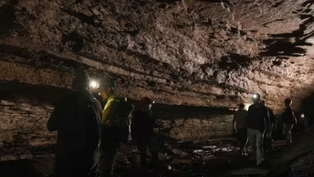
Clip: S31 Ep15 | 8m 24s | Follow cavers as they explore Kentucky’s karst terrain and work to protect its fragile ecosystems. (8m 24s)

The Life and Legacy of Verna Mae Slone
Video has Closed Captions
Clip: S31 Ep15 | 7m 59s | Meet the woman whom Eastern Kentuckians call the “Grandmother Moses of the Mountains”. (7m 59s)
Providing Support for PBS.org
Learn Moreabout PBS online sponsorship













Support for PBS provided by:
Kentucky Life is a local public television program presented by KET
You give every Kentuckian the opportunity to explore new ideas and new worlds through KET. Visit the Kentucky Life website.