
The Life and Legacy of Verna Mae Slone
Clip: Season 31 Episode 15 | 7m 59sVideo has Closed Captions
Meet the woman whom Eastern Kentuckians call the “Grandmother Moses of the Mountains”.
In many Appalachian communities, history lives beyond textbooks, and in kitchens, on front porches, and at community gatherings. In Eastern Kentucky, one woman led the charge for cultural preservation, gaining the nickname, “Grandmother Moses of the Mountains”.
Problems playing video? | Closed Captioning Feedback
Problems playing video? | Closed Captioning Feedback
Kentucky Life is a local public television program presented by KET
You give every Kentuckian the opportunity to explore new ideas and new worlds through KET. Visit the Kentucky Life website.
The Life and Legacy of Verna Mae Slone
Clip: Season 31 Episode 15 | 7m 59sVideo has Closed Captions
In many Appalachian communities, history lives beyond textbooks, and in kitchens, on front porches, and at community gatherings. In Eastern Kentucky, one woman led the charge for cultural preservation, gaining the nickname, “Grandmother Moses of the Mountains”.
Problems playing video? | Closed Captioning Feedback
How to Watch Kentucky Life
Kentucky Life is available to stream on pbs.org and the free PBS App, available on iPhone, Apple TV, Android TV, Android smartphones, Amazon Fire TV, Amazon Fire Tablet, Roku, Samsung Smart TV, LG TV, and Vizio.
Providing Support for PBS.org
Learn Moreabout PBS online sponsorshipIn many Appalachian communities, history lives beyond textbooks, in kitchens, on front porches, and community gatherings.
In eastern Kentucky, one woman led the charge for cultural preservation, earning the nickname Grandmother Moses of the Mountains.
Let's meet Verna Mae Slone.
[music playing] [music playing] [music playing] Born in Knott County in 1914, Verna Mae Slone was raised by her father in a one-room log house.
After losing her mother to illness as an infant, her world became one of devotion and responsibility.
She left school in the eighth grade to care for her younger siblings while her father worked at the local post office.
From these humble beginnings grew a story of resilience and love, one that would become a lasting memento of Appalachian culture.
She grew up hard.
She grew up in a simpler time.
She grew up very close to her family.
And you would be close to your family if you lived in such a small quarter.
A lot of the people here struggled to survive.
People didn't have a lot of hope.
And so they had to find their joy wherever they could.
And that's where she enters the building.
In 1979, at the age of 65, she published her first book, What My Heart Wants to Tell, a collection of essays shaped by her experiences in the hills around Caney Creek, Kentucky.
The book offered a deeply personal account of Appalachian life.
A lot of it is just passed down memories of her father, of her sisters, of their parents, everything that she could tell to her kids and her grandkids because she wanted to have that living narrative.
I think she had great pride in being a great storyteller, which she was.
And so when she originally made the book, she made 100 copies of that book.
And one of them so happened to make its way out of Caney Creek.
She wanted to just write a memoir of her dad to leave for actually her grandkids.
Her life was around family, being proud of your family and where you came from, and that hard work never killed you.
Because I didn't want them to read what has been written about us mountain people, and believe that that was the way it was really wrong because it wasn't like that at all.
They've just written so many lies about us and told so many things that were not true.
And so I thought I'd write this and write the history of my father's life and the way the folks really did live.
And they didn't have very much money because they didn't need money.
When a publisher heard an excerpt of her book being read on local radio, she became one of Appalachia's most widely read voices, putting out an additional five books.
She quickly gained national attention for her portrayal of mountain life and was given the nickname the Grandmother Moses of the Mountains.
Her books have been embraced by scholars and educators all over the world for their historical significance and contribution to Appalachian studies, they are still being studied in universities today.
For Verna, writing was an act of resistance, but also an act of love for her community.
She was a rebel.
She was a trailblazer.
She was a renegade.
She did not care what other people thought.
And a true artist or a true folk artist does not care what other people think.
They just want to get what's inside of them out of them, and art is an expression of that.
She wanted to dispel the hillbilly image, and she had a wit about her that she could poke fun with her writing and get by with it.
So many lies and half-truths have been written about us, the mountain people, that folks from other states have formed an image of a gun-toting, backer-spitting, whiskey-drinking, barefooted, foolish hillbilly that never existed, but was conceived and born in the minds of the people who have written such things as Stay on, Stranger!
and Beverly Hillbillies.
[laughs] And they were not like that at all.
A lot of her inspiration was the kinship and the community of Caney Creek.
It was a small community, and she was really close-knit with a lot of the people located there.
She captured the richness of Appalachian English, documenting expressions and meanings that she grew up hearing on front porches.
One of her books is about just the meaning of our slang words, and I got a kick out of it.
She would give, like, 18 different ways to use the word mind in a sentence.
Mind your manners, mind your business, I have no mind, you know.
She wanted to preserve that dialect.
One thing the outsiders did not seem to realize was that they sounded just as different to us as we do to them.
We could understand them better than they could us because we have so many quaint expressions that are meaningless to anyone else but ourselves.
She played a part in preserving the dialect as a cultural record.
She also created a cultural record of her family.
Once I started reading, I couldn't lay it down because it's my family and it was my heritage.
She didn't realize, and I don't think any of us realized that she was so gifted, an author.
Long before her words were bound into books, her hands were already at work.
Throughout her life, she hand-sewed and stitched thousands of quilts and dolls, honoring the people and traditions that shaped her life.
They would have to make things their self.
So she started making her quilts, and she had a lot to say.
And one way that she could get her point across or to tell a story was through her quilting.
So every quilt told a story.
She said once you were born, you were given a group of scraps.
So those scraps you'd piece together, and that's how she would make her quilts.
Her deep belief in the arts and education were her tools for bringing joy to others.
She wanted to be the one to bring the light, and she expressed that through her dolls because she said that she would always put a smiley face on the dolls because she wanted kids to feel happy.
She wanted people to feel happy when they saw them.
Verna Mae believed that everyday lives were worth honoring.
Her book, What My Heart Wants to Tell, put those lives on the page.
That is what makes her books stand out from anybody because they give you a strength that you have inside, but you didn't know how to bring it out.
She knew that we had intelligent people here and people that were worth listening to, but they only needed a voice, and I think she wanted to be that voice.
She instilled in us the fact that we were as good as anybody, but better than nobody.
In the book, I said God knew that it would take brave and sturdy people to survive in these beautiful but rugged hills, and so He sent us His very strongest men and women, people who could endure life and search out the few pleasures that were contained in a life of hard work and toil.
They were enduring people who did not whimper and complain because their burdens were heavy, but they loved each other and lived closer to God and nature than any folks anywhere.
[music playing]
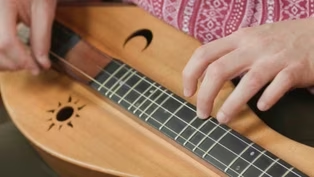
Video has Closed Captions
Clip: S31 Ep15 | 6m 3s | Learn about the history of the mountain dulcimer and its birthplace in Hindman, Kentucky. (6m 3s)
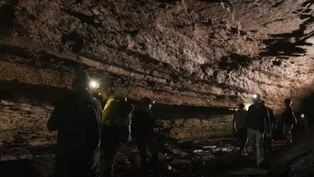
Video has Closed Captions
Clip: S31 Ep15 | 8m 24s | Follow cavers as they explore Kentucky’s karst terrain and work to protect its fragile ecosystems. (8m 24s)
Providing Support for PBS.org
Learn Moreabout PBS online sponsorship











Support for PBS provided by:
Kentucky Life is a local public television program presented by KET
You give every Kentuckian the opportunity to explore new ideas and new worlds through KET. Visit the Kentucky Life website.