
Otherworldly Wonders | Sophie’s ELECTRIC Road Trip Part 7
Special | 28m 33sVideo has Closed Captions
Arkansas to Arizona is full of extremes, literally!
Scientist-comedian Sophie goes to extremes, investigating microbe-filled hot springs in Arkansas, the pros and cons of wind farms in Texas, otherworldly fairylands of Carlsbad Caverns, and the search for alien life in Roswell, New Mexico. A last-minute opportunity means a rush to change plans, and a rush of powerful emotions.
Problems playing video? | Closed Captioning Feedback
Problems playing video? | Closed Captioning Feedback
Major support for NATURE is provided by The Arnhold Family in memory of Henry and Clarisse Arnhold, Sue and Edgar Wachenheim III, Sarah and Sandra Lyu in memory of Seung...
Otherworldly Wonders | Sophie’s ELECTRIC Road Trip Part 7
Special | 28m 33sVideo has Closed Captions
Scientist-comedian Sophie goes to extremes, investigating microbe-filled hot springs in Arkansas, the pros and cons of wind farms in Texas, otherworldly fairylands of Carlsbad Caverns, and the search for alien life in Roswell, New Mexico. A last-minute opportunity means a rush to change plans, and a rush of powerful emotions.
Problems playing video? | Closed Captioning Feedback
Where to Watch Nature
Nature is available to stream on pbs.org and the PBS app.
Buy Now
Explore More Ways to Watch
Bring the beauty and wonders of wildlife and natural history into your home with classic NATURE episodes.Providing Support for PBS.org
Learn Moreabout PBS online sponsorshipMore from This Collection
Scientist-comedian Sophie Shrand drives an electric car from Los Angeles to Boston and back on a coast-to-coast, roundtrip journey across the USA. Across 7,000 miles and 25 states, Sophie scopes out spectacular sights, explores the science of sustainable travel, and meets people across the working to build a brighter tomorrow.
![The Grand [Canyon] Finale | Sophie's ELECTRIC Road Trip Part 8](https://image.pbs.org/video-assets/bXtXc12-asset-mezzanine-16x9-fDqsQHK.jpg?format=avif&resize=316x177)
The Grand [Canyon] Finale | Sophie's ELECTRIC Road Trip Part 8
Video has Closed Captions
Sophie finishes her coast-to-coast-to-coast trip, completing her biggest science experiment yet. (25m 22s)
Liquid Metal, Ancient Mountains | Sophie’s ELECTRIC Road Trip Part 6
Video has Closed Captions
In her drive from New York to Tennessee, Sophie spots ancient mountains in Shenandoah. (31m 26s)
Dinos, Tortoises, Rats and... Garlic: Massachusetts| Sophie’s ELECTRIC Road Trip Part 5
Video has Closed Captions
A museum, a university, and a festival remind Sophie that home is where the science is. (24m 35s)
Fast and Curious: Midwest Bikes and NYC Bugs | Sophie's ELECTRIC Road Trip Part 4
Video has Closed Captions
Sophie investigates electric racing motorcycles and stomps invasive bugs as she makes it halfway! (25m 53s)
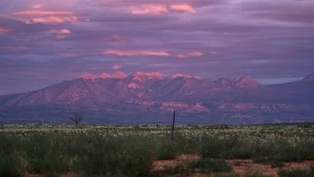
The Detour is Worth It | Sophie’s ELECTRIC Road Trip Part 3
Video has Closed Captions
Sophie and team face the challenges of 12,000-ft elevation and a bullet run through middle America. (28m 21s)
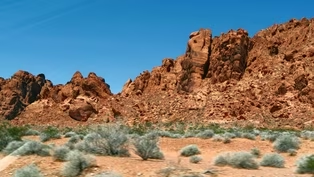
Horsepower vs Horse Power | Sophie’s ELECTRIC Road Trip Part 2
Video has Closed Captions
From Moab to Arches, Sophie examines the (literal) science of horsepower. (26m 40s)
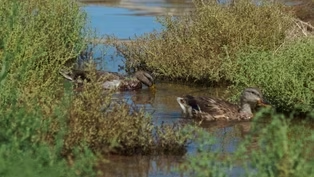
Lake Mead Mysteries | Sophie's ELECTRIC Road Trip Part 1
Video has Closed Captions
Sophie Shrand and crew pack the car, charge the batteries, focus the cameras, and hit the road. (24m 16s)
Providing Support for PBS.org
Learn Moreabout PBS online sponsorship(water splashing) (Sophie exclaiming) - Oh, oh, oh, oh.
Not what I expected.
Ooh, way softer.
(water splashing) - What is it?
(water splashing) Hi!
I'm Sophie.
I drove an electric car on a coast-to-coast round trip journey across the USA.
I set out to answer two questions.
Can it be done?
And can it be fun?
What I found was so much more.
(upbeat music) It's "Sophie's Great American Electric Road Trip."
(sirens wailing) 26 cents per kilowatt hour.
- [Brendan] Can't beat that price.
- But it doesn't charge.
- [Brendan] I think, I mean, we have enough mileage, I think, to get somewhere else.
- Yeah.
- It says battery very low.
Charge soon.
- We are just gonna think positively.
(bright "on hold" music) (music stops) - [Assistant] Did you know you can report an issue using the Electrify America app?
- [Sophie] Well, if we can ever charge, we're going from Nashville, Tennessee, to Hot Springs, Arkansas.
That's, is that the lowest we've gone so far?
- Absolutely.
By a lot.
If we drive conservatively... - I hereby agree to not turn on my seat heat.
- [Brendan] Thanks, babe.
Here we go.
Here we go.
Here we go.
Here we go.
- [Megan, on the phone] The next couple of days are long, but then you have like a down day in Carlsbad.
- [Sophie] Carlsbad does sound awesome and we, ooh, big sign!
- [Brendan] Can you get this in focus?
On no, the truck is gonna.... - [Sophie] No, no, no, no, no.
(Brendan laughing) - [Sophie] No, no, no, no.
- [Brendan] You good, you good, you good.
- [Sophie] I think so.
Yay.
- [Brendan] All right.
We're crossing.
We're in Tennessee, crossing the Mississippi into Arkansas.
♪ Arkansas ♪ (gentle 40's swing music) (gentle music continues) (gentle music continues) (cheery music) - Ooh, ooh, ooh, cool, there it is.
A display spring.
That's not what I thought it would be.
(cheery music) These are the display springs, maybe.
These look more like displays.
It's probably these.
Hot Springs, Arkansas has 47 natural hot springs flowing with water at about 143 degrees Fahrenheit.
- [Brendan] Ooh.
- [Sophie] Right?
- [Brendan] It is hot.
- Yeah.
Hot water that you can just drink from underneath the earth.
There's something that feels very magical about it.
To see it coming out of these structures and as we would say in New England, "Bubblers".
Water fountains.
There are so many layers and levels to the history of this place that all come from science.
This phenomenon of water, rainwater that comes down, heats up underneath the surface of the earth over 4,000 years, and then gets shot up back to the surface as very, very hot water.
One of the coolest things about hot springs is this.
(Sophie exclaiming) Oh, oh, oh, oh, not what I expected.
Ooh, way softer.
What is it?
This is alive!
Say hello to extremophiles.
Extremophiles are organisms that love extremes.
They thrive in conditions we consider harsh, like high altitude, acidity, pressure, cold, or heat.
It's hot.
It's hot!
Thermophiles are extremophiles that love heat.
Thermophiles have DNA and enzymes that have adapted to really high temps, sometimes hotter than water's boiling point.
The naturally hot water of hot springs is the perfect home for organisms like thermophilic bacteria, ostracods, and this blue-green cyanobacteria.
Cyanobacteria is also called blue-green algae, but it's not actually an algae at all.
It's a bacteria that can photosynthesize.
That's right.
Cyanobacteria produce energy from sunlight.
Its green color comes from chlorophyll.
Cyanobacteria is one of the earliest life forms to appear on earth, dating back more than two and a half billion years.
They were the first known organisms to produce oxygen, paving the way for complex oxygen breathing life like us.
Cyanobacteria keeps showing up on this trip.
Cyan-o, we'll see them again.
[Boston accent] Nature!
We are in a town within a national park.
You've got sort of, hand-in-hand, conservation and commerce.
But with climate changing the amount of rainwater and the patterns of that rainfall, that may change the availability of these hot springs as well.
I feel a lot of different things at once, and I don't even know how to name them.
And I will have a lot of time to think about them because we have so much driving left.
Good morning from Arkansas.
I have to think for a second about where we are, because we've been to so many places, and we only have a week left of the trip, and I'm feeling a little bit sad today, because I don't want it to be over.
I also don't want to leave these beautiful places.
I really like these places that we've been to.
It's so nice here and peaceful here, and I don't want to leave to get in the car.
Texas.
- [Brendan] Lone Star State.
- So big that it can't all fit on one page of an atlas.
Today we go through what, eastern Texas.
Our goal is to basically get halfway across.
And then tomorrow, the other half, because it's going to take us seven and a half hours with charging.
- All right.
- And I'm going to try to be trusting that we will find a place to stay, somewhere in the middle of Texas.
Huh, maybe we should just build some cabins and rent them out and live in one, and call it a life, you know?
- Sure!
(upbeat music) - I find myself more and more distracted by the world every day.
This has been so awesome, because we actually get to do the thing.
- Right.
- We actually get to do the work that I love to do.
- What brings you joy about being a creative person?
- Sharing an experience with other people.
We have been storytelling since the very beginning of humanity.
That is one of the things that has made us human.
We are social and we want to tell stories.
And so when I'm in these experiences, it's like I have a thread that's like an entire line of ancestors of storytellers.
And that's my favorite thing.
Also, we're passing by so many thrift and antique stores and I am not stopping because I know we have a goal, but it hurts.
It hurts to go by them.
- Are we coming up on the border?
- We passed it.
- Oh no!
We totally went through Texarkana?
- Yep.
- I didn't even see a sign.
- I did, but we were talking.
Should we go back?
- I think we can find a way to let people know that we crossed into Texas.
(video rewinding) (Wild West music) - So far, so good.
So far, pretty smooth sailing.
Charging-wise, it's been like fine.
Eww, interesting.
So on one side, an oil rig.
And on the other side, we are coming up on Sweetwater, which has the highest concentration of wind turbines in Texas.
You see that?
It was a wind turbine blade.
Wind energy is actually a type of solar energy.
As the sun heats the earth, warmer and cooler air moves faster in some places, and slower in others.
That kinetic energy can be harnessed to generate mechanical energy.
Humans have harnessed wind power for thousands of years to sail the seas, explore the skies, and do work.
Much more recently, like since the 1980s, we've realized it's a clean, renewable way to generate electricity.
A wind turbine looks like a tall fan with aerodynamic blades set in motion by wind, which in turn spins a generator, which moves electric current through wires to the power grid.
Put a bunch of wind turbines together, and you've got yourself a wind farm.
These are especially effective in areas with, well, a lot of wind, like out in the ocean, up in tall places, and in wide open spaces.
They're a really clean energy solution.
But like everything, they're not perfect.
- [Brendan] What'd we find out as we were driving in here?
- So it has all of these wind turbines.
Very cool, very pro.
The flip side of that is that it has a massive dumping ground of used turbine blades that have not been cleaned up by the company that said it would clean them up.
It's right near where people live, so it's taking up space.
Meanwhile, there are people here.
There are people who live here, and they are just dealing with the consequences.
Investigative journalism time.
We're on the hunt.
They keep saying they're going to recycle them, and they're not.
I think these are them.
Look!
- [Brendan] Yeah.
- It does feel like a graveyard.
Feels like bones.
It's incredible to see the kind of technology.
That makes sense, you can really generate power from wind.
But when they're here, just discarded, it feels very dystopian.
It makes me think about the containers and how the shipping containers are being reused to make housing.
Look at how big this is!
I can fit in this.
I can make a little hobbit hole out of this.
Like there's got to be a solution to repurposing these.
There are always solutions.
People across the world are turning old wind turbines into playgrounds, bridges, tiny homes, hobbit holes pending.
Put that panels on solar panels, look at that.
Wow!
It's a picture of the complexity.
You know?
We've got some individual, small house, solar panels whose view is a boneyard of wind turbine blades.
(gentle guitar music) Wait, is that us?
Or is this us?
- [Brendan] It's us.
Other side's a bat cave.
- Oh, but on that side is a bunch of cats.
I want to go look at the cats.
- Alright.
- Cats.
(twangy guitar music) - Back in the desert.
- We are in the gorgeous Chihuahuan Desert of Southern New Mexico, but we're here to see what's underneath.
- [Brendan] Is that part of a cavern?
- Like the muffin top of a cavern?
- Yeah.
- Yeah.
For a second I thought that was ocean.
It's not!
- It was.
- It was.
Yes, another inland sea from 250 to 300 million years ago.
I definitely thought we were going to be going down into caverns.
Didn't think we went up, we'd go up first.
Going to the top.
- [Brendan] Taking it to the top!
- [Sophie] Sure feels like it.
Cool, we're here!
Yay.
(twangy guitar music) - [Park Staff] The elevator is going to go down directly to our underground lunchroom in the big room level of the cave, 75 stories beneath the Visitor Center.
- So cool.
75 stories!
- [Park Staff] And resist the temptation to touch any of the rocks in the cave as they are permanently stained by the oils of our skin.
You are allowed to touch this broken formation here behind you.
That's what we like to call our sacrificial stone.
That's very helpful for a lot of people.
- Yeah, yeah, great.
And they're limestone, right?
This is limestone formation?
- [Park Staff] Correct.
They're all derived from limestone.
The particular mineral that the formations are is called calcite.
Go ahead and come aboard.
- Thanks so much.
- [Speaker] 16 persons per car.
(upbeat electronic music) (music continues) (Sophie chuckling) Oooh!
- This cave is amazing!
Can you believe?
Naturally formed these square tiles in a pattern?
Oh, wow.
This is incredible already.
Even if they didn't tell us to whisper, I feel like it's necessary to whisper in here.
It's so quiet.
It's already significantly colder.
I wish I brought a thermometer in here to test it out.
Wow, look at these though.
Oh my God, this is so cool.
Wow!
Look at that, huh?
See all that?
We are in for a treat?
(gentle cello music) Look at this cute little friend.
It's a rock.
But a girl can dream, you know?
A rock can be your friend.
Can you see me?
- [Brendan] Yeah.
Can you see me?
- Yeah.
The lighting in here is excellently done.
There's so much artistry that goes into choosing the lights.
I wonder how long that took, and who was responsible for that.
Did they major in theater?
Look down there.
It's so deep.
Question.
Would you live down here?
- [Brendan] Would I live down here?
- [Sophie] Yeah.
- [Brendan] No.
- Where else can you get 260-foot ceilings?
At our budget?
Think about it.
It's otherworldly in an entirely different way than say other places we've seen.
There are so many places on our planet that feel like another world.
And they're right here.
Lion's tail, stalactite and popcorn.
Two of my favorite things!
I really want popcorn.
Did you want something science-y?
Yes, yes, yes.
These stalagmites, they're calcite.
They're formed by acidic water that drips, drop by drop by drop over time.
The rate at which that water falls and evaporation rate determines whether they're going to be short and fat, or tall and skinnier.
Similar to arches where the movement was so palpable in the rock.
You can see the way it dripped down over time.
And if you listen closely, you can still hear water dropping right now.
(faint water drops) Each little "ping" is a future stalagmite.
Welcome to Fairyland.
This fairy land of popcorn-covered stalagmites exists because of all the stalactites above it.
The little knobby bits grew on every stalagmite as the water continued to splash from thousands and thousands of these stalactites over time.
Have you ever seen stalactites that you thought looked like curtains?
Well, you're not alone, because these are called draperies.
It's like an official science name.
Each section we go into, we're like, "This is even cooler than the last thing!"
That goes down way further than I expected.
Can you imagine being the explorers that went down there?
Very spooky.
Big scary.
What will these caverns look like in another 300 million years?
I hope I'm there to find out.
Hear that kid?
(distant echo) When we're babies, we make sounds, because it's how we discover the world.
And it's only as we get older that society tells us to be quiet and to start to hold in our sound.
And we start to judge our own sounds.
And there's something so very human about hearing a child make a sound in a space like this where they're just discovering their own voice.
Okay, where the heck are we?
Can you imagine first exploring these caves where there were not lights, and having to find your way back like we are trying to do?
If there are signs for a snack bar, then we're near the entrance.
Okay, one last look.
Thank you, caves.
My nose is a stalactite.
(sniffs) Drippin'.
(upbeat electronic music) And in true Banksy style, we exit through the gift shop.
(Sophie chuckling) Nice.
- [Brendan] Want me to make a fire?
- I do, but I think I need to go to bed.
- [Brendan] Feeling all right?
- No, I feel kind of sicky.
- [Brendan] Uh-oh.
- Yeah.
Hopefully it's just a passing thing.
- [Brendan] We had a great day otherwise.
- Yeah, we did.
It was great.
Uh, okay.
(Brendan kissing Sophie's head) - [Brendan] Love you.
- Love you.
Goodnight.
- All right.
Sleep well.
(upbeat electric organ music) We're on our way to the International UFO Museum in Roswell, New Mexico.
- Roswell.
Roswell, New Mexico.
Famous for purported UFO sightings.
(electric organ music continues) Mondays, am I right?
Mondays, am I right?
Mondays, am I right?
I don't know what the gun is for.
We're going to find out.
Is it for peaceful conflict resolution?
I hope so.
(computerized sci-fi sounds) (upbeat music) Quintessential American road trip stop.
Thank you, Roswell.
Now, to be fair, little green aliens is more science fiction than science.
But the question of estra traruhruhruh.. is very much a scientific question.
Question of extraterrestrial life is very much a scientific question.
Something that scientists and everyone have been wondering for a long, long time.
Are we truly the only ones out there?
Or does life exist on other planets?
In the search for life on other planets, some scientists are looking closer to home.
Life on planets like Mars would have to withstand extremes.
Luckily, we have extremes here, too.
And living organisms who love them.
Say hello again to cyanobacteria.
Cyanobacteria are kind of the ultimate extremophile.
Having survived extremes on Earth for over two billion years, they're basically the OG earthlings.
Not only can they survive extreme heat, they can also survive in extremely low humidity, low oxygen, and even in the dark!
(disc scratching) Wait, how does a photosynthesizing organism survive in the dark?
Here's where it gets even more extreme.
Cyanobacteria have been found in caves - - yes, like the Carlsbad Caverns we were just in - where no visible light can reach.
Their chlorophyll can use near-infrared light, which travels further than visible light, and bounces off the limestone walls.
Near-infrared light is the same type of light emitted by red dwarf stars, the most abundant type of star in the galaxy with the most rocky exoplanets we've discovered so far.
So this discovery that near-infrared light can support photosynthesis massively widens our search for life on other planets.
The more we explore, the more this planet surprises us.
We still haven't found the limits on how extreme life can get.
Life does indeed find a way.
So out there in space, little green aliens?
science fiction says, "Maybe."
But little green bacteria?
Science says "May be!"
So if you have ever wondered if there is life on other planets, you are not alone.
These are not photographs.
(upbeat music) (upbeat music continues) Ugh!
Yikes.
So many bugs were harmed in the making of this documentary.
I have news!
We have a permit to film at the Grand Canyon!
So we got to get there today, now, but we can film there.
(traffic noises) First things first, car wash.
- We can put it in carwash mode and not get out of the car.
- Right.
We're learning.
Ah.
Wow.
(jaunty music) That was fun.
- So where are we going?
- Okay.
So we're going to the Grand Canyon.
Where we're staying tonight, don't know yet.
We're going to figure that out.
(jaunty music) Well, we better get more than that.
I can hear it disconnecting.
I don't know why it's... My head hurts so much.
- [Brendan] Yeah.
- Man, it's been awhile since I've done one of these.
We just can't do it.
I don't know.
- [Brendan] Well, we went through all the trouble of getting the car washed and the windshield clean so that we could film traffic.
- We're going to get there at 10 at night.
Later.
We are going an average speed of one mile an hour.
- [Brendan] And the cameras have burned out, 'cause it's too hot in the sun.
- Yeah.
- [Brendan] So none of our GoPros are working.
- This is probably the part of the documentary where we would say, "Okay, well, what are things we can do while we're sitting in traffic?"
- [Brendan] Hey, Soph.
Seven fun things you can do in traffic when you've been on the road for 42 days and you have a head cold and your head is pounding and you took some Advil, and it's not working at all.
And we're in 97 degree heat, and all the cameras have turned off and you're supposed to be running a TV show and you don't feel like you know how to do that anymore.
- Just lose it.
(Brendan laughing) - [Brendan] One.
- [Sophie] Cry it out.
- [Brendan] Two.
- [Sophie] Drink water.
- [Brendan] Three.
- [Sophie] Have a snack.
- [Brendan] Four.
- [Sophie] Cry again.
- [Brendan] Five.
- [Sophie] Imagine your future house.
- [Brendan] Six.
- [Sophie] Blow your nose.
- [Brendan] Seven.
("A Choir of Angels" by Saints & Exiles playing) - Oh, look at this crying comedian!
That's not confusing for anyone.
Neggy-eggy.
- [Brendan] All right.
- [Sophie] COVID test is negative.
Just a cold.
("A Choir of Angels" continues) Woo hoo!
Nice.
Next up, - [Brendan] Grand Canyon.
[Brendan] This isn't as big as I thought it would be.
- Yeah, not as much of a canyon as I expected.
I actually need to go to bed like right now, because we got special permission to go do a cool thing.
We are going to try to get some sunrise stuff.
You know, some sunrise stuff.
That's the official term.
This has been such a fun, wild ride, literally and figuratively.
I really didn't expect to get a head cold for the ending.
- [Brendan] Yeah.
- I really thought that was going to happen when we got home and we've turned off cameras, and to be there like [mocking congested voice] "It's the Grand Canyon!"
because I can't breathe!
- [Brendan] Well, then I think maybe you just need some Vitamin C.
- Oh!
- [Brendan] Ooh!
See you at sunrise.
- No, way before!
- [Brendan] I'm not talking to you.
I'm talking to America.
- Oh, okay.
Ready?
- Let's do it.
- [Sophie] Hey, need a ride?
- Yeah.
Here we go.
- [Sophie] We're doing Grand Canyon in the dark.
Yeah!
Gonna be good!
(gentle atmospheric music) (atmospheric music continues) (gentle music) - [Brendan] You hungry?
- Yeah, I was waiting for you to get the shot so I didn't make a sound.
(playful music) (playful music) [Sophie] Wow.
Nature is beautiful.
(playful music continues) Support for this program was provided in part by Vela.
Vela connects families and founders in the indie education movement, where families take charge of their children's education.
Learn more in the Vela app or at vela.org.
(snap) Cool Jacket!
 New Episode
- Science and Nature

Explore scientific discoveries on television's most acclaimed science documentary series.

 New Episode









Support for PBS provided by:
Major support for NATURE is provided by The Arnhold Family in memory of Henry and Clarisse Arnhold, Sue and Edgar Wachenheim III, Sarah and Sandra Lyu in memory of Seung...