Prairie Sportsman
A Home for Hens
Clip: Season 17 Episode 9 | 8m 32sVideo has Closed Captions
In Minnesota volunteers install hen houses designed to protect nesting ducks from predators.
In Minnesota volunteers install hen houses designed to protect nesting ducks from predators, providing a safer environment for hens to raise their broods. Organizations like Delta Waterfowl support these efforts by placing hen houses over water, where mallard hens are less vulnerable to predators such as raccoons, skunks and coyotes. In addition, wood duck boxes are installed to create nests.
Problems playing video? | Closed Captioning Feedback
Problems playing video? | Closed Captioning Feedback
Prairie Sportsman is a local public television program presented by Pioneer PBS
Production sponsorship is provided by funding from the Environment and Natural Resources Trust Fund and Shalom Hill Farm. Additional funding provided by Big Stone County, Yellow Medicine County, Lac qui...
Support provided by:


Prairie Sportsman
A Home for Hens
Clip: Season 17 Episode 9 | 8m 32sVideo has Closed Captions
In Minnesota volunteers install hen houses designed to protect nesting ducks from predators, providing a safer environment for hens to raise their broods. Organizations like Delta Waterfowl support these efforts by placing hen houses over water, where mallard hens are less vulnerable to predators such as raccoons, skunks and coyotes. In addition, wood duck boxes are installed to create nests.
Problems playing video? | Closed Captioning Feedback
How to Watch Prairie Sportsman
Prairie Sportsman is available to stream on pbs.org and the free PBS App, available on iPhone, Apple TV, Android TV, Android smartphones, Amazon Fire TV, Amazon Fire Tablet, Roku, Samsung Smart TV, LG TV, and Vizio.
Providing Support for PBS.org
Learn Moreabout PBS online sponsorship(gentle music) - Welcome to "Prairie Sportsman."
I'm Bret Amundson.
Well, what does the future of waterfowling look like?
Well, for one group of dedicated conservationists, it means sky's full of waterfowl and blinds full of happy hunters.
And today, we're gonna find out the hard work they're doing to help make sure that happens.
(bright music) - I'm the Chairman of our Delta Waterfowl Group in St.
Michael, Minnesota.
Been the chairman for about 14 years.
Our group, this is our 18th year of being together.
Ever since that day I came on as a chapter committee member, I have said I'm gonna do my part to make more ducks and produce more ducks.
When Delta first came up with the idea of putting henhouses out, and we saw some of the research from some of the biologists and the studies that they had been doing, and what the numbers were coming back at us as hunters saying that this is putting more ducks out there, that kinda got me the head to the fire to get that fire burning in me, and I took that fire and brought it to the group and said, "We need to start doing this."
And the guys jumped on board, and they've been going with it ever since.
(bright music) Need a drill, I think, and then the cradle.
- All right, so Lance, the plan is that you're gonna kind of surround this body of water here with henhouses and wood duck boxes.
- Yeah, so putting the hen house out right now, we feel that this is gonna be a good spot.
- [Bret] Why did you pick this spot?
- With a little bit bigger water, We don't want the ice to take out the henhouse, but at the same time, we want to be in an area where we feel that there's gonna be some birds that are gonna use this area, and really, we want 'em to come into the area, and hopefully, see it and say, "I'm nesting there."
- So now that we got a spot picked out, you got a crew of guys walking out there.
What's the next step?
- So right now their job is to get out there.
We try to put the post down into the water in the muck about three to four feet.
- [Bret] So first thing they're doing, they're drilling through the ice.
- Yep, augering down through the ice.
Try to get it away from the cattails, anywhere from five to seven feet away.
Augering a hole in, putting it in, and then we'll try to get it into the muck, you know, like I said, three to four feet into the mud.
We want the pole off of the ice, anywhere from two to three feet, because then the hen structure or the house itself sits above the water that three to four feet.
During, call it the summer months, predators shouldn't be able to get to 'em when they're out in the water.
And that's the whole point of putting 'em out over the water like this, of course, 'cause these birds would normally be nesting in the grass, sometimes a little ways away from the water.
- You get that post in the ground down into that muck, and then what's after that?
- After we've got that set situated, feel like it's a good base, what we'll do is we'll take the cradle, which we have prewelded together and put that in, and we'll usually drill two pilot holes into 'em to hold that secure.
- And then you actually try to point 'em in a certain direction.
- We do.
- Isn't it?
- Yeah, north is there.
- All right.
- We try to stay away from the northwest wind to go right through the tube.
We try to offset 'em a little bit.
Once that cradle is secure and we feel good, put the hen house in there, and then we zip tie 'em with metal, not just plastic, but with metal.
Wind will come.
You know, these prairie areas, 30, 40 mile an hour winds won't push that off into the water.
And once we've got that down, we put a little nesting grass in there for her to come in, and hopefully, she'll bed it down.
Put a little pocket about the size of our fist.
and hopefully, she'll have some eggs.
And we got some mallards down the way.
(gentle music) The biggest thing that we have found and that biologists, whether it be any out there projects that they're doing, those biologists have said, "We gotta keep the raccoons and the skunks and all those predators."
And having that hen house and that tube on water, it's given her a chance.
I think we should put a wood duck house right up here.
- [Jarrod] Okay.
- Because it looks like there's some flat ground there.
- Yep.
- We'll get it in there.
- [Jarrod] Okay.
In the water or?
- Ah, we'll try to get it up on land if we can.
(gentle upbeat music) - Yeah, you don't really need a whole lot of gear, I mean, an auger or an ice chisel and a couple of wrenches, - [Bret] A drill.
- [Chris] And a drill is about all you really need.
- As much as people think it is a lot of work, the spearheading of just getting the guys is the hardest part.
Finding the resources and finding the materials isn't hard in this day and age with the internet and all of that stuff.
And it doesn't take a lot of money.
But if you get the guys that can support it, it doesn't take much.
(gentle upbeat music) - We all look forward to doing it, and it's basically like duck camp without being able to shoot any ducks.
That's basically it.
We have a lot of fun.
We laugh.
We joke.
(gentle upbeat music) - [Bret] All right, so you put up some hen houses around this Waterfowl Production Area.
You're also doing some wood duck boxes.
- Yeah, our group, years ago, was primarily putting wood duck houses up, and when the hen houses came in, then we started doing a combination of about half and half, and we really liked the wood duck house thing.
We think it's a beneficial deal.
So same kind of deal?
They're just gonna put this pole in, but they're putting it actually on the ground, not in the water.
- Yeah.
Yeah, we try to get it close to the water, but again, yeah, we get it right uptight.
We try to get it close to the water, so they can jump off, get in the water as quick as they can, those little ones These are pretty quick, pretty quick insulation for us.
- You know, you're doing something good for the birds.
I've been mentored as a young person hunting and fishing, and it's good to do this when you get older when you can.
- It just ups the nesting success so much from nature.
I mean, they got a rough road out there with all the predators, raccoons, mink, skunks.
It just makes it a little bit easier for 'em.
- About the only metric you can use to quantify any success is when you look in those tubes, and you see broken eggshells.
- Absolutely.
After putting out all the hen houses and the wood duck house or wood duck boxes and the hen houses, our last day, we usually take, and that's kind of our day where we, as a group, go out and we kinda wait, and we get to that house, or we get to that wood duck hut, and we open it.
And when you've seen the shells, or you've seen the little nesting the hen house, I mean all of us kind of get the little kid in us, and jump up and down a little bit, and it makes us feel good.
(bright music) - Well, how's it look?
- [Member] This one's been used.
It's got- - [Bret] Oh, nice.
- [Member] Eggshells in it.
I don't see any feathers in there.
But there are eggshells, and there's the imprint in the middle.
So it's been used.
Duck sitting there.
(gentle upbeat music) - So from what we have out here in Western Minnesota, our success rate on our wood duck houses, I can confidently say that we are 90% or better on our wood duck houses.
Our hen houses were probably more of like that 40 to 50%, which has been awesome for us.
- [Bret] What impacts have you seen from those efforts?
- I think we're seeing more ducks.
It's tough to always tell because of so many different variables, you know, but I do believe we're doing what's right, and I do believe we're seeing more.
Seeing the birds come back at this time and the numbers of birds and knowing that we're putting the henhouses and the wood duck houses out there to hopefully give them a chance of survival for the future, it doesn't get better.
(gentle music)
 New
NewVideo has Closed Captions
Clip: S17 Ep9 | 5m 56s | Learn about ongoing research where scientists collect and analyze ticks to better understand them. (5m 56s)
 New
NewVideo has Closed Captions
Clip: S17 Ep9 | 9m 22s | Researchers study bumblebee populations across Minnesota, working to better understand species. (9m 22s)
Video has Closed Captions
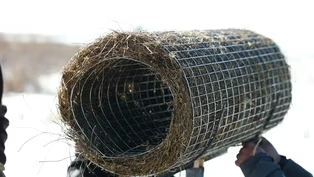
Preview: S17 Ep9 | 30s | The value of hen houses to duck populations and the University of Minnesota tracks entomology. (30s)
Providing Support for PBS.org
Learn Moreabout PBS online sponsorship
- Science and Nature

Explore scientific discoveries on television's most acclaimed science documentary series.

- Science and Nature

Capturing the splendor of the natural world, from the African plains to the Antarctic ice.











Support for PBS provided by:
Prairie Sportsman is a local public television program presented by Pioneer PBS
Production sponsorship is provided by funding from the Environment and Natural Resources Trust Fund and Shalom Hill Farm. Additional funding provided by Big Stone County, Yellow Medicine County, Lac qui...