Prairie Sportsman
The Bloodsucker Survey
Clip: Season 17 Episode 9 | 5m 56sVideo has Closed Captions
Learn about ongoing research where scientists collect and analyze ticks to better understand them.
Learn about ongoing research led by Dr. Ben Cull at the University of Minnesota, where scientists collect and analyze ticks to better understand their range and the risks they pose. The effort includes collaboration with veterinarians at the Wildlife Rehabilitation Center of Minnesota.
Problems playing video? | Closed Captioning Feedback
Problems playing video? | Closed Captioning Feedback
Prairie Sportsman is a local public television program presented by Pioneer PBS
Production sponsorship is provided by funding from the Environment and Natural Resources Trust Fund and Shalom Hill Farm. Additional funding provided by Big Stone County, Yellow Medicine County, Lac qui...
Support provided by:


Prairie Sportsman
The Bloodsucker Survey
Clip: Season 17 Episode 9 | 5m 56sVideo has Closed Captions
Learn about ongoing research led by Dr. Ben Cull at the University of Minnesota, where scientists collect and analyze ticks to better understand their range and the risks they pose. The effort includes collaboration with veterinarians at the Wildlife Rehabilitation Center of Minnesota.
Problems playing video? | Closed Captioning Feedback
How to Watch Prairie Sportsman
Prairie Sportsman is available to stream on pbs.org and the free PBS App, available on iPhone, Apple TV, Android TV, Android smartphones, Amazon Fire TV, Amazon Fire Tablet, Roku, Samsung Smart TV, LG TV, and Vizio.
Providing Support for PBS.org
Learn Moreabout PBS online sponsorship(soft music) Hi, it's good to see you.
- So good to see you again.
Welcome back.
- Yeah, thanks for having me.
(soft music) - This is one of our storage areas at the museum where we take care of the objects and keep them until we're using them for exhibits or for researchers.
So come here, I'll show you where your pieces are going to end up.
(machine clatters) - [Dana] Is this the entire collection in here?
- [Speaker] No, it's just a portion of the collection.
We call these small objects, so trunk-sized and smaller.
- [Dana] Oh, wow!
- So some of the other things we have here include the wool combs, much like you had the carders, and we also have things like this.
This one is called a banketre, a washing paddle, probably things you've never seen before.
This would've been a clamp to hold needlework onto a table as you were using it, and there would've been a pin cushion on top.
This one is from Nordland.
This is a small loom for weaving bands.
Here's the band in progress.
And this is from Nordland County, which is where Nesna is located.
And this is located not far from there.
- [Dana] Oh, that's beautiful.
How did you find one that's in progress?
- It's the way it came to us.
So that's really a great thing because you would tie yourself up, have all of this to weave, and that actually it would be upside down like this.
And then you would pull this up and down to help you weave the band here.
That would work for hair ribbons or sock garters or maybe an apron band.
(machine clatters) So this is a travel chest covered with seal skin from Nordland, and they used the seal skin because then it would repel the water well.
If you were traveling in a boat and it was raining or the waves were splashing, that would keep everything inside dry.
- Oh, that's amazing.
Do you have any other ones like these?
- No, this is our only one with this kind of covering.
We have some with leather for protection, but this is our only one from Nordland with seal skin.
- [Dana] That's beautiful.
(soft music) Okay, so what do we have here?
- We have some more objects from the same family as the coverlet.
So these were brought by Berit and Nils Nesgjerdet from Vefsn, Norway, which is not far from Nesna.
And in the US they use the name Nelson, and we have a bodice.
And the family told us that Berit had handwoven the fabric.
- Oh my gosh!
- And I'm not sure if she wore it or one of her daughters.
- [Dana] Oh my gosh, it's so small.
- I know.
It's tiny.
(Dana chuckles) - [Dana] The buttons on there are beautiful.
- They are.
And this is the back.
The front is missing part of the fabric.
I think it would've had a red velvet in the front, in the center here.
But it's one thing to sew a garment, but to weave the fabric first.
- [Dana] Yeah.
- That's a lot of work.
They brought some textile tools with them, a weaving shuttle and a small loom of the type that you would make these bands.
They brought these as well.
And these could have been used for hair ribbons or sock garters or a tie for an apron.
And then also from the same family is this pocket that would hang on the waistband of a skirt.
And so instead of having the pockets that we're used to, you would hook this on your waist to carry maybe a little bit of money or maybe a spoon or something else that was small.
- Oh, I love the engraving on there.
That's a date on there.
- It is initials and the date of 1821.
- Wow!
This must have been so special to somebody.
- And too special to leave behind.
I think... - Yeah.
- That's why they brought them with them.
And then finally a pair of stockings, and the knitting technique is called entrelac.
These would've been worn probably by Berit or one of her daughters.
And you might not notice them under all the clothes, but it would be fun to have some colorful socks to keep you warm.
- It's crazy, 'cause these look almost new.
It looks like you just bought them from a store.
- They're old.
They're 1800s, brought by the Nelson family.
- And so this all came from the same person.
- As well as the coverlet behind us.
- Oh, wow!
These are beautiful.
Thanks for sharing them with me.
- Of course.
Yeah.
(soft music) (screen whooshes) (soft music) - [Narrator] Postcards is made possible by the Minnesota Arts and Cultural Heritage Fund and the citizens of Minnesota.
Additional support provided by Margaret A. Cargill Philanthropies, Mark and Margaret Yackel-Juleen, on behalf of Shalom Hill Farm, a retreat and conference center in a prairie setting near Windom, Minnesota.
On the web at shalomhillfarm.org.
A better future starts now.
West Central Initiative empowers communities with resources, funding, and support for a thriving region.
More at wcif.org.
(instrumental music)
 New
NewVideo has Closed Captions
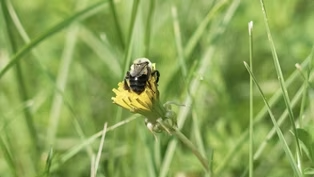
Clip: S17 Ep9 | 9m 22s | Researchers study bumblebee populations across Minnesota, working to better understand species. (9m 22s)
Video has Closed Captions
Preview: S17 Ep9 | 30s | The value of hen houses to duck populations and the University of Minnesota tracks entomology. (30s)
 New
NewVideo has Closed Captions
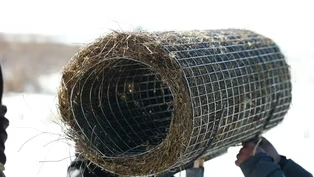
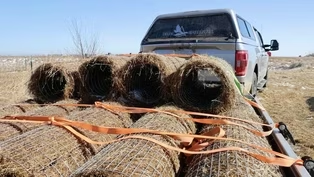
Clip: S17 Ep9 | 8m 32s | In Minnesota volunteers install hen houses designed to protect nesting ducks from predators. (8m 32s)
Providing Support for PBS.org
Learn Moreabout PBS online sponsorship
- Science and Nature

Explore scientific discoveries on television's most acclaimed science documentary series.

- Science and Nature

Capturing the splendor of the natural world, from the African plains to the Antarctic ice.











Support for PBS provided by:
Prairie Sportsman is a local public television program presented by Pioneer PBS
Production sponsorship is provided by funding from the Environment and Natural Resources Trust Fund and Shalom Hill Farm. Additional funding provided by Big Stone County, Yellow Medicine County, Lac qui...