
August 24, 2024 - PBS News Weekend full episode
8/24/2024 | 26m 44sVideo has Closed Captions
August 24, 2024 - PBS News Weekend full episode
Saturday on PBS News Weekend, why this summer’s extreme heat is contributing to a nationwide blood shortage. Then, as COVID cases surge, why vaccines will soon be harder to get for uninsured Americans. We look at the future of debt relief for Black farmers after decades of discrimination. Plus, how climate change is threatening centuries of culture and history on Tangier Island, Virginia.
Problems playing video? | Closed Captioning Feedback
Problems playing video? | Closed Captioning Feedback
Major corporate funding for the PBS News Hour is provided by BDO, BNSF, Consumer Cellular, American Cruise Lines, and Raymond James. Funding for the PBS NewsHour Weekend is provided by...
Support provided by:

August 24, 2024 - PBS News Weekend full episode
8/24/2024 | 26m 44sVideo has Closed Captions
Saturday on PBS News Weekend, why this summer’s extreme heat is contributing to a nationwide blood shortage. Then, as COVID cases surge, why vaccines will soon be harder to get for uninsured Americans. We look at the future of debt relief for Black farmers after decades of discrimination. Plus, how climate change is threatening centuries of culture and history on Tangier Island, Virginia.
Problems playing video? | Closed Captioning Feedback
How to Watch PBS News Hour
PBS News Hour is available to stream on pbs.org and the free PBS App, available on iPhone, Apple TV, Android TV, Android smartphones, Amazon Fire TV, Amazon Fire Tablet, Roku, Samsung Smart TV, and Vizio.
Providing Support for PBS.org
Learn Moreabout PBS online sponsorshipJOHN YANG: Tonight on PBS News Weekend, why this summer's extreme heat is contributing to the nationwide blood shortage, then amid the summer surge of COVID cases, why vaccines will soon be harder to get for uninsured Americans and the future of debt relief for black farmers after decades of discrimination.
MAN: The very federal arm that was supposed to be lending a hand up for black farmers was denying us the opportunity to farm in this country the way that white farmers did.
(BREAK) JOHN YANG: Good evening.
I'm John Yang.
When two astronauts were launched into space in June, they were supposed to be home in time for the Fourth of July.
But today, NASA said they'll be in space for the holidays and into the new year.
NASA officials decided that questions about the propulsion system make it too risky for the astronauts to return to Earth in the Boeing built spacecraft that took them to the International Space Station.
Now the plan is for Suni Williams and Butch Wilmore to return on a SpaceX vehicle in February.
Officials say the veteran astronauts are prepared for the lengthy delay, but it will be a hardship for their families.
NORMAN KNIGHT, NASA Flight Operations Director: When they launch they know that there are circumstances where they can be on board for up to a year.
I know this is a huge impact to their families, and it means a lot.
Their families are the pillars that keep them strong.
They're the pillars that we at NASA depend on for the workforce to keep us going.
JOHN YANG: Despite the series of problems with the Boeing Starliner capsule, NASA Administrator Bill Nelson says it will carry astronauts again in future missions.
Ukrainian Independence Day brought freedom for 115 Ukrainian servicemen who had been Russian prisoners of war.
They were exchanged for an equal number of Russian soldiers who had been held by Ukraine.
The swap was brokered by the United Arab Emirates.
The repatriated Ukrainians sang the National Anthem and telephone loved ones.
In a video address said to be shot near the Russian border, President Volodymyr Zelenskyy vowed to make Moscow pay a price for the war that began two and a half years ago.
VOLODYMYR ZELENSKYY, Ukrainian President (through translator): Ukrainians always pay back their debt.
Whoever wished misery upon our land shall find it in their own home with interest.
Whoever seeks to sow evil on our lands will reap its roots on their own territory.
JOHN YANG: Earlier today, Russian shelling killed five in Kostyantynivka in the east and two in the southern city of Kherson.
Three more were killed during Russian attacks in the northeastern Sumi region and the Biden administration gave Ukraine a boost in the form of a $125 million military aid package.
In southern Gaza, a barrage of Israeli airstrikes killed dozens of people, including 11 members of one family.
With the war now in its 10th month, health workers say conditions are deteriorating due to disease and lack of water, food and medical care.
Since the war began, Israeli evacuation orders have displaced around 90 percent of Gaza residents.
In the last month alone, according to the Associated Press, there have been at least 13 evacuation mandates.
German police have made a second arrest in connection with the stabbing rampage at a festival in Solingen, which is north of Cologne.
Police said it came after a raid on a home for refugees.
The group, the Islamic State, has claimed responsibility for the attack.
Police say that on Friday night, a man carrying a knife killed three people and injured at least eight others, four of them seriously.
Earlier, police detained a 15-year old who they say knew in advance about the attack but didn't report it.
And the countdown is on for the Paralympic Games in Paris.
Torches were lit in Stoke Mandeville, the English village widely considered to be the site of the first Paralympic Games in 1948 for men injured in World War II.
The flame will travel beneath the English Channel to France and wind its way through 50 cities before arriving in Paris for Wednesday's opening ceremony.
Still to come on PBS News Weekend, what the end of a COVID vaccine program means for the uninsured and the future of debt relief for black farmers.
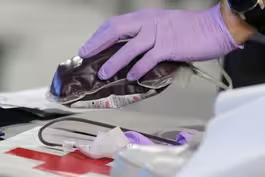
(BREAK) JOHN YANG: The American Red Cross says there's an emergency shortage of blood for transfusions.
In July, the national supply dropped by more than 25 percent the Red Cross says the only solution is more blood donors.
Jessa Merrill is director of Biomedical Communications at the Red Cross.
Jessa, how did we get here?
What led to this?
JESSA MERRILL, Director of Biomedical Communications, American Red Cross: Sure, thanks so much for having me here.
There are a number of factors that have led us here.
For one the last few months have been extremely hot, so that heat alone, while hasn't just impacted, you know, our ability to enjoy the outdoors, it's actually impacted about 100 blood drives in July alone for the Red Cross.
And what I mean by impacted, it means that those blood drives either started late or ended early because the facility in which we were hosting, so that could be your local community organization, church, you name it, that those rooms were too hot.
A blood drive needs to be cool for people to have a good experience.
Think of like the grocery store, right?
When you walk in, it's sort of a naturally cool environment.
But in addition to that, we've seen really severe weather already in the month of August, right?
We've seen remnants from a hurricane Debbie fled most of the East Coast.
We've seen tornadoes throughout the Midwest, and then we've seen wildfires out west, and those disasters and those severe weather impacts have canceled 60 blood drives just this month alone, and that has caused about 1,500 blood donations to go uncollected.
So in addition to having blood drives, either, you know, start late or end early, we also see that fewer people are out and about, right.
They're heeding precautions that public officials have said.
They've said, Sstay indoors, don't travel if you don't need to, move slow, pick your activities wisely.
And so we just sort of see lower blood donor turnout when it's hot.
JOHN YANG: And there is a shelf life for blood, is that right?
JESSA MERRILL: Absolutely.
So blood donations can't be stockpiled.
They can't be manufactured.
They can only come from generous blood donors, and they have to be constantly replenished.
If you think about whole blood donation, that's the red bag, generally speaking, those donations have a shelf life of about 42 days.
And then we have other products, which we call platelets.
They're generally yellow and mostly transfused to cancer patients.
They have a shelf life of just five days.
And so they're in critical supply, almost always because of that short supply.
So we need donors all the time, not just when there's a shortage, but especially now, because we simply don't have enough blood on shelves to keep up with hospital demand.
JOHN YANG: Even putting the weather we've seen this summer aside, I read somewhere that the blood donors are at the lowest level in 20 years.
Why do you think that is?
JESSA MERRILL: We've been looking through a lot of our data to sort of understand that trend in 2020 we all went remote.
We all became hybrid.
We all became much more comfortable connecting with the world virtually through our computers.
And so some of that makes our ability as the Red Cross to meet you where you are, to host convenient blood drives challenging, right?
We see fewer people going into the office, which was has been a bread and butter of hours to be able to reach you conveniently.
We see schools with stricter protocols about who can be on campus and trying to keep them safe from COVID and other things.
And so we're just seeing fewer people come out and give than ever, and that really strains the blood supply.
So even when we have small disruptions, right?
Hurricane Debbie last for a few days, but that small disruption can have really big impacts, because we just don't have other people giving the blood.
JOHN YANG: For people who are thinking about giving blood.
What are the requirements or restrictions on giving blood?
And I think particular of the changes that have been recently made in dealing with men who have sex with men.
JESSA MERRILL: Sure, the basic requirements are not that, not that robust.
Basic requirements is that you have to be at least 17 in most states.
And weigh 110 pounds and feel healthy and well at the time of donation, right?
Those are sort of the bare bones requirements.
The other thing I want to encourage people is that a lot of the restrictions around blood donations have changed in recent years.
We have a more inclusive blood donation eligibility process.
It's based on individual risk factors, and not sexual orientation now, individuals who may have thought they're not able to give because they lived overseas in European countries due to med cow might think that they're not eligible give, and all those restrictions have changed in recent years.
So we really encourage folks to go to redcrossblood.org/eligibility and have all the eligibility requirements there, and really take a look -- a quick look to see if you're if you might be eligible now.
JOHN YANG: Jessa Merrill of the American Red Cross.
Thank you very much.
JESSA MERRILL: Thank you so much.
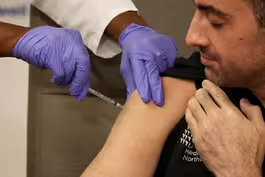
JOHN YANG: This week, the Food and Drug Administration approved this year's updated COVID vaccines, as new highly contagious mutations are making the summer surge significantly bigger than expected.
Many experts say COVID will be around for a while, but it could be as manageable as the flu, especially with widespread vaccination.
But this month, funding runs out for a federal program providing free vaccines to people who either don't have insurance or whose insurance doesn't fully cover vaccines.
Laura Santhanam is PBS Digital health reporter.
Laura, where did this program come from?
I know it's delivered about a million and a half vaccines so far, where did it start?
LAURA SANTHANAM: So the bridge access program was really a response to our nation's fractured and costly health care system.
If you want to get vaccinated for COVID, you go to the place that your health insurance plan covers, you roll up your sleeve, get the vaccine, and then your health insurance and doctor or pharmacist, you know, figure out who pays what later.
But that becomes really problematic for people who don't have health care coverage, or adequate health care coverage, you know, they could be expected to pay $100 per vaccine dose.
And for people who are counting pennies, that is just -- that's they're gambling, they're forced to gamble with their health and still be able to, you know, cover bills.
So what the CDC then decided to do last fall was launch this program, and so it provided free COVID vaccines to uninsured or underinsured adults, and it was largely modeled after the wildly successful vaccines for children's program, which this week actually celebrated its 30th anniversary.
It's prevented hundreds of millions of deaths, tens of millions of hospitalizations, and has been real cost savings for the country, especially for kids.
So this was like the grown up version of that program.
JOHN YANG: Is it as successful as the kids program?
LAURA SANTHANAM: It was supposed to last until this December, but last March, it fell victim to congressional haggling over the nation's budget.
You know, the Department of Health and Human Services ended up taking a $4.3 billion hit.
What that translated to was this program getting cut earlier than expected.
When I spoke with people at the CDC after the program was launched, they were hoping that this would be a prototype for offering more vaccines to adults and just further expanding health equity.
JOHN YANG: And what are state and local health officials doing in response?
LAURA SANTHANAM: They're now forced to scramble when negotiations fell through in Congress that was really setting, you know, state and local health officials on a race against time, and there haven't been a lot of really good answers that have come up in the meantime, some local state health departments have been forced to ask for donations from pharmaceutical companies.
Community Health Centers are still able to offer doses on a sliding fee scale, but again, when you're even a small amount of price tag attached to these vaccine doses can be enough to dissuade someone who's really strapped for cash.
JOHN YANG: So what all the alternatives?
What are the options now for people who either are don't have insurance at all, or are underinsured?
LAURA SANTHANAM: So the program still exists and is in place until August 31 if you're wanting to get a dose, the issue that people are running into, and that has been raised a number of times, is the fact that we don't have the updated 2024, 2025 COVID vaccine dose online yet.
So there's a real chance that people who were relying on this program might miss out on that updated dose, depending on when it's -- when it is made available.
Aside from that, you know, if people are, you know, qualified for Medicare or Medicaid, but haven't been able to get those paper - - their paperwork sorted out.
Now is a good time to try and find a healthcare navigator, contact their local state public health department and try and get a dose that way.
There aren't a lot of good answers, unfortunately, and it appears to be one more case of lessons pandemic era lessons going unlearned, and people who are most vulnerable are paying the price.
JOHN YANG: Laura Santhanam, thank you very much.
LAURA SANTHANAM: Thanks, John.
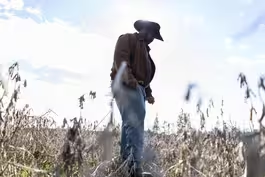
JOHN YANG: In 1920 according to federal data, there were about 925,000 black farmers in America, or about 14 percent of all farmers.
A century later, there were only about 42,000 or about 1 percent, much of that is a legacy of systemic discrimination in Agriculture Department programs.
Ali Rogin reports on how the Biden administration is trying to help farmers who have been historically excluded from government assistance programs.
ALI ROGIN: Today, black farmers own less than 1 percent of U.S. farmland, according to the Agriculture Department's latest farmer census, but efforts are underway to help these farmers reclaim their lost land.
Last month, the USDA issued over $2.2 billion in payments to black and other minority farmers across the country.
It's a move the department hopes will offset decades of discrimination these farmers face when trying to secure loans.
John Boyd is the founder and president of the National Black Farmers Association.
Mr. Boyd, thank you so much for joining us.
You yourself are a fourth generation farmer.
I'd like to ask you about the discrimination that you personally have faced over the course of your career.
JOHN BOYD, National Black Farmers Association: The discrimination that I faced was more in your face, blatant type of discrimination.
There are many black farmers in the area experienced.
You know, I was called the N word.
I was spat on that had my application torn up and thrown in trash can in front of me.
And this person that was responsible for making farm loans in my local county office would only see black farmers on Wednesday, so we named it Black Wednesday.
When white farmers came in, he would bring them in service them.
And one particular year he his farmer, Earl, he passed him a check for $157,000 in front of me, after he told me a qualified borrower that he wasn't going to lend me $5,000 of his money.
This farmer walked out the door and he said, hey, Earl, I need you to come back in and fill out them papers, because I used last year's numbers to make this known.
So here, this farmer hadn't even applied, and he didn't even process my loan application there in front of me, that type of discrimination put thousands of black farmers out of business.
We've lost millions of acres of land because of blatant discrimination that we face for decades.
This went on for decades, unchecked by Congress President, not the president.
I visited with every president since Jimmy Carter to talk about discrimination that black farmers faced in this country, so a very, very long time.
ALI ROGIN: And as you mentioned these are systemic issues that happened all over the country for farmers like yourself and of course, many farmers yourself included, feel that these payments have been well overdue.
Tell me about the journey that it's taken to get to this point.
JOHN BOYD: Well, first of all, I'm proud to have led the fight that led to this $2.2 billion pay up.
These payments are timely for thousands of black farmers who are facing farm foreclosure.
These payments are timely for farmers who can't pay their bills and send their kids to college.
And this wasn't a black payout, the way that people are describing it.
These were payments made to black farmers and others because of the discrimination that we face at the hands of the United States Department of Agriculture, the very federal arm that was supposed to be lending a hand up for black farmers, was denying us the opportunity to farm in this country the way that white farmers did.
ALI ROGIN: And I know you fought to get an additional $5 billion in debt relief, but that was held up in court by white farmers who argued that they were being discriminated against.
Can you tell me about that?
JOHN BOYD: When I first started this campaign, 41 years ago, my farmers in federal inventory, right along with many other black farmers, 120 percent, 100 percent for debt, right off, 20 percent to pay the taxes.
We are still in court, in federal court, represented by attorney Ben Crum that's looking to seek those 5 billion in actual debt relief.
We didn't get it.
It was blocked because white farmers were suing us in federal court around the country.
They were successful in two courts, Florida and Texas putting a temporary injunction in place blocking the $5 billion.
I'm currently reaching out to the Biden administration, and I'm asking them to make that happen by executive order the $5 billion the same way that they've done for student loan debt forgiveness by executive order.
So they felt the pressure of large scale white farmers and basically said, hey, you know, we don't want to move forward, but we're going to do some other initiatives to replace that.
But I'm steadfast, and I'm holding my feet firm, because land is the only way to pass down generational wealth.
So the next generation of black farmers, my daddy and grandfather said land is the only way to freedom.
Every good and great thing comes from land, food to put on the table, timber to build the house, clean drinking water.
And when you lose the land, people, you lose a part of your identity, you lose a part of your history.
And we've lost in this country, at the turn the century, we were tilling 20 million acres of land.
We're down to 3 million acres of land.
So we've blown our land.
And I'm not going to give up the fight by the grace of God.
I think he's going to bring relief for black farmers in the form of land ownership in this country.
ALI ROGIN: Finally, the Republican vice presidential candidate J.D.
Vance commented on these payouts.
And I'd like to play the sound for you.
J.D.
VANCE, Republican Vice Presidential Nominee: The Harris administration, for example, handed out farm benefits to people based on skin color.
I think that's disgraceful.
I don't think we should say you get farm benefits if you're a black farmer, you don't get farm benefits if you're a white farmer.
ALI ROGIN: What's your response to him?
JOHN BOYD: That he can say that to our nation's black farmers, the oldest occupation in history for black people in this country, we were slaves.
We came through on Jim Crow.
We came through on sharecropping.
And to have someone who wants to be Vice President of the United States make those types of comments, that's not the way of the future.
That's not the way to bring this country together, but to have him say it was based on skin color when it was totally based on discrimination, and he knows that as a member of the Senate.
So his comments to me are deplorable, and he needs to apologize to black people in this country and directly to Black Farmers.
ALI ROGIN: John Boyd, founder and president of the National Black Farmers Association, thank you so much for joining us.
JOHN BOYD: Thank you so much for having me.
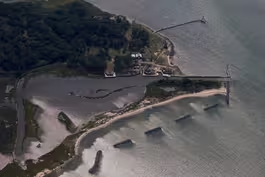
JOHN YANG: Anyone looking for the effects of climate change need look no farther than Tangier Island, Virginia, a tiny speck of land in the Chesapeake Bay, erosion and rising waters due to climate change are diminishing its land mass threatening a centuries old culture fostered by the island's isolation.
Tangier's 23-year old vice mayor is working with the island's 400 or so residents to try to restore their land and preserve their history and traditions, from the NewsHour Student Reporting Labs journalism training program, Sabrina Tomei reports.
CAMERON EVANS, Tangier, Virginia Vice Mayor: Living here isn't easy.
If you find the things that are worth living here for, then you'll begin to understand it as much as I have is one of the reasons why I've stayed.
That's one of the forms of crabbing.
This is crab scraping.
SABRINA TOMEI (voice-over): Cameron Evans is the 23-year old vice mayor of Tangier Island, a small community in the Chesapeake Bay, whose ancestors are direct descendants of some of the earliest English settlers in Virginia.
They continue to honor their traditions of crabbing and seafaring.
CAMERON EVANS: You get a sense of freedom by living here, be on the water, be in nature, just live in a very close, tight, knit community.
It's something that I didn't begin to treasure more until I was older.
We've also seen a lot of land laws due to coastal erosion.
DR. KANTA KUMARI RIGAUD, Lead Environment Specialist, World Bank Group: Their livelihoods are tied to the sea and to the coastal asset, whether it's tourism, whether it's fisheries or whether it's businesses, coastal areas are one of the most exposed.
With the sea level rising and with the storm surges affecting their assets, they lose their property, they lose their infrastructure.
It's eroded.
People tend to move away.
SABRINA TOMEI (voice-over): Since 1850 the land mass has decreased by 67 percent and according to the 2020 census, the population has fallen by nearly half since 2010.
KANTA KUMARI RIGAUD: So they're already climate migrants, but the numbers will increase over time if we do nothing about it.
CAMERON EVANS: In today's world, there's less and less watermen and less and less people want to stick in their own hometowns, especially this one, that it's very hard to, you know, obtain a job for a career, unless you make certain jobs, like I've tried to do here.
SABRINA TOMEI (voice-over): He's the vice mayor, a boat captain, fisherman, tour guide, crabber, and a photographer who's recording the history and capturing the changes on the island.
CAMERON EVANS: I saw that things were changing, you know, not staying the same.
And I said, Why not capture it from, you know, myself and then future generations.
KATNA KUMARI RIGAUD: We need to bring the communities and the planners and others together to make a collective decision.
CAMERON EVANS: I'm very hopeful that we'll get, you know, protection from coastal erosion.
But I want more than that.
I want to see land restoration, rebuild back to habitat.
I just hope for the future generations, if I could speak to them now, you know, to try to appreciate Tangier as much as I have.
SABRINA TOMEI (voice-over): From PBS NewsHour Student Reporting Labs, this is Sabrina Tomei.
JOHN YANG: Now on the NewsHour Instagram page.
Now that the FDA has approved updated COVID vaccines, find out when they'll be available and who can get them, all that and more is on the NewsHour Instagram page.
And that is PBS News Weekend for this Saturday.
I'm John Yang, for all of my colleagues, thanks for joining us.
See you tomorrow.
The future of debt relief for Black farmers in America
Video has Closed Captions
Clip: 8/24/2024 | 6m 58s | The future of debt relief for Black farmers after decades of discrimination (6m 58s)
How extreme heat is contributing to a U.S. blood shortage
Video has Closed Captions
Clip: 8/24/2024 | 5m 11s | How extreme heat is contributing to a nationwide blood shortage (5m 11s)
Residents try to save Tangier Island amid rising sea levels
Video has Closed Captions
Clip: 8/24/2024 | 3m 11s | Tangier Island residents work to preserve culture threatened by rising sea levels (3m 11s)
What a COVID vaccine program’s end means for the uninsured
Video has Closed Captions
Clip: 8/24/2024 | 4m 13s | What the end of a COVID vaccine access program means for uninsured Americans (4m 13s)
Providing Support for PBS.org
Learn Moreabout PBS online sponsorship
- News and Public Affairs

FRONTLINE is investigative journalism that questions, explains and changes our world.

- News and Public Affairs

Amanpour and Company features conversations with leaders and decision makers.












Support for PBS provided by:
Major corporate funding for the PBS News Hour is provided by BDO, BNSF, Consumer Cellular, American Cruise Lines, and Raymond James. Funding for the PBS NewsHour Weekend is provided by...