
August 26, 2023 - PBS News Weekend full episode
8/26/2023 | 26m 45sVideo has Closed Captions
August 26, 2023 - PBS News Weekend full episode
Saturday on PBS News Weekend, we look at the increasingly controversial practice of unpaid internships and what they mean for young people starting their careers. Then, Mali’s former minister of foreign affairs discusses the rise of coups in West African nations. Plus, an innovative Colorado art exhibit sparks collaborations between artists and farmers.
Problems playing video? | Closed Captioning Feedback
Problems playing video? | Closed Captioning Feedback
Major corporate funding for the PBS News Hour is provided by BDO, BNSF, Consumer Cellular, American Cruise Lines, and Raymond James. Funding for the PBS NewsHour Weekend is provided by...
Support provided by:

August 26, 2023 - PBS News Weekend full episode
8/26/2023 | 26m 45sVideo has Closed Captions
Saturday on PBS News Weekend, we look at the increasingly controversial practice of unpaid internships and what they mean for young people starting their careers. Then, Mali’s former minister of foreign affairs discusses the rise of coups in West African nations. Plus, an innovative Colorado art exhibit sparks collaborations between artists and farmers.
Problems playing video? | Closed Captioning Feedback
How to Watch PBS News Hour
PBS News Hour is available to stream on pbs.org and the free PBS App, available on iPhone, Apple TV, Android TV, Android smartphones, Amazon Fire TV, Amazon Fire Tablet, Roku, Samsung Smart TV, and Vizio.
Providing Support for PBS.org
Learn Moreabout PBS online sponsorshipJOHN YANG: Tonight on PBS News Weekend, the increasingly controversial practice of paid internships and what they mean for young people starting their careers.
Then, Mali's former foreign minister discusses the rise of coups in West African nations and an innovative Colorado art exhibit sparking collaborations between artists and farmers.
MAN: This was just a great opportunity to sort of almost use different language to think about farming, to sort of explore it from this artistic perspective as well.
It's so exciting.
(BREAK) JOHN YANG: Good evening.
I'm John Yang.
One day after Luis Rubiales, head of Spain's soccer federation, defiantly said he wasn't quitting, FIFA, the sports international governing body, suspended him for 90 days while it investigates his conduct at the Women's World Cup Final.
During the medal ceremony, Rubiales grabbed a player's head and kissed her on the lips.
The player, Jennifer Hermoso, says she never consented.
Nearly 80 members of the squad said they won't play as long as Rubiales has his job.
Four astronauts from four countries are on their way to the International Space Station for a six month stay.
The crew that launched before dawn today is from the United States, Denmark, Japan and Russia.
It's the first time that each crew member is from a different country.
They're set to arrive at the space station tomorrow morning.
Thousands gathered at the Lincoln Memorial today to commemorate the 60th anniversary of the March on Washington.
And Martin Luther King, Jr's.
I have a Dream speech.
Speakers, including Dr. King's granddaughter, said his dream of equality and justice remains unfulfilled.
President Biden and Vice President Harris are to welcome King's family to the White House on Monday, which is the actual anniversary of the march.
And Bob Barker has died.
For 35 years, he was host of The Price Is Right.
Barker presided over contestants who guessed retail prices on everything from kitchen appliances to cars.
The Price Is Right is the longest running TV game show ever.
Barker retired from the show in 2007.
BOB BARKER, Host, The Price Is Right: They have invited me into their homes for more than 50 years.
He said goodbye, and it was tough.
JOHN YANG: Bob Barker was 99 years old.
Still to come on PBS News Weekend, a look at the spread of political turmoil in West Africa.
And art and agriculture intersect in Colorado's Rocky Mountains.
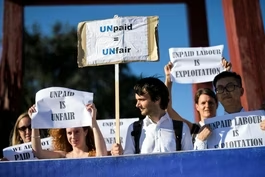
(BREAK) JOHN YANG: Internships can give students a leg up starting their careers.
According to the National Association of Colleges and Employers, more than half of internships lead to full time jobs, and people with internship experience received more job offers and higher starting salaries than those without it.
But nearly half of last year's interns in the United States were unpaid.
Earlier, I spoke with Washington Post reporter Kelsey Ables, who's written about this issue.
I asked her how big a factor pay is for young people choosing an internship.
KELSEY ABLES, Washington Post: I guess there are a range of different experiences.
Some people just kind of decide to with the sacrifice of taking one of these unpaid internships, and that can mean working extra hours.
I spoke to one person who said he walked home from his internship because paying for transportation was too expensive.
And then there are other people who have to do these internships for academic credit.
Some people are lucky enough to be funded by their parents, but some people end up having to work extra jobs and all of that.
But for some people it's really pivotal.
I mean, one person that I spoke to, she said that, you know, she was looking at three different internships.
One was unpaid, but it was at a nonprofit that she was really excited about.
The other was paid, but not paid very well.
It was at a think tank.
And then this third option was at an investment bank and it was incredibly well paid, more than twice as much as the think tank.
She did not have financial support from her parents.
She was a first generation college student and the only option she had was to take the investment bank.
And she said that now sometimes she even feels bad talking about it because it doesn't feel like it represents who she is or what she wants to do going forward.
But that was kind of what was necessary, she said, to get by.
JOHN YANG: Are there certain types of students who are more likely than not to base a decision on whether or not they're going to get paid for the summer?
KELSEY ABLES: When you look for people who do unpaid internships, often you find people who do have their parent's financial support.
And some of those people I spoke to, they said that they were grateful for that.
But they recognize that this isn't possible for everyone.
JOHN YANG: Does that skew or put disparities into the system of who gets this boost, this leg up of having an internship?
KELSEY ABLES: It does, but it also kind of creates two tiers of internships.
Some data has shown that the people who are most offered unpaid internships tend to be people of color and women.
So this kind of creates this kind of fracture where you have some people who are being paid and some people who aren't.
And unpaid internships also are less often to lead to jobs.
They have been shown not to establish interns in the kind of industry in the same way that paid internships do.
So it creates this kind of division starting at the very beginning of when you are starting not even your first job, but you're kind of like first step into the working world.
JOHN YANG: Are there fields or industries that are more likely than others to offer only unpaid internships?
KELSEY ABLES: So when you look at unpaid internships, it helps at first to divide into two different categories.
So there are academic unpaid internships and open market unpaid internships.
So academic internships are internships that are required for the completion of an academic degree.
These happen in areas like social work where you're expected to do field work, in areas like psychology where you're expected to kind of treat patients as you go through and get maybe a master's in clinical psychology.
But then open market internships are internships that are sort of they're more unregulated.
They're not really attached to any degree program.
They're kind of just maybe a volunteer opportunity that's been kind of morphed into an internship.
For example, the European parliament recently voted in favor of a report that calls for banning unpaid internships, but specifically open market unpaid internships.
It does not take issue with the academic version of them.
Then kind of the other areas that you run into them tend to be lesser funded areas.
So a lot of museums, kind of arts areas, theaters, that kind of discipline you can find unpaid internships in.
Media is known for having unpaid internships, unfortunately.
And then there's kind of another category, which is areas where they probably could be paid, but it's not really clear why.
Some experts say that those places are ignoring the ethics of needing to pay people for work, and those tend to be in government areas.
So a lot of government internships are also unpaid.
Actually, it's kind of interesting.
The white house just started paying interns last year.
JOHN YANG: You mentioned the media.
I should note that the PBS NewsHour does pay the interns who come work for us.
So you talk about the ethics of this.
The benefits for the employer are evident.
They get free labor.
But does U.S. labor law say anything about this?
KELSEY ABLES: So, you know, there actually is some justification in the law that allows for this.
It kind of depends on who is considered the primary beneficiary of an internship, but that also is a little bit of a gray area, how you kind of define that.
So basically the idea is, if you can make a case that the intern is the primary beneficiary, it kind of can function as an extension of the classroom.
And in that case, it's okay.
But I did talk to a legal expert about this, and he was kind of like, I tend to advise people to pay because I have often run into people who think, oh, it's an intern.
It's someone from college.
I can get away without paying them.
But it's really not that simple.
You need to kind of have a structure where it functions more like a classroom, and the benefit is to the intern.
JOHN YANG: You mentioned the European parliament voting to ban unpaid open market internships.
Are there any similar efforts in the United States or any similar efforts elsewhere in the world?
KELSEY ABLES: There have been some small efforts in the United States, but I do not think any of them have been successful.
I will say that there is.
In France, they have actually successfully banned open market internships.
And if you have an intern for more than two months, they have to be paid.
Experts say that is kind of the most holistic, systematic approach that they've seen.
JOHN YANG: Why do you think there's no effort like that in the United States?
KELSEY ABLES: I think that what the experts often say is that when the economy is not doing great, the burden falls on the young people, and they're kind of expected to make do.
I think that the reality is that there will always be people who are willing to take these internships, whether it's because they have parents who can help them pay their bills or because they'll end up working 18 hours a day just to get by.
Because it makes sense career wise, I think that when people will take them, they'll continue to exist.
JOHN YANG: Kelsey Ables of the Washington Post.
Thank you very much.
KELSEY ABLES: Thank you for having me.
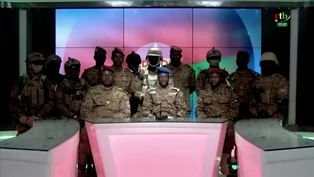
JOHN YANG: In just three years, six West African nations have seen the military seize control of the government.
While there are unifying factors running through these coups, Ali Rogin tells us that looking at each case individually helps explain what's going on.
ALI ROGIN: The countries are laid out like a belt hugging a northern stretch of the African continent.
From the Atlantic Ocean to the Red Sea, Africa has seen a domino effect of political uprisings across these six nations.
Four of them are former colonies of France.
They gained independence in the late 1950s and early 60s, but anti-French sentiment still runs high there today.
Russia, meanwhile, has capitalized on that attitude, spreading anti-Western propaganda throughout the region.
The mercenary Wagner Group, run by former Putin ally Yevgeny Prigozhin until his presumed death this week, has fighters on the ground in Mali and Sudan.
But focusing on foreign influences ignores each country's internal politics and security, as well as the effects they have on each other.
To discuss those elements, I'm joined by Kamissa Camara.
She is a senior Africa advisor at the nonpartisan U. S. Institute of Peace and previously served as Mali's Minister of Foreign Affairs and as Presidential Chief of Staff.
Kamissa, thank you so much for joining us.
First of all, you heard the commonalities I just laid out.
Why are they imperfect lenses through which to discuss this spate of coups?
And are though any of these commonalities at all instructive in any way?
KAMISSA CAMARA, Senior Adviser For Africa, United States Institute of Peace: Well, the first commonality that observers usually mention is that all of these countries are former French colonies.
We've had successful coups in Sudan recently, but also coup attempts in Guinea-Bissau, which is a country that was colonized by the Portuguese.
We've had a coup attempt recently in Sao Tome and Principe same story.
And so all of the three countries that I just mentioned have not necessarily been colonized by the French.
But I believe that the reason why France is mentioned so often in the recent military coups in West Africa is because France, as a Western power, has been definitely extremely present in domestic politics, but also in security assistance.
And so France has become the easy culprit.
One overarching issue is definitely the security threat, the terrorist threat that we've seen in the region for the past 10 years and more.
And because of this security situation, these countries have had to require international security assistance.
And this has definitely played a role in how domestic politics have played out, but also how presidents have also used security as a way to strengthen their stature internationally.
ALI ROGIN: What background do these coup leaders have?
Again, underscoring they are all different.
These are all different countries.
But some of the coup leaders you've mentioned actually know each other.
KAMISSA CAMARA: If we look at the places where they have been trained, there are definitely connections that have been made.
Some of them knew one another.
There's definitely a trio there, especially the Burkina Faso, Mali and Guinea.
And what I also want to highlight is that military coup leaders are very often portrayed as passive actors in the post-coup situation, which is definitely not the case.
And as we've seen in the case of Niger, the Nigerien junta has made connections very quickly with the juntas in Burkina, in Mali and in guinea to seek their support in the case of a military intervention by the ECOWAS.
ALI ROGIN: As these coups have taken place, it seems like there have been increases in the amount of Islamist extremist attacks that occur that follow.
Is there a connection there?
KAMISSA CAMARA: I have read many research that suggests that what happens on the front is that military officials and military leaders, the ones who are fighting, are actually demoralized by the fact of their leaders have become politicians, basically.
And so they either refuse to fight or there is some sort of vacuum that takes place in the remote areas of the countries that definitely make these terrorist attacks increase intensity, but also in frequency.
ALI ROGIN: The presence of the Wagner group, as I mentioned, present in several countries we have seen people waving Russian flags in the wake of these coups.
What is your response to that?
Is the influence of Russia overstated in these cases?
KAMISSA CAMARA: It's always overstated.
These Russian flags that you see right after a coup has taken place have been planted there.
I have absolutely no doubt about that.
I do not believe that Russia is an important player in this region.
I believe that there is definitely a Russian propaganda at play.
But culturally and even looking at these youth in West Africa, they speak French, most of them.
They study in French, and they either want to immigrate to France or the United States.
I do not see any of them queuing in front of the Russian embassy.
ALI ROGIN: Based on this recent spate of coups, what are your thoughts and hopes for the future of this region, especially when it comes to the overwhelmingly young populations?
KAMISSA CAMARA: Well, two things.
The first what I'm seeing is that the democracy as we understand it in the west has not been that successful in some African countries, including the ones that have recently experienced the coup.
And so, first of all, what I'm hoping is that the youth in these countries define their own path and design the institutions that they want to see.
And my second hope is that we, as international partners, put our emphasis on the private sector, which will be able to create the jobs that will be needed in the next few years when these millions of youth will come onto the drug market seeking a better future.
ALI ROGIN: Kamissa Camara with the U.S. Institute of Peace.
Thank you so much for your time.
JOHN YANG: We recently went to Colorado's Rocky Mountains for a look at an innovative art exhibit.
It uses multimedia collaborations between artists and farmers to explore the similarities between the two fields.
Our report is part of our Arts and Culture series, CANVAS.
A vegetable from a small organic farm in the Rockies becomes an Asian dish cooked on a food cart in a museum gallery.
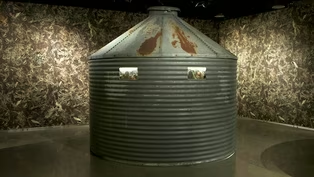
Hundreds of dried corn stalks fill a wall at another Boulder County museum.
And a series of embroidery panels with images of wildflowers hang in a 140 year old barn.
They're all part of a multivenue exhibition called agriCULTURE Art inspired by the land, more than 15 local and national artists and collectives teamed with Boulder County farmers to create the works now on display at two museums and three local farms.
Organizers say the goal was to explore our relationship with nature.
JAMIE KOPKE, Lead Curator, "Agriculture: It's not a typical art show.
It's not a typical gallery experience.
JOHN YANG: Jamie Kopke, coordinates it all as lead curator.
JAMIE KOPKE: It allowed us to explore a topic which I think is just so vital to all of us in these times, and that's how people are connecting or being disconnected from the natural world around us.
The disconnection from nature has created a whole host of problems in our lives.
MARK DERESPINIS, Esoterra Culinary Garden: Every season is a new opportunity to have another relationship with a plant.
YUMI JANAIRO ROTH, Aritst: So, yeah.
MARK DERESPINIS: Here we are.
YUMI JANAIRO ROTH: I know.
Here we are, like months later, from the little seedlings to this lush field.
JOHN YANG: Artist Yumi Janairo Roth and organic farmer Mark Derespinis teamed up to grow kangkong, a vegetable sometimes called water spinach.
While not well known in the United States, it's a staple in Asian countries like the Philippines, where Janeiro Roth's mother was born.
YUMI JANAIRO ROTH: The plants she grew up with and the plants that she had access to in the U.S. she had to do a lot of food substitutions.
So kangkong was one of these things that was really interesting to me because I would eat the foods, but I would eat it without this core vegetable that was in it.
In the United States, it's considered an invasive weed.
And I was interested in this idea of it as something invasive or illegal.
And when you attach that to a plant, and then what happens when it's actually the core of somebody else's diet?
MARK DERESPINIS: Having this opportunity to give people this meaningful connection with a plant.
Not a product, not something you buy in the store, but with a plant that you can watch grow from a seed and bring it to harvest and then bring it into your kitchen and then feed yourselves and your community with.
This was just a great opportunity to sort of almost use different language to think about farming as well.
JANE BURKE, Curator, Boulder Museum of Contemporary Art: Experimental it's been -- JOHN YANG: Jane Burke at the Boulder Museum of Contemporary Art is another of the project's three curators.
She says the collaborative nature of the project cultivated the artist's creativity.
JANE BURKE: This has challenged their work.
It has made them kind of think outside of their normal practice by incorporating, really, these philosophies of the farmers.
For me, personally, it's really inspired me to look at farmers in a different way and to really see them as these interdisciplinary practitioners in the same way that we kind of see artists.
JARED THOMPSON, Curator, Longmont Museum: This piece here is by artist Patrick Merrill.
He really wanted to cover scale and what it takes to feed the masses.
JOHN YANG: Jared Thompson, curator at the Longmont Museum, explains the meaning behind the array of dried corn stalks.
JARED THOMPSON: He was trying to show how much corn it takes to feed cattle to produce milk.
So this screen represents how much corn food energy a cow would eat to produce about three gallons of milk.
So that would supply an average American about two months.
This piece is actually put together with toothpicks.
When the show comes down, he's actually going to return it to the field, and it's all biodegradable, so he can go back into the field, put nutrients back into the soil.
JOHN YANG: From actual nutrients to whimsical inflated depictions of them.
JARED THOMPSON: This was by artist Nicole Banowetz.
She created a fictional futuristic machine that actually adds microbes and oxygen to the soil.
So the white part of this sculpture represents the machine.
The gold parts represent the microbes and the worms that are being added.
JOHN YANG: This would be the microbe that goes into the soil to help give nutrients and help things grow.
JARED THOMPSON: Yeah.
She's giving visual form to these tiny creatures that you cannot see with a naked eye.
JOHN YANG: Canadian artist Amanda McCavour's ethereal hanging panels use digitally scanned images of prairie, wildflowers and grasses.
JAMIE KOPKE: She'll print them into these larger than life pieces that we see, and then she presses them onto the fabric, almost like you would find a specimen pressed in an herbarium.
JOHN YANG: Hanging in the drafty old barn they wave in the summer breeze like flowers in a field.
JAMIE KOPKE: She really loved that about the place.
She loved that there were birds in here and that when you walk into this space, it's actually a very sensory experience.
JOHN YANG: It sort of feels like you're out in the field where these plants are growing.
JAMIE KOPKE: Exactly.
And she hung them in this space to create kind of this larger than life, monumental feel to the plants.
But also, the fabric itself is also representing the delicacy of the ecosystem in which all of these plants interact and live.
JOHN YANG: At the organic farm, Yumi Janeiro Roth and Mark Derespinis harvested and washed kangkong to go to the Boulder Museum of Contemporary Art to be the main ingredient in a traditional Philippine dish cooked by Yumi's mom, Shirley Janeiro.
SHIRLEY JANAIRO ROTH, Yumi's Mother: Roth what cooking means to me is the world.
I love to cook.
JOHN YANG: She indulged in some of that love.
Taking the food cart her daughter created for its maiden run.
SHIRLEY JANAIRO ROTH: Adobo is one of the Philippine main course that we always we do it every day, and we serve to our guests.
JOHN YANG: So, Yumi, tell me about this is your exhibit.
This is your piece of art.
YUMI JANAIRO ROTH: It's the totalizing thing is the piece of art.
So working with Mark, working with my mom, this is sort of just kind of an object that functions as a vehicle to bring all these different components together.
So this object is actually modeled after food carts that you see throughout Manila.
The imagery is actually all derived from the image of kangong.
JOHN YANG: She says the cart's decorations upend 19th century artist James McNeil Whistler's famous bit of cultural appropriation.
YUMI JANAIRO ROTH: The color scheme and the sort of the carving is all inspired by the Peacock Room at the Freer Art Gallery.
That was an Englishman and expat American's idea of what Asia sort of meant to non-Asians.
And this is sort of playing that language back, but sort of representing it for, I guess, Asian and Asian American audiences.
JOHN YANG: From farm to table, this collaboration between farmer and artist infused the art with meaning as well as flavor.
You knew it as a plant, but not necessarily its role.
MARK DERESPINIS: I'd never eaten it.
Yeah.
JOHN YANG: How do each of you feel learning each other's world?
YUMI JANAIRO ROTH: I mean, amazing.
I think that's been really amazing.
My mom has cooked side by side the store bought stuff and Mark's kangkong.
When she tried Mark's kangkong, she's like, this is better than the stuff I grew up with.
JOHN YANG: And, Mark, for you, that learning what it means, you know, Yumi's mother.
Does that deepen your feel for the plant or your relationship to the plant?
MARK DERESPINIS: Absolutely, 100%.
I mean, we're dimensionalizing our relationships and that narrative, that connection, that personalization, that's what drives me to continue and deepen the relationship further and further.
JOHN YANG: From seedling to plant to artist creation, fueled by collaboration and nature.
We have an update before we go.
A mass shooting in Jacksonville, Florida has left multiple people dead.
That's according to the city's mayor.
The mayor also said the victims were inside a Dollar General Store.
And that is PBS News Weekend for this Saturday.
I'm John Yang.
For all of my colleagues, thanks for joining us.
See you tomorrow.
Art and agriculture meet in collaborative Colorado exhibit
Video has Closed Captions
Clip: 8/26/2023 | 8m | Art and agriculture meet in collaborative Colorado exhibition (8m)
Why unpaid internships still exist despite controversy
Video has Closed Captions
Clip: 8/26/2023 | 6m 17s | Why unpaid internships still exist despite hardships for young workers (6m 17s)
Why West Africa is seeing a spate of military coups
Video has Closed Captions
Clip: 8/26/2023 | 6m 51s | Why West African nations are seeing a spate of military coups (6m 51s)
Providing Support for PBS.org
Learn Moreabout PBS online sponsorship
- News and Public Affairs

FRONTLINE is investigative journalism that questions, explains and changes our world.

- News and Public Affairs

Amanpour and Company features conversations with leaders and decision makers.












Support for PBS provided by:
Major corporate funding for the PBS News Hour is provided by BDO, BNSF, Consumer Cellular, American Cruise Lines, and Raymond James. Funding for the PBS NewsHour Weekend is provided by...