
Beach Access and a Threatened Track
Clip | 7m 13sVideo has Closed Captions
As the coastline erodes, what can be done to save the seaside rail link between LA and San Diego?
The coastal rail link between Los Angeles and San Diego is the second busiest passenger rail route in the country. But in San Clemente, where train service skirts the Pacific Ocean, rail service has frequently been stopped for months at a time because of thinning beaches and coastal erosion that threatens the tracks. Is there a way to protect the train along the Southern California coast?
Problems playing video? | Closed Captioning Feedback
Problems playing video? | Closed Captioning Feedback
Earth Focus is a local public television program presented by PBS SoCal
Beach Access and a Threatened Track
Clip | 7m 13sVideo has Closed Captions
The coastal rail link between Los Angeles and San Diego is the second busiest passenger rail route in the country. But in San Clemente, where train service skirts the Pacific Ocean, rail service has frequently been stopped for months at a time because of thinning beaches and coastal erosion that threatens the tracks. Is there a way to protect the train along the Southern California coast?
Problems playing video? | Closed Captioning Feedback
How to Watch Earth Focus
Earth Focus is available to stream on pbs.org and the free PBS App, available on iPhone, Apple TV, Android TV, Android smartphones, Amazon Fire TV, Amazon Fire Tablet, Roku, Samsung Smart TV, LG TV, and Vizio.
Providing Support for PBS.org
Learn Moreabout PBS online sponsorship[music] -I moved here about seven years ago, and I immediately noticed that the beaches were in trouble, that they were starting to narrow.
As the beaches get narrower and narrower, what happens is the railroad becomes worried about the security of their tracks, and they start throwing out more and more of these really large boulders that you see here, the riprap.
I started talking to the city and city officials about this problem and how they needed to put more sand down and address this problem, or else we're going to end up with beaches that are just filled with boulders.
-The rock is meant to protect the integrity of the rail line.
The armory provides a level of predictability to anchor and protect the rail line.
The sand, while it is a very good source for buffering between the .. and the rail line, there's a lack of predictability in terms of the ability for the sand to stay resident for a long period of time such that there isn't direct ocean wave intrusion against the rail line.
-What is ocean wave intrusion?
-That would be, in simple terms, the wave pounding against the rail line.
Mother Nature is a very strong force, and we have seen, over the last handful of years, there's been situations where there's literally no beach, and what's separating the rail line is really just the protection of the rocks that's there and the Pacific Ocean.
That's why it's needed to protect the rail line.
OCTA, as the County Transportation Agency, owns 42 miles of the rail line in Orange County, of which 7 miles of the rail line is actually through a very critical southern Orange County portion, and it goes through the cities of San Clemente as well as Dana Point and San Juan Capistrano.
For the Amtrak service, it's actually the second busiest in the nation from the standpoint of passenger throughput.
It is really the only alternative via the coast, the Interstate 5, so it is a critical rail line that carries both passenger as well as freight for our neighbors to the south.
This particular rail line has been in operation for over 130 years, and for the first 120-plus years, we have seen closures that happened, I would say, pretty sporadically, but something happened along the way starting around fall of 2021 where we have seen a series of rail closures that's led to passenger rail service disruptions.
It's a function of both coastal erosion on the beach side and inland bluff failures on the inland side.
It's a very challenging situation for the rail line to be nestled between the Pacific Ocean to the west and then the inland bluffs to the east.
It's definitely a straightjacket for the rail line.
There's absolutely not a lot of room to maneuver.
-The amount of rock they have here we believe is an appropriate amount to structurally support their tracks.
What they want to do is put rock all the way out to there and across the entire San Clemente State Beach.
The boulders do at least temporarily protect the structure of the railroad tracks, but what they do is actually increase the erosion and make the beaches erode even faster.
We used to get some erosion from the bluffs, and that would feed some of the beaches, but the railroad is elevated and that blocks that sand.
Every year we lose a little bit of sand offshore or down coast, and if it's not replaced by natural sources, the beach just gets narrower and narrower.
-Tonight, I want to focus on what will shape our coastline in the near term and why it represents greatest immediate threat to .. We have a critical choice in San Clemente.
We can protect the rail line and our world-class beaches together, or we can allow our beaches to disappear behind a failing approach paid for with our tax dollars.
This is where you can help.
Support leaders that are advocating sand replenishment over hard.. -My organization is advocating for a sand-only or a sand-first approach.
We think that sand is the best way to protect the tracks, and it's also the best way to protect this wonderful public resource we have because the rocks themselves won't keep the water out.
The only thing that's going to keep the water out is the sandy beach.
You can truck in sand, we've done that on smaller projects, but the trucking involves a lot of other undesirable environmental consequences.
There's air quality.
There's traffic.
It's just more expensive, and so for a larger project, you really need to go offshore, and you dredge up.
What you're actually dredging up is ancient beach dep.. During the last ice ages, the coastline was miles offshore, and that's where the beaches were.
As the glaciers melted, it covered up those beaches, and so we're going back out and seeking those ancient beach deposits, and you dredge it up and place it back on the beach.
-What we're finding with respect to sand is while sand is a great mechanism and instrument as a buffer for the rail line, it takes a very large volume of sand to actually provide that sufficient buffer.
You're talking about potentially half a million or greater cubic yard of sand, and in terms of that quantity, it would take many, many years to actually be able to bring that amount of sand in from a sand source, and the permitting process is very complex when it comes to sand.
With the prediction that we're seeing with sea level rise and climate change over the next 50 years, any development, namely the tracks in South Orange County with r.. will be vulnerable to both sea level rise and climate change over the next several decades, so that is something that we're mindful of, and we're looking to basically come up with solutions to protect it.. while we're looking at longer term solutions.
-There's been talk of moving the rails inland.
They started talking about it three years ago.
They got money for a study.
They spent the money on other things, and now they have said that Caltrans is going to study the relocation.
The issue is there's no land.
The only land where they could do it would be the tunnel under the I-5 freeway.
That's going to take at least five years to study whether it can be done and another 20 or 30 years to construct it.
That's a whole generation, and I'm not willing for a generation to miss out on our beaches, and that rock, once it's on our beach, isn't going to go away, so it's a forever loss for all of our generations.
-Thanks for watching.
If you liked this story, don't forget to like, comment, and subscribe for more, and stick around for the next video.
I think you're going to love it.
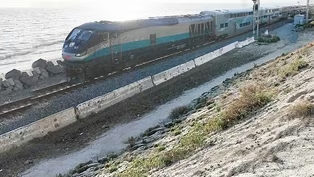 Now Playing
Beach Access and a Threatened Track
Video has Closed Captions
Clip | 7m 13s | As the coastline erodes, what can be done to save the seaside rail link between LA and San Diego? (7m 13s)
A Visit to Carlsbad's Fix-It Clinic
Video has Closed Captions
Clip | 6m 47s | The people who find joy and purpose in repairing the broken items in our lives. (6m 47s)
Sun, Sand and Climate Change: The Fight to Save California’s Coast
Video has Closed Captions
Clip | 6m 53s | What’s being done to save Southern California’s beaches from being washed away for good? (6m 53s)
How to Create a Sustainable, Zero Waste Meal Plan
Clip | 7m 11s | A climate change activist tells us how to create a more sustainable kitchen. (7m 11s)
The Community That Transforms Food Scraps Together, Stays Together
Video has Closed Captions
Clip | 5m 50s | L.A.’s garden activists create a composting movement. (5m 50s)
Meet the People Rescuing Food, Feeding Neighbors & Helping the Climate
Video has Closed Captions
Clip | 6m 32s | Saving perfectly good food from dumpsters (6m 32s)
Video has Closed Captions
Clip | 6m 27s | We explore why enough water couldn’t be pumped through fire hydrants to protect homes from burning. (6m 27s)
Goodbye Plants, Hello Fire Safety
Video has Closed Captions
Clip | 7m 53s | Controversial proposal to protect homes from wildfires by forcing homeowners to remove vegetation. (7m 53s)
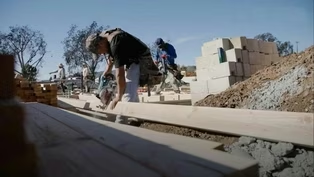
Can You Build a Fire-Proof Home?
Video has Closed Captions
Clip | 7m 46s | How to rebuild after L.A.’s devastating wildfires. (7m 46s)
Earth Focus Environmental Film Festival 2023 (Preview)
Preview | 30s | The fifth annual Earth Focus Environmental Film Festival features five days of screenings. (30s)
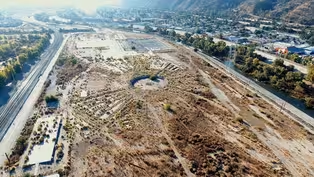
Clip | 8m 17s | Taylor Yard is now an undeveloped and still-contaminated site adjacent to the L.A. River. (8m 17s)
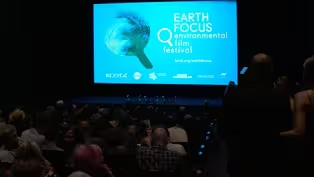
Earth Focus Environmental Film Festival
Preview | 1m 18s | Earth Focus Environmental Film Festival (1m 18s)
Cold Rush? The Changing Arctic
Clip | 14m 41s | "Earth Focus" looks at the changing face of the Arctic today. (14m 41s)
Fukushima: Can it Happen in the US?
Clip | 7m 21s | Fukushima was not a Japanese nuclear disaster. (7m 21s)
Cambodia: Fight for Areng Valley
Clip | 10m 47s | The Chong people are fighting to protect their forests. (10m 47s)
Inside Illicit Ivory and Rhino Horn Trade
Clip | 6m 41s | Inside Illicit Ivory and Rhino Horn Trade (6m 41s)
Unacceptable Risk: Firefighters on the Frontline
Clip | 12m 52s | Fires are becoming more frequent, larger and more devastating than ever. (12m 52s)
China: Religion and Environment
Clip | 13m 37s | Filmmakers Gary Marcuse and Shi Lihong capture a surprising trend in China. (13m 37s)
Hope for Rhinos? New Approaches to Save Endangered Species
Clip | 14m 31s | Rhino horn is more expensive than gold or platinum. (14m 31s)
Making Coastal Communities More Resilient to Extreme Weather
Clip | 5m 48s | Joshua Saks looks at how America's communities can be protected. (5m 48s)
Paying for Climate Change: A Reinsurance Industry View
Clip | 6m 32s | Climate change is anticipated to have a big impact on the insurance industries. (6m 32s)

Encroaching Tides: What's at Stake for the US
Clip | 6m 32s | The eastern coast of the United States has one of the highest rates of sea level rise. (6m 32s)
Sacred Economics: A Post Money World?
Clip | 11m 55s | Charles Eisenstein speaks to Earth Focus about his new book Sacred Economics. (11m 55s)

Neonics: Toxic Until Fully Tested
Clip | 8m 58s | Scott Hoffman Black speaks about the impact of neonicotinoid pesticides. (8m 58s)

Neonics: Driving Declines in Biodiversity
Clip | 8m 26s | Dr. David Goulson speaks about the impact of neonicotinoid pesticides. (8m 26s)
Clip | 5m 43s | Earl Blumenauer talks about why protecting pollinators in the US is the national interest. (5m 43s)
Clip | 11m 29s | Shrimp farmers tell us to reject contaminated shrimp from Bangladesh. (11m 29s)

Killing the Senate Filibuster Could Inspire Bipartisanship
Clip: Special | 27m 36s | Jon Christensen moderates a conversation with former Nevada Sen. Harry Reid. (27m 36s)
Sen. Cortez Masto: Pursuing a Green Economy
Video has Closed Captions
Clip: Special | 1m 9s | Cortez Masto has a goal to grow a clean energy economy that includes jobs for the future. (1m 9s)

Sen. Cortez Masto: Protecting the Outdoors is Nonpartisan
Video has Closed Captions
Clip: Special | 37s | Protecting the environment should not be considered a partisan issue, Cortez Masto says. (37s)

Sen. Cortez Masto: On Reid’s Environmental Legacy
Video has Closed Captions
Clip: Special | 54s | Sen. Harry Reid struck a balance when crafting inclusive environmental policy, she says. (54s)

Sen. Cortez Masto: On Growing Up in Rural Las Vegas
Video has Closed Captions
Clip: Special | 40s | Cortez Masto grew up in a rural Las Vegas with cowboys and ranches. (40s)
Sen. Cortez Masto: ‘A Microcosm of America’
Video has Closed Captions
Clip: Special | 1m 17s | Sen. Catherine Cortez Masto describes her state’s role in national politics. (1m 17s)
The New West and the Politics of the Environment (Preview)
Video has Closed Captions
Preview: Special | 1m | A quiet, little-known revolution is taking place in American environmental politics. (1m)
Moapa Solar Plant Addressed Injustice, Economy and Energy
Video has Closed Captions
Clip: Special | 5m 7s | Behind-the-scenes negotiations helped establish the Moapa transition from coal to solar. (5m 7s)
How SNPLMA Wove Urban Las Vegas Back Into the Environment
Video has Closed Captions
Clip: Special | 2m 17s | The legislation helped balance urban growth in Las Vegas with environmental conservation. (2m 17s)
Black Rock-High Rock: The Negotiation Behind Conservation
Video has Closed Captions
Clip: Special | 8m 2s | A proposal to protect Nevada’s Black Rock Desert-High Rock Canyon received much criticism. (8m 2s)
Providing Support for PBS.org
Learn Moreabout PBS online sponsorship














Support for PBS provided by:
Earth Focus is a local public television program presented by PBS SoCal