One-on-One
Dave Ciliberto; Erin Putman; Shihong Zhang
Season 2026 Episode 2909 | 27m 33sVideo has Closed Captions
Dave Ciliberto; Erin Putman; Shihong Zhang
Dave Ciliberto, President of Dave Ciliberto Enterprises talks about why diverse life experiences make the world a better place. Erin Putman, Design Team Ambassador for the NJEA Consortium, Special Education Teacher, discusses building inclusive classrooms. Shihong Zhang, Founder & Board Chair of the NJ Chinese Teachers Association, discusses building community among Chinese educators.
Problems playing video? | Closed Captioning Feedback
Problems playing video? | Closed Captioning Feedback
One-on-One is a local public television program presented by NJ PBS
One-on-One
Dave Ciliberto; Erin Putman; Shihong Zhang
Season 2026 Episode 2909 | 27m 33sVideo has Closed Captions
Dave Ciliberto, President of Dave Ciliberto Enterprises talks about why diverse life experiences make the world a better place. Erin Putman, Design Team Ambassador for the NJEA Consortium, Special Education Teacher, discusses building inclusive classrooms. Shihong Zhang, Founder & Board Chair of the NJ Chinese Teachers Association, discusses building community among Chinese educators.
Problems playing video? | Closed Captioning Feedback
How to Watch One-on-One
One-on-One is available to stream on pbs.org and the free PBS App, available on iPhone, Apple TV, Android TV, Android smartphones, Amazon Fire TV, Amazon Fire Tablet, Roku, Samsung Smart TV, and Vizio.
Providing Support for PBS.org
Learn Moreabout PBS online sponsorship- [Narrator] Funding for this edition of One-On-One with Steve Adubato has been provided by NJ Best, New Jersey’s five-two-nine college savings plan.
New Jersey Institute of Technology.
NJIT makes industry ready professionals in all STEM fields.
Bergen New Bridge Medical Center.
Horizon Blue Cross Blue Shield of New Jersey.
New Jersey Manufacturing Extension Program.
Garden State Initiative The Port Authority of New York and New Jersey.
Moving the region through air, land, rail, and sea.
South Jersey Industries.
The parent company of South Jersey Gas, and Elizabethtown gas.
And by New Jersey Sharing Network.
Promotional support provided by ROI-NJ.
Informing and connecting businesses in New Jersey.
And by CIANJ, and Commerce Magazine.
- This is One-On-One.
- I'm an equal American just like you are.
- The way we change Presidents in this country is by voting.
- A quartet is already a jawn, it’s just The New Jawn.
- January 6th was not some sort of violent, crazy outlier.
- I don't care how good you are or how good you think you are, there is always something to learn.
- I mean what other country sends comedians over to embedded military to make them feel better.
- People call me 'cause they feel nobody's paying attention.
_ It’s not all about memorizing and getting information, it’s what you do with that information.
- (slowly) Start talking right now.
- That's a good question, high five.
(upbeat music) Hi everyone, Steve Adubato with my co-anchor and colleague Jacqui Tricarico.
Jacqui, let's set this up.
People are about to see a series of interviews that we did down in Atlantic City at the New Jersey Education Association Convention.
Let's tee it up.
- Yeah, three interviews that we did down in Atlantic City.
Some are yours, some are mine.
Just great people that we got a chance to speak with about why they were there, why they were attending, and some of the work that they're doing to support educators and as well as the citizens of New Jersey.
So many nonprofit leaders that we had a chance to speak with as well.
So you're gonna see that up in this next half hour.
- So if you wanna know what goes on at the teachers convention, the NJEA Convention, Atlantic City, this is just a taste of some of the folks who are down there, more than 10,000 this year, and the important conversations that took place.
Let's check it out.
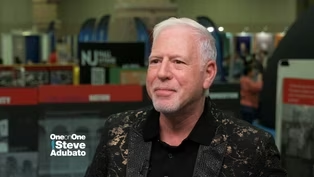
- We're here with Dave Ciliberto, who is one of the many distinguished guests here, folks who are collaborating with the New Jersey Education Association, one of our longtime educational partners.
We're here in Atlantic City for the fascinating NJEA Convention.
Dave, President of Dave Ciliberto Enterprises, it's good to see you.
- Good to see you.
Thank you, Steve.
- For folks who don't know what Ciliberto Enterprises is, tell folks.
- Great, so I've been consulting in workplace culture and leadership for the last 20 years, and there are elements of emotional intelligence, communication, working styles, all things that help leaders lead and employees contribute.
- So, you mentioned emotional intelligence, I go to Dr.
Daniel Goleman, the author of- - Yes.
- Who coined that phrase.
Tell folks who hear the term emotional intelligence, what is it?
First of all, what is it?
What does it have to do with leadership and then in the classroom?
- Okay, awesome.
Well, it is the core of leadership that you can understand yourself, your own emotions, what triggers you, what motivates you, what inspires you, while also paying attention to others and what motivates, inspires them, but also their body language, how they behave, how they perform.
And you pull this together in what Goleman and Bradberry, Greaves from Emotional Intelligence 2.0 do, which is self-management, social management, relationship management.
And you pull that together so that you build relationships in positive ways, creating positive impact through how you communicate, how you observe, and how you partner and collaborate.
- Wow, there's a lot going on there.
As a student of leadership who's tried to understand it for many years and written and taught in the field, I realize that there's much more that I don't know, so I'm gonna follow up on this.
- Okay.
- Do you believe that this thing called emotional intelligence is either you have it or you don't, or you can learn it because you need to?
- You can learn it if you want to.
There are many leaders out in society that don't want to.
There are many organizational, academic, nonprofit leaders who do wanna learn it.
And it's not- - There are some folks in high level government positions- - Oh.
- In the nation's capital who may not want to learn it or even understand that it's a thing to be learned.
- Exactly.
- Just hypothetically.
- Hypothetically, I couldn't agree more because people think it means woke.
And to me, woke is part of emotional intelligence, that I am aware of you and respect you and respect your lived experience, and I'm gonna embrace that with my lived experience.
- How dare you do that?
- I know.
- How did that get... Hold on, how did woke, as you just described it, Dave, become a thing, become political, become divisive?
I'm trying to follow that.
- Yeah, but my small 2 cents is that some politicians like to get on a bandwagon and redefine what is actually happening that's good and turn it into a political platform for bad.
So, renaming formally DEI, like the governor of Florida did and the current incumbent in the Big House did.
But diversity means difference, and aren't we all different?
Isn't every human being different?
So, why is it bad to be diverse which equals different?
I don't think it's bad.
I'm different.
- But Dave, let me follow up.
- Sure.
- Different.
- Yes.
- We're distinct from others.
What do you think makes you... Now, first of all, I said this before you got on the air.
I don't know if you can't pick this up because you can't see.
We should get a shot of Dave's shoes later because it goes with the whole ensemble.
- (laughs) Thank you.
- Beyond the fact that I'm dressed very conservatively and you're dressed in a much more interesting way, what do you think makes you different?
- Okay, well, my lived experience being who I am, my lens makes me different, my lens includes everything I've gone through.
So, coming out in my early 20s, being gay, marrying a Latin man, so interracial relationship in my marriage, my education's different than others' education.
My work experience, world experience, travel experience is different than others.
Like every other human being, we all have different experiences, but I will say what connects us is shared experiences.
So, although I am not a person of color, my husband is, we both experience biases.
We both experience discrimination based on our own identities.
So my identity defines me, my intersectionality, some of these words might be deemed bad words currently.
- Define inter- - Yes.
- Operationalize the term- - Great.
- Intersectionality.
- So I'll give you an example of myself.
- Sure.
- My intersectionality is I'm a white guy and my age, so I'm in my early 60s.
I have lived in New Jersey until I couldn't stand it and moved to New York City, so geographically, I went to college in Virginia.
I'm diabetic, I'm gay, I'm in a interracial marriage.
These are parts of my intersectionality.
My client population as a consultant, that's part of my intersectionality.
I've worked with a lot of non-profit, for-profit and now academia, so this builds my experience uniquely with my intersectionality.
- Connect it to this convention, to the New Jersey Education Association Convention to the folks you'll be speaking to.
- Okay.
- How does it from a practical point of view, Dave, help educators be even better educators?
- Great question.
So, I think the connectedness is what makes educators so brilliant, and they can connect to students, they connect to colleagues by understanding lived experiences are different.
We're not judging them.
We are understanding them and respecting them, hence woke.
Woke means that I understand your lived experience, you understand mine even though they're dramatically different.
- Hold on one second.
To you, woke doesn't mean conservative, liberal, progressive, all those political terms.
That's not woke to you?
- That is not.
- Left's not woke to you?
- That's not.
What to me, it's that we feel comfortable with each other because we respect each other and we have an understanding that we have different lives, and that's not a judgment, it's an observation.
And then we can collaborate because we respect each other's background.
- P.S.
what message needs to be sent in your view, Dave, to students who are all different, who come from different backgrounds, their family situation is different, the neighborhood, their ZIP code, if you will, whole range of things, their sexual orientation, whatever you wanna say.
Why is this so important for younger people as they're developing a sense of self-confidence as they get to know themselves and see the world around them?
- Ah, because we don't want anybody to cover who they are authentically.
We want people to embrace who they are, their own identity, who have comfort and confidence in themselves and what they bring to the world.
We all have gifts that we bring to the world, and I do not want anyone stifled for the gift that they bring to the world because somebody else's opinion is negative on who they might be, could be or will be.
- Why are you so passionate about your work?
And is your work a big part of who you are?
Because people say your work isn't who you are.
I just, for me- - I agree.
- I disagree.
- Well, to answer your question, my passion is my work, so my work is who I am.
And growing up the way I grew up and what I'm able to contribute to the world is my superpower, which is creating comfort for people to be who they are, but also get skills to embrace what they're about to do.
And that's the leadership coaching I do and helping the workplace thrive.
- Well said.
Hey, Dave, thank you.
It was great meeting you.
- Great meeting you.
Thank you so much.
- Let's make sure we get a shot of those shoes.
Thanks, Dave.
- Appreciate it.
- [Narrator] To watch more One on One with Steve Adubato find us online and follow us on Social media.
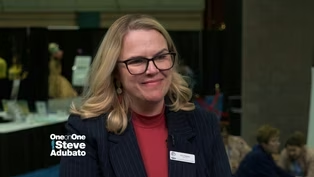
- Hi, I am Jacqui Tricarico on location at the NJEA Convention here in Atlantic City, and so pleased to be joined now by Erin Putman, who is the Design Team Ambassador with the NJEA Consortium, as well as a special education teacher.
Thank you for joining us.
- Of course.
- So, the NJEA Consortium, it's always has a big corner here at the convention.
There's so much going on here, but it has a very prominent place.
Tell us what the consortium is.
What are you doing over there?
- Absolutely.
We are at the end of a three-year grant.
Unfortunately, we're at the end, but we've done a lot from the NEA, and we are focused on creating resources, performance tasks, scholar talks, anything to help teachers feel more comfortable teaching the curricular mandates about diversity, so Amistad, Holocaust, LGBTQ, diversity and inclusion, all of those different mandates.
We're trying to make teachers feel more comfortable teaching subject areas that sometimes they're a little scared to teach, they're not quite sure what resources to use, so we're trying to take all of that out of their hands and here you go, and offer it to them.
- Give us an example of that, of how that's really been helpful for some of the educators in our state.
- Well, it's been wonderful 'cause I feel like a lot of teachers aren't even aware that the mandates are required.
It kinda depends on the administration in different school districts if they're pushing it or not, but it is law, and so it is required by law for them to be teaching it, and so, you know, a lot of people who have walked up to the table even today have said, "I didn't even know about these."
Or, "I didn't know how to teach it."
Or, "I didn't know I could do that."
Especially at the elementary level, a lot of teachers are just really gun shy about teaching some of these topics, and so we have a lot of great DTAs that are creating materials that are just great.
They're accessible for K all the way up through 12.
- You said DTA, Design Team Ambassador?
- Yes, yes.
- That is what you do.
- Yes.
- What does that role look like?
- So, we meet and we discuss.
So, first of all, they created a macro curriculum before I even came on 'cause it's been three years, so there's been DTAs from the beginning, and then I kinda came on a little bit later.
We take the macro curriculum and then we create performance tasks out of it, so we will create a lesson plan, we'll make sure that the students are really engaged, and then we map it all out and we add all the resources so the teachers don't have to do any of that legwork.
We put in all the links, the videos, you know, anything that they need, any visuals, anything like that so that they're gonna be able to just kind of go on, and there it is for them.
- Making it a lot more accessible.
- Yes, yes.
- And you're doing all that on top of being a special education teacher.
Talk about your fourth grade class.
- Oh, I've got a great class.
(Jacqui chuckles) I'm a co-teacher, so I teach in an inclusive classroom with a general education teacher.
And I have, I think, eight students this year with IEPs, but we're basically, you know, equals in the classroom.
All the students belong to both of us, and we feel really strongly about that.
And, you know, our class sort of mirrors what I'm doing with the consortium, just all different kinds of cultures, races, disability types, and so I'm kinda able to take what I'm learning and what we're talking about into my classroom.
- How are you advocating for those students?
Because like you said, it's a variety of different things that they're dealing with, challenges that they're dealing with.
How are you advocating for them?
- Well, one thing that is just very important to me is that they are seen as being a general education student first, because legally they are.
And a lot of times, that kinda gets sort of misconstrued by teachers, by administrators, by you know, so I try really hard to make sure that all the teachers, that they have, specialists, you know, if they go out for a math class, you know, they belong to every classroom that they're in.
They're not visitors, they belong there.
And that's just one of the most important things that I try to really get across.
- 25 years you've been doing this.
We often hear about burnout, especially with teachers.
(Erin laughs) I mean, it's real, I know some educators.
What keeps you motivated?
What keeps you going?
- To be honest, doing things like the consortium, like this little side job that I'm doing, you know, I kinda thought, "Gosh, it's gonna be extra work."
But it sort of reinvigorated me.
I mean, being here, hearing people, like, just responding and getting excited about what they're gonna do in their classroom.
Because I think a couple of years ago, I started to realize I do like teaching, but I kind of wanna take some of the things that I've learned and I really wanna share them with other people.
You know, it's great when I do it with my 20 kids, but they're just my 20 kids, you know.
I wanna get this out there to other teachers, to other students, and so this is a way to do that, and so that definitely helps.
- And you're a mom too.
- Yes.
Yes, yes.
(Jacqui laughs) - Staying really busy.
How do you stay just overall motivated?
How do you stay positive to keep doing this?
- I think that I really try to listen to, you know, the things that the students are responding back to and that sort of makes me realize, "Oh, okay, I am doing the right thing, you know."
After I'll finish a lesson, and the next day, I'll have a student say, "You know, I was watching this movie and I saw this kid with a disability, and I was like, 'Oh, wait a second, you know, I learned about that in class.'"
Or, you know, I'll hear my daughter say that she stood up for somebody at school, and she'll say, "Mom, you know, you were talking to me about this, and it made me think, you know, I should say something."
And it just keeps me going 'cause I realize it's not just sort of in my head, it's actually (laughs) making a difference.
- Yeah, and what's advice that you give other educators, people, you know, your peers, to make sure that they're doing just that, too, in their schools, making sure that there is that inclusivity, especially for those with disabilities?
- I think that I want them to realize, like I said before, that all of the students, like if they look at every student in their class as somebody who belongs there first and foremost, then everything else just sort of falls into place.
And so, I always say there's gonna be teachers that aren't comfortable with what you're saying, but give them a chance because, you know, we were all there at some point.
I mean, I've learned over the years.
You have to give that grace.
You know, you don't know until you know, and then you just have to make those changes.
- You're doing wonderful work.
I don't know how you have time for all the things that you're doing and being a mom (laughs) to your young ones.
One's almost a teenager- - Yeah, yeah, yeah, yeah.
- And the other one a teenager.
So, thank you so much for taking the time to chat with us today.
- Of course.
Thank you, thank you.
- We appreciate it.
We'll be right back after this.
- [Narrator] To watch more One on One with Steve Adubato find us online and follow us on Social media.
- Hi, I am Jacqui Tricarico on location at the NJEA Convention here in Atlantic City.
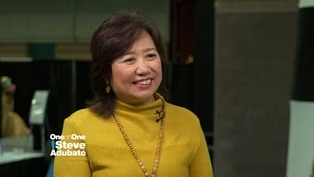
And so pleased to be joined by Shihong Zhang, who's the founder and board chair of New Jersey Chinese Teachers Association.
And you're also here as a design team ambassador for the NJEA consortium.
So great to have you with us.
- Thank you, I'm glad to be here.
- Well, tell us first about your own personal journey to becoming an educator.
Because you came here from China about 30 years ago.
Why did you know teaching was your calling?
- Teaching is my whole life.
So when I was a student, I admire my teachers.
So when I graduate from a college in China, I immediately become the teacher.
Then after I work four years and go to the education as a Master degree to further study education, then I come to America.
And I never thought about having second career.
So that's why, you know, being the education for years almost in my whole life.
- Yeah, yeah, you were born with it, it feels like.
- I think so, I made up for that, I think.
- Yes, yes.
So tell, I wanna go back to 2021 because that was at the height of the pandemic.
What we were seeing across our state and across the nation were a rise in hate crimes against Asian Americans because of the pandemic.
But you took that time to look at it as an opportunity and you wanted to create the New Jersey Chinese Teacher Association.
Why did you feel that was so important?
- I don't think I wanted to create it, it's just a call.
So we need it because Chinese actually, in every school is a kind of a small program, you know, so Spanish, French is much bigger than Chinese, but during the pandemic, like people saying the Chinese virus, then some, you know, kind of hate.
So most of school only have one Chinese teacher.
They're afraid, they feel like helpless.
Nobody help them, they just no friends.
So we get together, should we support each other, right?
So we start doing that.
Now we say, why we not gonna have our own organization to support our ourself?
That's how the idea was started.
And actually it's very interesting, it started in Bell Lab.
- Oh, Bell Labs, yes.
- Yeah, I think that's a place for innovation.
- Yes it is.
- We have the discussion there.
We have the idea we applied, that's how the New Jersey Chinese Association, NJCTA was born.
- How many members now and what has been the reaction from your colleagues?
- At 2021, so we have three people, you know, have that conversation.
Then we have like 17, almost 20 people have a further discussion about that.
Then by September we registered, we have 28 people, but right now we have general group have 200 people, but almost 100 paid members.
- Okay, and what kind of ideas are you bouncing off each other?
How are you using this association to really lean on each other?
- I want this association for us, for the teachers initially.
You know, we want have a platform to exchange ideas, you know, teaching materials and get to know each other.
And later we also find out, you know, it's our responsibility to reach out the community, let the community understand better.
So we know each other, we will, you know, be better to connected.
And later we expanded it to, you know, students learning the language.
So we must include students.
So we also provide a platform for students, have a competition, have a exchange program.
So now we are fully expanded with professional development, the student youth leadership and you know, other connections in the state-wise and nation-wise.
- That's great, now, like you said, often you hear students and when I was growing up it was, you had either Spanish or French to learn as a second language in high school or middle school.
How prevalent now is the Chinese language being offered in our schools across the state?
I mean, do we need to offer it more?
(people laughing) - You know, I think during the 2010, something like this year, the Chinese really, because Chinese economy really soared then a lot of people want to learn Chinese.
So no matter college or community or public schools, a lot of schools started to offer Chinese.
I think that really helped to bridge between the two great countries then get to know each other culture, understand, then exchange a lot of stuff going on.
But after the pandemic, actually the Chinese program, it's getting shrink a lot because of the, you know, political, economic issues.
And right now actually facing some challenges because everything, the budget cut and the Chinese is a smaller program and also due to the political issues and stuff.
So actually, some schools are facing the problem and as association, we are trying to support them.
Try to help them.
- Yeah, yeah.
- Definitely for the community.
I think diversity is the key for America, right?
So that's a country, like everybody seek the freedom, come here, you know, want to be respectful to each other.
So there's nowhere in the world, any other country like American and really tolerated for all kind of the cultures and appreciate each other.
I know there are some, hey, some thing it's not perfect, but it's better than anywhere else.
So I do think Chinese is needed and China's culture have 5,000 years culture, it be 5,000 years, must something great then can last a lot long, right?
Should we have that curiosity to find out what that is, what we can learn from.
- Yeah, yeah, and I love what you're doing with the association to make sure that's happening.
- And lastly, I know AI, you're passionate about that.
There's a lot of controversy around, is AI beneficial for our students?
How is it hurting them?
How have you seen into and how can we integrate it into classrooms effectively and making sure that we're also keeping our students safe?
- You know what?
That's a really good question.
AI is a such hot topic in the world right now.
So actually, I'm doing my EDD at Penn State University on AI and instructional design.
I think AI is a change the world as we know, you know, for school curriculum, we involve a school subject matter teachers, students, AI change all four common places.
You know, the school, all schools starting to develop AI policies and if any textbook without AI, that's not modern, you know, curriculum.
And for teachers, I have a conversation with some teachers say, oh, I'm gonna retire.
I cannot deal with this technology.
I said, no, you not gonna retire now because with AI, will make your life so much easier.
Think about that teacher before, when we make the worksheet, we spend so much time, right, to format it, to do the PowerPoint, to add the picture, decide the font.
Now you just tell the AI, they do for you, right?
- Yeah, it's helping save a lot of time 'cause we know teachers spend a lot more time outside of the classroom than they do in the classroom preparing and all this.
- So that's really can release a lot of burden for teacher preparation time and for students, we know the student always want personalized learning.
We never can do that because with one teacher for 20 students, now you have AI, AI can be the personal student, like a personal individual practice partner, right?
So then your teacher, you just guided the student, you know, how to do it.
Your life is much enjoyable, why you retired?
No, no retired.
(person laughing) - Telling all teachers don't retire.
Use the resources to your benefit.
- Yeah, this is the golden age of a educator.
- Yeah.
- So I'm very excited.
So my research topic is that use AI to improve world language teaching and learning with the instructional design.
- Well, look forward to hearing more about what you learned during that court, during that schooling that you're doing at Penn State.
Good luck with all of that.
And thank you for taking the time to speak with us.
- Thank you.
Yes, they have the workshop.
A lot of people was there, it's very interesting, yeah.
- Wonderful, well thank you for joining us here at the convention, we appreciate it.
- Thank you.
- For Steve Adubato and myself, Thanks for watching, we'll see you next time.
- [Narrator] One-On-One with Steve Adubato is a production of the Caucus Educational Corporation.
Funding has been provided by NJ Best.
New Jersey’s five-two-nine college savings plan.
New Jersey Institute of Technology.
Bergen New Bridge Medical Center.
Horizon Blue Cross Blue Shield of New Jersey.
New Jersey Manufacturing Extension Program.
Garden State Initiative The Port Authority of New York and New Jersey.
South Jersey Industries.
And by New Jersey Sharing Network.
Promotional support provided by ROI-NJ.
And by CIANJ, and Commerce Magazine.
- How long you been waiting?
- About a half hour.
- Brutal.
This keeps up, I'm gonna miss my pickleball game.
- I've been waiting eight years for a kidney.
What can you do?
(gentle music) - [Narrator] Over 100,000 people in the US are waiting for a life-saving transplant.
But you can do your part in an instant.
Register as an organ donor today at NJSN.org.
 New
NewBuilding community & collaboration among Chinese educators
Video has Closed Captions
Clip: S2026 Ep2909 | 10m 22s | Building community & collaboration among Chinese educators (10m 22s)
 New
NewBuilding inclusive classrooms to support learning needs
Video has Closed Captions
Clip: S2026 Ep2909 | 7m 48s | Building inclusive classrooms to support diverse learning needs (7m 48s)
 New
NewEmotional intelligence and how this can improve our lives
Video has Closed Captions
Clip: S2026 Ep2909 | 8m 56s | Emotional intelligence and how this can improve our lives (8m 56s)
Providing Support for PBS.org
Learn Moreabout PBS online sponsorship
- News and Public Affairs

Top journalists deliver compelling original analysis of the hour's headlines.

- News and Public Affairs

FRONTLINE is investigative journalism that questions, explains and changes our world.











Support for PBS provided by:
One-on-One is a local public television program presented by NJ PBS