State of Affairs with Steve Adubato
Deborah Visconi; Matthew Ellison; K. Leanna Jahnke
Season 10 Episode 16 | 26m 46sVideo has Closed Captions
Deborah Visconi; Matthew Ellison; K. Leanna Jahnke
Deborah Visconi, President & CEO of Bergen New Bridge Medical Center, explains healthcare challenges facing Bergen County. Matthew Ellison, Executive Director, The Patriot Fund, Inc. discusses how the organization supports veterans, service members, and their families. K. Leanna Jahnke, CEO of Princeton Nursery School, examines the importance of affordable early childhood education.
Problems playing video? | Closed Captioning Feedback
Problems playing video? | Closed Captioning Feedback
State of Affairs with Steve Adubato is a local public television program presented by NJ PBS
State of Affairs with Steve Adubato
Deborah Visconi; Matthew Ellison; K. Leanna Jahnke
Season 10 Episode 16 | 26m 46sVideo has Closed Captions
Deborah Visconi, President & CEO of Bergen New Bridge Medical Center, explains healthcare challenges facing Bergen County. Matthew Ellison, Executive Director, The Patriot Fund, Inc. discusses how the organization supports veterans, service members, and their families. K. Leanna Jahnke, CEO of Princeton Nursery School, examines the importance of affordable early childhood education.
Problems playing video? | Closed Captioning Feedback
Where to Watch State of Affairs with Steve Adubato
State of Affairs with Steve Adubato is available to stream on pbs.org and the PBS app.
Providing Support for PBS.org
Learn Moreabout PBS online sponsorship- [Narrator] Funding for this edition of State of Affairs with Steve Adubato has been provided by NJM Insurance Group.
Serving New Jersey’s drivers, homeowners and business owners for more than 100 years.
EJI, Excellence in Medicine Awards.
A New Jersey health foundation program.
The Turrell Fund, a foundation serving children.
The Burke Foundation Braven Health.
Honoring our veterans with Braven Salute.
United Airlines.
The Russell Berrie Foundation.
Making a difference.
Robert Wood Johnson Foundation.
Working to create a future where health is no longer a privilege, but a right.
And by Rowan University.
In person and online.
Promotional support provided by ROI-NJ.
Informing and connecting businesses in New Jersey.
And by NJBIA.
We put business at the center.
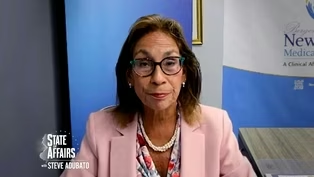
[INSPRATIONAL MUSIC] - Hey, everyone, Steve Adubato, we kick off the program with a longtime friend and colleague, Deborah Visconi, President and Chief Executive Officer at Bergen New Bridge Medical Center.
Deb, good to see you.
- Good to see you too, Steve.
Thanks for having me on.
- Now tell everyone as we put up the website what Bergen New Bridge Medical Center is.
- So Bergen New Bridge Medical Center is the largest hospital in the state of New Jersey.
It is a full service, acute care hospital with a specialty in behavioral health, mental health, addiction services, chronic disease conditions, as well as long-term care.
We are 1,070 beds located in Paramus, New Jersey, which is in Bergen County, New Jersey.
- You know, people hear Bergen County and people think, "Wow, it must be one of the wealthiest counties in the state and the nation."
But you and your team conducted what's called "The Bergen County Community Health Needs Assessment."
What came back from that that makes it clear that Bergen County, a county with 70, 7-0 communities is a very diverse county and there are very complex and challenging health needs?
- Yeah, thanks, Steve.
So yes, Bergen County is close to one million people strong.
And the Community Health Needs Assessment was a comprehensive evaluation that identifies the most significant health needs, disparities, and priorities within a community that helps to guide hospitals, community partners in improving population health and directing resources where they're needed most to help address those health needs.
- Deb, sorry for interrupting.
Go back.
You mentioned population health.
We hear that term a lot.
Explain that for those who are not familiar with it.
- So population health is around all of the things that encompass an individual's life.
So it includes healthcare, it includes education, it includes transportation, it includes food, it includes housing, all the things that you need to live your life.
And it's all interconnected and under the umbrella of population health.
And really assuring the health and wellbeing of the communities that we serve.
- Great, and the Health Needs Assessment told us, what are the top three, four medical health needs of the citizens of Bergen County?
- Yeah, so not surprisingly to us certainly, but mental health continues to be one of the largest challenges, one of the largest health issues that we're facing.
A second to mental health and behavioral health is chronic diseases.
So things like obesity, diabetes, hypertension.
That would be the second category of issues that our communities are facing.
And then I mentioned population health, but it's the social determinants of health that drive a healthy community.
So things like housing insecurity or food insecurity or lack of transportation all play into an individual's being able to live their healthiest lifestyle.
- Deb, let's go back to the mental health piece.
I mean, all of us either for ourselves or our family members or both, I hear people saying all the time, and I know in our family it was like, "How do we find a mental health professional?"
Why is there such a disparity between the needs that we have in terms of mental behavioral health and the supply of professionals in the field?
I don't want to complicate the question, but it can't be a new thing.
- No, so we are seeing an unprecedented demand for behavioral health and mental health services in our area.
And not just here in Bergen County, but I would say throughout the region, certainly.
What we're seeing is that more than half of our emergency behavioral health visits that we evaluated involve some sort of mental health crisis.
And we're seeing increasing rates of anxiety, depression, substance use disorders, social isolation, emotional distress, particularly, Steve, amongst adolescents and young adults.
And I think that's where we're seeing this almost crisis come to the tipping point.
And the way we look at it, and this is the truth, right, mental health is no longer a healthcare issue alone.
It affects families, schools, workplaces, and entire communities.
And so one of the clearest messages that we got from the Community Health Needs Assessment is that people need timely access to care when they are the most vulnerable.
And that's for us, you know, one of the reasons why we're transforming our emergency department and expanding our emergency department, because people need access to healthcare services, in particular, behavioral health.
- Let's talk economics.
And let me disclose that Bergen New Bridge is an underwriter of our healthcare programming.
Economics.
Most of your money comes from where?
Is it government money?
Is it private money?
Talk about that.
- Most of our money comes from patient revenue, patient visits.
And though, you know, from the Medicaid program in particular is a very big payer for us.
So 65% of our of the individuals that we care for have Medicaid or some sort of Medicaid.
And another 10 to 15% of the individuals that we serve don't have any insurance at all.
And so they fall into what we call the charity care bucket.
And so that's, you know, 1 out of 10 people that use our services don't have insurance to pay for the services.
And us, we are a safety net provider, the true beacon of health, hope, and healing for our communities.
And so we take care of the individuals regardless of the type of insurance they have or if they have insurance at all.
And then, you know, we do get some state funding through the charity care program and through the state-directed payments that support our Medicaid patients.
- So as Deb's talking about charity care, just to be clear, and if I'm mistaken, you correct me, charity care means if someone comes into your emergency room, regardless of their ability to pay, regardless of their insurance situation, your hospital takes care of them.
It's called charity care, and that is paid for with public dollars.
- Yes, through the state.
- Through the state.
Now, thorny question, but important.
Federal money, changes in federal policy as it relates to Medicaid/Medicare has had what impact on the patients you serve?
- Oh, it's going to be devastating for a huge amount of the patients that we serve because we believe that the federal changes coming soon will affect people's ability to enroll in Medicaid, and people will fall off the Medicaid books, and then they'll end up in charity care, which means, again, very, very devastating for safety net hospitals.
And hospitals across the country will really experience significant struggles in being able to take care of these individuals.
- Hey, listen, all the federal government's doing is saying you have to prove that you're trying to get a job, you have to prove that you're going to school.
You just have to prove it, and then you get Medicaid.
And if not, you can't.
Is it that simple?
- Well, I mean, that's what the rule says, right?
You have to show that you work or volunteer for 80 hours or you have to, you know, be able to.
But I think the complexity in that is the administrative bureaucracy for individuals to re-certify twice a year with Medicaid now and people- - Twice?
- Twice a year.
Now it's once a year.
It'll be twice a year starting next year.
And that will absolutely affect people that may not have access to a computer or ability to log on and resubmit their applications.
And we're going to see a big shift in people coming off Medicaid but still needing care.
And, again, what's going to end up happening is that people are not going to get the care that they need.
They're not going to go for their routine maintenance checks that they need on a regular basis.
So you're going to see an increase in individuals with more chronic diseases, more cancer, more heart disease that hasn't been cared for because they don't have insurance or they don't have ability to access services.
- Complex, important healthcare matters.
Deb Visconi is President and Chief Executive Officer at Bergen New Bridge Medical Center.
Deb, as always, thank you for joining us.
We appreciate it.
- Thank you, Steve.
Always great to be with you.
- Absolutely.
Stay with us.
We'll be right back.
(grand music) - [Announcer] To see more State of Affairs with Steve Adubato programs, find us online and follow us on social media.
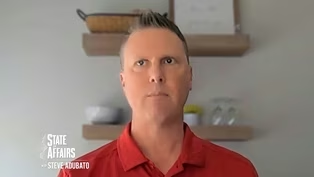
- We're joined now by Matthew Ellison, who's Executive Director of a terrific organization called the Patriot Fund, Inc.
Their website is up right now.
Matt, great to have you with us.
- Yeah, Steve, thanks for having me.
- Tell everyone what the fund is and the website's up and why this fund is so important.
- Sure, so the Patriot Fund exists as a fundraising entity for other nonprofit organizations that are supporting the veteran space.
What we do is we connect patriotic philanthropic individuals with our operational partners.
That's what we refer to as the organizations that we support.
There is a heavy vetting process that these organizations go through to earn the support of the Patriot Fund.
And for the folks that enjoy supporting us, they really find value in that due diligence component of what we do.
- Yeah, this is part of our series called "Honoring Our Veterans."
We also want to thank our partners and friends at New Jersey Manufacturing for making the connection between our programming and Matt and his team at the Patriot Fund.
So we can honor our veterans.
We can say thank you for your service, and that's important.
But let's be more specific.
The most pressing needs of our veterans in 2026 would be?
- So for me, it's clear.
It's not the official mission of what we do here at the Patriot Fund, but what really drives me and motivates me every morning is the dozens of veteran suicides that take their own lives each and every day.
That statistic, to me, is staggeringly sad.
And it's been a blessing to be in this role at the Patriot Fund, to be in a position to help those that are suffering.
And the men and women that have served and protected this country, we owe them everything.
And to contemplate that there are 22 that can no longer bear the difficulties that they encounter with their transition back into civilian life is just, it's soul-crushing.
It really is.
So being in the position to help is a wonderful experience for me.
- Some of the nonprofits you support are engaged in the effort to combat, to deal with suicide, but also to help veterans identify mental health issues and help them accordingly.
Fair to say, Matt?
- Oh, absolutely.
Absolutely.
- So help us understand this.
From your perspective, and I'm always curious about this, there are different reasons why different people get involved in veterans initiatives or initiatives that help veterans.
What's your why?
- So for me, this is a second career for me.
I left a 20-year career in healthcare.
And I took the role of the Patriot Fund as an opportunity to honor my grandfather, who's a 20-year Navy guy.
My father-in-law, basically the same type of story.
Both of these men were, they were just those guys.
They were everybody's best friend.
Everything they touched seemed to turn to gold.
And I took the role thinking it'd be a cool way to honor them and their service.
And it wasn't really until I started here that I learned about the 22 veterans that are committing suicide each and every day.
More when you consider deaths that can't be ruled a suicide, but it looks as though it may have been.
My why started off as a nice feel good story to honor those in my family that I've served.
Now it has taken on a much larger mission for me personally when I learn about the suicides that occur every day.
That's my why.
- Talk about the families of veterans and the programs and the organizations you support that support the families of veterans, Matt.
- Yeah, so Gold Star families, I mean, how can your heart not bleed for them?
There's a Gold Star family that lives right across the street from me.
And to be honest with you, Steve, when this man took his own life probably about three years ago, I was still in healthcare and I didn't realize the suicide issue that existed.
And when I learned of him taking his own life, I remember saying to my wife, "Wow, it's a shame, he served, "you know, and he just deserved a better fate."
And then when I realized about the issue and how widespread it is, all of a sudden, that man's death really carried some weight with me.
And I eventually worked up the courage to walk over and ask his sister if she'd be willing to talk about, you know, her brother.
And for the longest time, she really, really struggled.
She was actually the one that found him.
And, you know, she would, she talked about how she couldn't get the image out of her mind and how her life was completely turned upside down, not just by the sudden unexpected loss of a beloved family member, but just with her own mental issues, struggling with the PTSD of finding her brother like that.
She sought treatment, eventually found relief in some rapid eye movement therapy, which has been a tremendous blessing to her and her family now.
But I don't know, it's hard to put into words, honestly.
I mean, a tragic and unexpected loss in any family is difficult to bear.
But when you think that, you know, someone has served and has been overseas and hasn't been in your direct line of view and contact all the time and you worry and you worry and you worry another home and you feel like the worst is behind you, but then you check the statistics and you find that there's five times as many since 9/11 that are dying by suicide than were killed in action, you know, the real horror for many occurs back stateside in the dying.
That's hard to grasp.
It's hard to quantify, put into words.
- This has become personal for you.
- Yeah, very much so.
Yeah.
I can remember where I was, Steve, when I learned about that 22 a day suicide statistic, and it literally stopped me in my tracks.
And it sounds dramatic, but it's changed my life.
It really, really has.
You know, I thought the Patriot Fund had a wonderful mission.
Then when you layer on the dozens of lives that we are trying to save each and every day, all of a sudden, it takes a new meaning.
There's tragedies in this world, and that's an unfortunate reality of it, but it's a blessing to be in a position to help, and that's the way I look at my role at the Patriot Fund.
- Okay.
So money, we're a nonprofit, you're a nonprofit.
NJM, New Jersey Manufacturing supports a lot of nonprofits.
The money part of this, how important is it for you and your team to bring in the dollars to support these grants to these organizations that are helping our vets?
- Oh, it's everything.
My favorite day of the year is grant writing day and reaching out to everybody to let them know that they've been a recipient of the grant and let them know what their grant amounts are.
And our grant amounts run from about $100,000 down to 15, 20,000 for some of our first year organizations that we are supporting.
And it's my favorite day of the year for a reason.
The gratitude, the emotion that these organizations express when they receive the check for us is really moving.
I mean, for a lot of these organizations, it means the difference, especially in the current landscape of things with federal and state granting, you know, in, in question and so difficult to come by.
The grants from us, a private organization, means, again, a lot to them and the men and women they serve.
- And to New Jersey Manufacturing and other corporations who are corporate citizens who try to support organizations and make a difference, we say thank you to them as well.
So to Matt, to you and your team at the Patriot Fund, we thank you for the work you're doing.
We'll continue to honor our vets through our programming.
Thank you, Matt.
All the best.
- Oh, it's our pleasure.
Thanks for having me.
- You got it.
Stay with us.
We'll be right back.
(grand music) - [Announcer] To see more State of Affairs with Steve Adubato programs, find us online and follow us on social media.
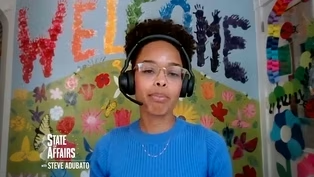
- We're now joined by Leanna Jahnke who is CEO of a great organization called the Princeton Nursery School.
Leanna, great to have you with us.
- So glad to be here, thank you for having me.
- This is part of our series on childcare, affordable, accessible childcare in cooperation with the folks at Start Strong NJ.
Their website is up.
We'll also put Leanna's organization, their website, up as well.
Tell everyone what the Princeton Nursery School is and why it's so significant in the community that it resides?
- The Princeton Nursery School, we're actually the longest continuously-run nursery school in all of Mercer County.
We were founded in 1929.
We're still in the same yellow stucco school building that we had our founding in, and we are actually located in Princeton, in the heart of Princeton, but in a neighborhood that's really not well known.
It's called Witherspoon-Jackson, which was the formerly segregated neighborhood for Black families, for immigrant families who, at that time, did not have access to childcare.
So there were Black mothers who were making Princeton great.
They were uptown as domestic workers for wealthy white families.
They were working at the university and restaurants, really uplifting the Princeton economy that we know, but they themselves did not have a place for childcare for their own children, so the school was founded to meet that need.
And we've really continued that mission now for nearly a century of filling the gap for working parents who are working hard on their education, their jobs, often multiple jobs, and do not have access to affordable and high-quality care.
- Along those lines, Leanna, one of the things that you and your colleagues do at the Princeton Nursery School is when it comes to the question of tuition, how are you gonna pay for this?
There's a, quote, unquote, "sliding scale"?
- That's right.
- Can you talk about that, please?
- That's right.
Well, equity, it's really at the heart of everything that we do, and affordability is a really big part of that, so we work to meet families where they are.
We accept the CCAP subsidy, which was really- - The CCAP is the... - The childcare assistance program subsidy that's offered through the state.
And so that is a really supportive funding stream that childcare providers like myself can accept for families who do need financial support for childcare.
Last year, the CCAP subsidy was at risk.
We had a lot of concern for whether it would be there to support families.
We're very grateful that it's back now, but here in Princeton, not many programs even participate in CCAP, meaning that they don't accept the subsidy, or even with the subsidy, the balance of the tuition would be so great that families still could not afford it.
We are a four-star program, and so we are quality-rated through the state.
We received four stars, but within Mercer County, there are only three other providers that also have a four-star rating.
And so when families are looking for affordability and for high quality, it's very challenging to find, so we work here a lot to meet that need.
We have a sliding-scale scholarship, and this is particularly for families who are not eligible for the state subsidy, even by just a few thousand dollars.
If parents are taking extra shifts, working hard, they no longer meet the very limited requirements that the subsidy has, and so we offer them a sliding-scale scholarship that meets family income, family size, where no two families are really paying the same, and it works to meet everyone where they are.
What's very unique, though, is our program is all-inclusive, and so no matter the rate, whether it's a subsidy, a sliding scale, if you are one of our few families that don't have any financial assistance, you are receiving the same experience.
It's high quality and it's very dignified for all of our families.
- Leanna, I'm curious about this, your passion, your commitment, your professionalism as it relates to the field of childcare, serving those who are in need of quality, affordable childcare, why is this your passion?
- It hits home in a number of ways.
I grew up in the DC Metro area, late '80s, early '90s, and at that time, the school districts were really struggling.
My own mother was a pre-K teacher, and she really saw that between me and my four siblings, the schools just weren't meeting our needs.
And she and my father made a really challenging decision to homeschool us, which now, I look back, I've got three kids, and I imagine, how would I homeschool all three?
She homeschooled all five of us because of the importance of education.
And now, also looking back, I see the sacrifices that my parents made for her to be our full-time teacher and the financial impact that it had on our family, and it continued to have throughout my childhood and upbringing.
In college, I knew that education was where I wanted to go into.
I told my dad I wanted to be a full-time volunteer, and he said, "No, you gotta pick something."
(Steve laughing) And so education was really where I saw a lot of my passions, particularly for students who were like me, BIPOC, low to moderate income, really working very hard.
I became an elementary school teacher.
I then became a teacher-teacher, a coach, and really embraced the nonprofit world and education programs that were creating access, but the older my students got, eventually I started working with high school students and college students, I started to see that it was never impossible, it just got really, really challenging for students, and so I was very strategic.
After I received my master's in nonprofit leadership, I was very thoughtful in going back to early childhood education, because this is the foundation for students, and it's the most challenging time for their parents.
- Got a minute left.
what message do you have for Governor Sherrill and the state legislature as it relates to what they need to do regarding state policy in connection with improving the childcare situation?
One more minute, go ahead, please.
- Well, I'm very, very grateful for Governor Sherrill's recognition of childcare, and particularly for the childcare workforce.
Recently, I was asked about any topics that I saw were needs for the community, and when I shared about childcare, they thanked me for bringing up a new topic when here at our school, we've been focusing on childcare for over a century, and so I'm grateful that she has just started her service as recognizing this.
And so our CCAP eligibility requirements are a really simple and very thoughtful way to expand them so that more families have access to childcare.
That moderate income family, for me, is the most vulnerable because they don't have a number of services that our low-income families do, and then really just recognizing what childcare providers are able to do when we have resources within our grasp.
- Well said.
That's Leanna Jahnke, who is CEO of Princeton Nursery School, an extraordinary organization founded in 1929 in Princeton.
Leanna, thank you for the work that you and your colleagues do every day, we appreciate it.
- Thank you so much, Steve, thank you for having me.
- You got it, I'm Steve Adubato, we'll see you next time.
- [Narrator] State of Affairs with Steve Adubato is a production of the Caucus Educational Corporation.
Funding has been provided by NJM Insurance Group.
EJI, Excellence in Medicine Awards.
A New Jersey health foundation program.
The Turrell Fund, a foundation serving children.
The Burke Foundation Braven Health.
United Airlines.
The Russell Berrie Foundation.
Robert Wood Johnson Foundation.
And by Rowan University.
Promotional support provided by ROI-NJ.
And by NJBIA.
- At the Burke Foundation, we know a healthy beginning changes everything.
In the first 1,000 days from pregnancy through age two, the brain builds the foundation for lifelong health and learning.
But in New Jersey, too many families face barriers to prenatal care, postpartum support, and quality childcare.
We work with partners across the state so every family can access the care, connections, and resources they need.
Because when families are supported early, children and communities thrive.
 New
NewHow The Patriot Fund is supporting veterans
Video has Closed Captions
Clip: S10 Ep16 | 9m 3s | How The Patriot Fund is supporting veterans (9m 3s)
 New
NewThe most pressing healthcare challenges facing Bergen County
Video has Closed Captions
Clip: S10 Ep16 | 9m 47s | The most pressing healthcare challenges facing Bergen County (9m 47s)
 New
NewThe need for early education with Princeton Nursery CEO
Video has Closed Captions
Clip: S10 Ep16 | 8m 33s | The need for early education with Princeton Nursery CEO (8m 33s)
Providing Support for PBS.org
Learn Moreabout PBS online sponsorship New Episode
- News and Public Affairs

Top journalists deliver compelling original analysis of the hour's headlines.
 New Episode
- News and Public Affairs

Today's top journalists discuss Washington's current political events and public affairs.


 New Episode
 New Episode
 New Episode
 New Episode
 New Episode

 New Episode
 New Episode
 New Episode
Support for PBS provided by:
State of Affairs with Steve Adubato is a local public television program presented by NJ PBS