
Fred and Barbara Erb Public Media Campus, debut play by Devin Scillian, COTS Detroit
Season 11 Episode 15 | 26m 46sVideo has Closed Captions
A look at our new campus, a Purple Rose Theatre production and a nonprofit helping Detroit families.
Detroit PBS and 90.9 WRCJ celebrate the construction kickoff for our new public media campus in Detroit. Plus, the Purple Rose Theatre Company debuts a play written by former Detroit TV news anchor Devin Scillian, and we’ll hear how “COTS Detroit” is helping at-risk families achieve stability and success.
Problems playing video? | Closed Captioning Feedback
Problems playing video? | Closed Captioning Feedback
One Detroit is a local public television program presented by Detroit PBS
Fred and Barbara Erb Public Media Campus, debut play by Devin Scillian, COTS Detroit
Season 11 Episode 15 | 26m 46sVideo has Closed Captions
Detroit PBS and 90.9 WRCJ celebrate the construction kickoff for our new public media campus in Detroit. Plus, the Purple Rose Theatre Company debuts a play written by former Detroit TV news anchor Devin Scillian, and we’ll hear how “COTS Detroit” is helping at-risk families achieve stability and success.
Problems playing video? | Closed Captioning Feedback
Where to Watch One Detroit
One Detroit is available to stream on pbs.org and the PBS app.
Providing Support for PBS.org
Learn Moreabout PBS online sponsorship- Coming up on "One Detroit", Detroit PBS and 90.9 WRCJ celebrate the construction kickoff for our new public media campus in Detroit.
Plus, the Purple Rose Theatre Company debuts a play written by former Detroit TV news anchor, Devin Scillian.
And we'll hear how COTS Detroit, is helping at-risk families achieve stability and success.
It's all coming up next on "One Detroit".
- [Announcer 1] Across our Masco family of companies, our goal is to deliver better living possibilities and make positive changes in the neighborhoods where we live, work and do business.
Masco, a Michigan company since 1929.
- [Announcer 2] Support also provided by the Cynthia & Edsel Ford Fund for Journalism at Detroit PBS.
- [Announcer 3] The DTE Foundation is a proud sponsor of Detroit PBS.
Through our giving, we are committed to meeting the needs of the communities we serve statewide to help ensure a bright and thriving future for all.
Learn more at dtefoundation.com.
- [Announcer 4] Nissan Foundation and viewers like you.
(upbeat music) - Hello, I'm Zosette Guir.
Just ahead on "One Detroit", journalist Devin Scillian talks about having his first play produced at Jeff Daniels' Purple Rose Theatre Company.
Plus, a nonprofit that provides services to the homeless, celebrates 10 years of helping families become self-sufficient.
But first up, an update on the construction of the new home for Detroit PBS and 90.9 WRCJ.
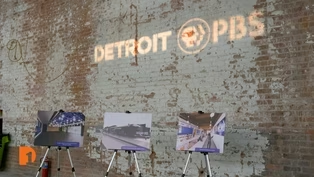
Last week marked a major milestone in the creation of the Fred and Barbara Erb Public Media Campus at 234 Piquette Avenue in Detroit.
Community leaders, partners and supporters came together at the site to celebrate the vision behind the new space for journalism, education, arts and culture and community engagement.
Producer Reyana Patterson-Cazares put together this piece.
Take a look.
(upbeat music) - We're here to celebrate the groundbreaking of the new headquarters, been anticipated for years and worked on by many, many people, and the success is coming.
- We challenged ourselves to be more Detroit than we've ever been.
And in this town, it all starts with engagement.
This is a face-to-face town and we got face-to-face.
We get in front of people, we listen and we learn.
(upbeat music) - Part of my job description was to lead the strategy to make this happen.
The transformed 50,000 square-foot space, will be a campus we all will be proud of.
- As a PBS kid, it's always good to have Detroit PBS in the neighborhood, a place where a community can really come together and also being able to cover stories and topics that a lot of residents and neighbors really want to hear from.
It's going to be a great neighbor to be in a neighborhood.
- I might just suggest for a moment that the Ford Piquette Plant is over there and to have Detroit PBS and the Ford Piquette Plant all in one neighborhood sort of brings it all home for both my husband and me and our family.
- Invest in this vision and ensure that Detroit PBS continues to inform, inspire and connect this region for generations to come.
- Imagine the future of public TV and radio station working as partners in this Milwaukee Junction community to serve viewers and listeners.
- It warms the cockles of my heart that Detroit PBS is back in Detroit.
- Detroit PBS belongs to this community.
And this new campus gives people an opportunity not simply to watch or listen, but to participate, to imagine what this institution can become in the years ahead.
And I hope that others in the community will want to be a part of it too.
(upbeat music) - And the new public media campus is scheduled to open next fall.
Let's turn now to the new season at the Purple Rose Theatre Company in Chelsea.
The opening play is titled "Bastard", and it's written by former Detroit TV news anchor, Devin Scillian.
This is the world premiere for the production and Scillian's first play.
One Detroit's Chris Jordan attended a rehearsal and spoke with him about his theater background and telling stories as a journalist, children's author, musician and now a playwright.
(upbeat music) - The Purple Rose Theatre Company in Chelsea, Michigan has opened their season with a brand-new original play.
The playwright, a very familiar name for Detroiters, but not in this context.
Devin, Detroiters, of course, know you as a journalist and also a lot of people know you as a musician and an author of many children's books.
But now, we are seeing a different side of you as a storyteller with your first play titled "Bastard".
What led you to this new kind of storytelling?
- Clearly, I lack focus is my problem.
(everyone laughing) I can't seem to dial in on what to do.
All those things that you just mentioned, I know it sounds to a lot of people, like I'm just all over the place, but they're all about storytelling.
And I love telling stories.
And obviously, when I was a journalist, I focused on nonfiction, true stories.
And this is very much getting back to my roots.
Because before I ever got into journalism, I started out in college as a theater major.
- Hmm.
- And even after I switched to the journalism school, I stayed very involved with theater and it's my first love.
And so, to be back at it this many years later, is just so gratifying and wonderful.
(Devin laughs) One funny thing that I realized, so, at Channel 4, I followed Mort Crim, who was of course my predecessor, legend, for years.
At the Purple Rose, I am following Carey Crim, his daughter, whose play just closed.
- Oh wow!
- So, I keep following Crims.
(everyone laughing) - [Rhiannon] Go, four, five, six, seven, hold.
(upbeat music) - So, I got to go back in time and ask you, what led you from being a theater major to then pivoting into journalism?
Like that does seem like quite a switch.
- Well, I think that there's, I'm sure going back and looking at it now, it had a lot to do with there was live performance involved in both.
- Hmm.
- No safety net, really.
- Yeah.
- And I really fell in love with the idea of writing the first draft of history.
Really, I love the craft of journalism.
I think it's a deeply honorable and important profession and a really important part of a functioning democracy.
And I always loved being a part of that.
The theme that underlies this play is this phrase, "Everyone is entitled to know their own story."
And that was something that Corey, my wife, said many years ago.
And that just stayed with me.
The play is these two brothers, who have never gotten along very well, are thrown back together.
Because their mother has passed away.
And I think this has been echoed in so many families.
Everybody knows what that's like.
But as they get back together, old wounds resurface, some new wounds develop and some surprises emerge.
But they're all trying to navigate what life is throwing at them.
And that's really, that obstacle course is really basically what the play is about.
- The sparrow taking care of the wounded bird.
- Yeah.
- And you think Jake is one.
- Don't you?
- A wounded bird, Jake?
No, I guess I've never seen it that way.
He hasn't exactly been deprived.
He's the luckiest guy on the planet.
Prom king who gets a full ride to play football at Alabama.
Blows out his knee in practice before his first game.
You think, "Oh, the luck finally dried up."
Nope, he quit school and moved to Nashville.
He's there three weeks and gets a record deal, still wearing a cast in the recording studio.
- Elmore Leonard gave me some great writing advice once.
Because I was talking to him about how intimidating writing can be.
If you can't, you don't always know where your story's headed and do you have to stop and wait, until you can see the whole thing before you can start to write it?
And Elmore said, "You can drive from New York to Los Angeles.
You can't see Los Angeles from New York.
But you can drive the entire way at night just getting there by the hundred yards that's provided by your headlights.
You can get there a hundred yards at a time."
That was great advice.
The idea, what he was basically saying, is just start driving.
- Mm-hmm (affirmative).
- And your instincts as a storyteller will get you to Los Angeles.
And that's kind of what happened with "Bastard".
- Yeah.
- Love that story.
- Which is kind of reflected in how we approach the work in the room too.
It's one day at a time and to let it build itself.
- Yeah, you can't see Los Angeles either.
- Yeah, yeah, you don't have to, it's not a result yet.
- Yeah.
- We're still finding it too.
- Yeah and also too, the process here at the Purple Rose is completely different than any process that I've ever worked with, or maybe any other process in the country.
I mean, a lot of the work is about, I would say, number one, it's getting in touch with your body.
It's number one about getting in touch with your fellow actors, right?
- [Rhiannon] Yeah.
- It's also about getting us out of our heads and into our hearts, which is sort of a catchphrase around here as well, "Out of your head and into your hearts."
- And also, what I've come to appreciate, is how much it changes the task for you.
If you were doing "Death of a Salesman", the script is going to stay the same through the entire rehearsal process at least.
- Right.
- And Rhiannon is sending me constantly, "Can we edit and change this?"
And you guys are having to adjust to our changes on the fly.
- Well, and especially with plays like that too, to set an example, you're also going to be looking at history as well as far as possibly other people that have played those roles depending on what the roles are- - Yeah.
- And how iconic they are.
But the really beautiful thing about this too with the new work, is that we get to put our stamp on this role.
- You are originating the role of Jake Lambert.
- Yeah.
- Yeah.
- Yeah.
- Yeah.
- I hope that means something someday.
(everyone laughing) - You know what?
You are too young to know so much.
- That could be a song title too.
- Yeah, that's right.
- But you actually have to write them.
This is your muse speaking.
A song needs more than a title.
- Well, and it does sort of touch back at least, I think there's transferable skills in the journalism world is that they're trying to find as much truth in themselves in your words, like that's it.
How much of this can we just make true, so that it just feels like a natural instinct?
- [Mark] Yeah.
- I try, I don't always succeed, to stay out of the world of a result and more of like an impetus.
Like if I push, then what happens?
- Interesting.
- I'll ask questions.
It really is just me sort of listening and watching and chasing them and finding out.
It is curiosity.
It's like, "Well, what if I go over and poke him and make him try something else, what will his scene partner's reaction be?"
- [Mark] Yeah.
- How much did the play grow and evolve from like when you first brought it to Jeff Daniels to now when we're in the rehearsal process and I'm sure it's still changing here?
- I'd say there's been, I guess, three phases of it.
When I first finished it, and I don't know how many phases there were as I worked on it, but when I first finished it and sent it to Jeff, he said, "Let's take this to a table read."
And when we did the table read, which was almost a year ago, I think now.
- Mm-hmm (affirmative).
Yeah.
- After that table read, Jeff and Rhiannon both had a long list of, "Well, let's think about it this way, including dropping two characters."
Ow!
(Rhiannon laughs) (Mark laughs) But I dropped one.
- Yeah, yeah.
- I didn't give in on both.
(Rhiannon laughs) (Mark laughs) So, then that, I went and did a bunch of rewriting, and so that was another phase.
And then once the rehearsal process started, Jeff told me, he said, "You need to appreciate the fact that once rehearsal starts, your play is only 80 to 90% written."
- Oh, interesting.
- There's going to be things that aren't going to work.
There's going to be things that need more.
There's going to be things that need to be excised.
And that's where we've been.
So, we're kind of in that third phase now, right?
- Yeah, yeah.
- Is that fair?
- Yeah, absolutely.
- Well, and also too, the beauty of it as well, is that it's going to hopefully change all the way up, until opening night, right?
We treat previews like rehearsals, right?
And so, you guys are going to keep listening to this thing and okay, this is working, this is not working, this is what the audience is responding to.
And I don't know, you should talk more about that.
- Yeah, the previews here are truly a gift.
There are things that we will really test on an audience.
I joke all the time that if somebody has an idea, I'm always like, "I'll burn one.
(everyone laughing) We'll put it in, we'll try it in front of an audience and see where it takes us."
But here it's really, it's sort of egoless, which is an amazingly free way to work.
'Cause you can just say best idea in the room wins.
But yeah, I mean, it goes up until opening night.
I told Devin, I said, "Listen, opening night doesn't mean you're done, it just means you have to let go, 'cause our time has ended."
My time with this cast and with this crew and with this playwright has ended and it's the audience.
It belongs to them now.
So, yeah, you're never done.
Sorry, buddy.
(Rhiannon laughs) (Mark laughs) - And of course, one of the two brothers I know, is a country musician, so you're bringing in one of your other great passions.
How did- - It's funny.
So, it's not a musical.
(everyone laughing) But I did write three songs for the play.
- [Chris] Nice.
- It's really funny, because Jake Lambert made the kind of country music that I have never loved.
And so, I had to set about trying to write, especially his big hit, a song called "Beerwagon", (Devin chuckles) which was a number one song apparently 20 or 30 years ago.
I had to write the kind of song that I, it's about beer and trucks and the kind of song that I don't love, but I had to write it in a way that it was believably a hit.
(Devin laughs) Oh, and then she says, well, so I sent it to her and she says, "This is really good.
Can you do a version?
Can you make a version that sounds live, like a live audience?"
So, the song actually got its debut a few nights ago at JD's, which is Jeff Daniels' new music venue here in Chelsea.
And I played it in front of the crowd that night, explaining to them, "I don't respect this song.
(everyone laughing) But I want you to know that this is what's coming up in the play."
And it went over like- - Listen, you might be stuck, sir.
I think you're gonna have to play this.
- It went over because by the end, they were all yelling bearwagon, right?
- We're too, I do not.
(Devin laughs) - That's right.
- Yeah.
("Beerwagon" playing in the background) - This is your first play, or are there going to be more on the way, do you think?
- I'm working on two right now.
(everyone laughing) One's a musical, so, I'm clearly losing my marbles.
(everyone laughing) - That songwriting thing came so easy for this.
- I know, I know, I know.
- Why not make a full musical?
- A musical that takes place in a Michigan lighthouse.
- Mm-hmm (affirmative).
(Mark laughs) - Oh, interesting.
- Can't wait to read that one.
- Yeah.
(everyone laughing) - "Bastard" runs until December 20th.
It's been 10 years, since COTS Detroit launched an initiative, called Passport to Self-Sufficiency.
It helps homeless families and those at risk of becoming homeless build pathways to long-term success.
The nonprofit released a publication titled, "COTS is Care", in celebration of the milestone.
It features the history, family stories and partnerships that have emerged over the past decade.
"One Detroit" contributor, Stephen Henderson of "American Black Journal" spoke with COTS Detroit CEO, Cheryl Johnson and Shoushanna Simpson, a participant in the program.
(upbeat music) - This was a really ambitious idea when you launched this 10 years ago.
I think you came on this show to talk about it.
- Yeah.
- Tell us about that decade- - Yeah.
- That's happened and what you've learned.
- Yeah, so, it literally came out of a moment where I was asked to go on a sabbatical called Away, began to kind of reminisce over the time that I had spent at COTS, our successes and the areas that we just wanted to say, "No, we don't need to do that anymore."
- [Stephen] It wasn't working, yeah.
- Right?
So, one of the things that really kept coming up for me were the number of stories from some of our families who were present there, who would say something like, "I remember being here when I was five years old."
Now, keep in mind, they're now the adult parent.
And that didn't sit well with me.
Like we had done very well in getting people housed, but breaking the cycle of what we call generational poverty- - [Stephen] Yeah.
- Was at play.
And so, I think one of the most courageous thing, was to call it what it was.
Let's talk about poverty and not about homelessness.
- [Stephen] Hmm.
- And the Passport came out of that.
- Yeah, so, talk a little about how that works, right?
I mean, as you point out, COTS has spent forever, in my memory at least, helping people find shelter- - Yeah.
- Someplace to stay.
That's a really very different task from moving people to the place where they don't need help getting shelter.
So, how does that work for you?
- So, the Passport literally is a theory of change.
It is really addressing five particular areas in a person's life, beginning with family stability, education, employment, your overall health and wellbeing, and then what we call economic mobility, financial literacy.
And we realize that if a person is lacking, or has some diminished capacity in any of those areas, and I don't care who you are, that means everything else in your life is at risk.
And so, to move this and address the issue of generational poverty, we've got to look at it in terms of generation, how we actually cross generations, and it takes time to do that.
And so, the first thing that we addressed was we will no longer, and it was a decision to serve single people, but families, so that we could like measure this over time and across generations.
- Wow.
- And so, the coaching is really at the middle of it.
It is about meeting our families where they are.
And we don't talk about anything else but these five particular areas and helping them to address whatever the goals are that they choose and then helping them to meet that.
And so, it is a long-term engagement, even after they leave any of our housing, which could be the emergency shelter, or our supportive housing programs.
- Mm-hmm (affirmative).
Yeah, so, Shoushanna, talk about your journey through this program.
- Well, I actually was in a bad situation.
And I lived with no amenities.
So, that's still considered being homeless.
But once I was connected with a coach, she pushed me forward.
She gave me the confidence to just push forward in life with me and my children.
Once I got in a housing situation, she was like my personal cheerleader.
She pushed hope into me that was taken out.
Like I just felt hopeless in this house where I had to make sure my children had something to eat, somewhere to wash, things that I couldn't just wake up and do.
She definitely gave me that confidence- - [Stephen] Yeah.
- As well as everyone else in this facility.
And that was very rare for me, I couldn't help.
- So, the situation that you were in, tell our viewers a little more about that and how you found yourself there.
- I owned a home.
And one day, I came home and my furnace and hot water tank was gone.
- Stolen?
- It was stolen and I couldn't, I had to pay the taxes, I had to pay other things.
But those two things were gone.
And that's just like what a house is.
That's the heart of your house.
I had nowhere else to go, so I had to live there.
Me and my children had to live there.
- No heat?
- Yeah.
- No hot water.
- Yep, the electricity was still on, so I had to work with that.
I had to buy the water and things like that.
So, that take the bulk of my money, but I just wanted my kids to be somewhere safe.
- Mm-hmm (affirmative).
- And that's what I had purchased, this home, so I had to be there.
- And now, what's different?
Talk about what is specifically different for you.
- Everything, I can't imagine!
When I was just in that home, I was feeling just so hopeless, like it wasn't going to be nothing.
Now, after this, like I just thought it wasn't.
But once I got that coach, everything is different.
I'm smarter, my decisions are much better.
I'll wake up with more hope than I can imagine.
Yes, everything is definitely different with her just being there.
And somebody you can turn to it and just give what you feel- - [Stephen] Yeah.
- Your opinion.
And she's going to say, "I don't think," or "Yes, yes, that's a good idea."
- Yeah.
- And I'm very much different.
- So, Cheryl was talking about how the idea here is to identify what you want, what you want to do and sort of how you want your life to be and to help you get there.
Can you talk about what that means for you, what you want and where you want to be?
- From watching what they do and how they do it and how they allow me to help them when I'm needed, I want to be a peer support counselor coach.
I want to be a certified coach.
- Hmm.
- So, I have got my peer support coach certificate that needs to be certified with 500 hours.
And they allow me to get those 500 hours.
- Yeah.
- And I'm also online at Grand Canyon University for my bachelor's in social work.
- Cheryl, this has got to feel really good to hear Shoushanna talk about this, but you have this story, I imagine, in many places now.
- Absolutely.
And as I'm listening to Shoushanna, I'm thinking about the impact across generations.
So, here, this is what's really important, is that the experience that Shoushanna has had, her kids won't have to experience that as adult people.
- Hmm, right.
- That's the critical piece.
And to see that we are listening, like we are listening to the voices of our families.
And historically, in work, we've known better.
We know better for you, right?
But we've come away from that and realized that the power, their voices are their voices.
- Mm-hmm (affirmative).
- And their dreams are their dreams.
And so, we align ourselves with that.
- Hmm.
- And help them to reach that.
And so, when we look at those five particular dimensions, Shoushanna has worked really hard around her finances, around getting her family stable and then her own education.
And she's not just looking at a job, and that's a good thing.
She's looking at a career that can sustain her family and bring her joy.
And so, our desire is for our families to not just thrive, but to flourish.
- Hmm.
- That is our desire.
- Wow!
- That'll do it for this week's show.
Thank you for watching.
Head to the "One Detroit" website for all the stories we're working on.
Follow us on social media and check us out on the PBS app.
- [Announcer 1] Across our Masco family of companies, our goal is to deliver better living possibilities and make positive changes in the neighborhoods where we live, work and do business.
Masco, a Michigan company since 1929.
- [Announcer 2] Support also provided by the Cynthia & Edsel Ford Fund for Journalism at Detroit PBS.
- [Announcer 3] The DTE Foundation is a proud sponsor of Detroit PBS.
Through our giving, we are committed to meeting the needs of the communities we serve statewide to help ensure a bright and thriving future for all.
Learn more at dtefoundation.com.
- [Announcer 4] Nissan Foundation and viewers like you.
(upbeat music) (bright music)
 New
NewConstruction is underway for Detroit PBS and 90.9 WRCJ’s new home
Video has Closed Captions
Clip: S11 Ep15 | 2m 17s | The new public media campus is scheduled to open in the fall of 2027. (2m 17s)
 New
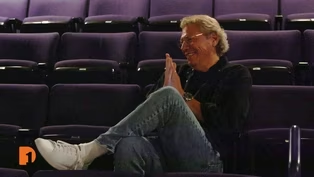
NewDevin Scillian makes his playwrighting debut with "Bastard" at The Purple Rose Theatre Company
Video has Closed Captions
Clip: S11 Ep15 | 11m 17s | Journalist Devin Scillian talks about his first play at Jeff Daniels’ Purple Rose Theatre Company. (11m 17s)
 New
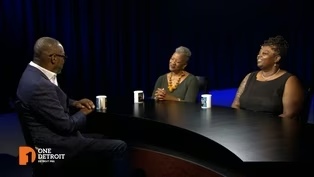
NewHow COTS Detroit is helping at-risk families achieve stability and success
Video has Closed Captions
Clip: S11 Ep15 | 9m | In celebration of the anniversary, the nonprofit has released a publication titled “COTS is Care." (9m)
Providing Support for PBS.org
Learn Moreabout PBS online sponsorship New Episode
- News and Public Affairs

Top journalists deliver compelling original analysis of the hour's headlines.

- News and Public Affairs

FRONTLINE is investigative journalism that questions, explains and changes our world.

 New Episode
 New Episode
 New Episode
 New Episode
 New Episode
 New Episode


 New Episode
Support for PBS provided by:
One Detroit is a local public television program presented by Detroit PBS