One-on-One
Jack Ford; Michele Adubato
Season 2026 Episode 2912 | 27m 27sVideo has Closed Captions
Jack Ford; Michele Adubato
Jack Ford, author of "Beyond This Place of Wrath and Tears," legal analyst, and Emmy Award-winning journalist, to commemorate the career of Lee Carson - a pioneering female World War II correspondent. Michele Adubato, CEO of The North Ward Center and Founder of The Center for Autism, talks about the services The Center for Autism provides to help adults with autism live independently.
Problems playing video? | Closed Captioning Feedback
Problems playing video? | Closed Captioning Feedback
One-on-One is a local public television program presented by NJ PBS
One-on-One
Jack Ford; Michele Adubato
Season 2026 Episode 2912 | 27m 27sVideo has Closed Captions
Jack Ford, author of "Beyond This Place of Wrath and Tears," legal analyst, and Emmy Award-winning journalist, to commemorate the career of Lee Carson - a pioneering female World War II correspondent. Michele Adubato, CEO of The North Ward Center and Founder of The Center for Autism, talks about the services The Center for Autism provides to help adults with autism live independently.
Problems playing video? | Closed Captioning Feedback
How to Watch One-on-One
One-on-One is available to stream on pbs.org and the free PBS App, available on iPhone, Apple TV, Android TV, Android smartphones, Amazon Fire TV, Amazon Fire Tablet, Roku, Samsung Smart TV, and Vizio.
Providing Support for PBS.org
Learn Moreabout PBS online sponsorship- [Narrator] Funding for this edition of One-On-One with Steve Adubato has been provided by The Turrell Fund, a foundation serving children.
The Adubado Center for Media Leadership.
Because media matters more than ever.
RWJBarnabas Health.
Learn More at RWJBH.org.
Horizon Blue Cross Blue Shield of New Jersey.
Johnson & Johnson.
Valley Bank.
The Russell Berrie Foundation.
Making a difference.
PSE&G.
Powering progress.
And by Robert Wood Johnson Foundation.
Working to create a future where health is no longer a privilege, but a right.
Promotional support provided by CIANJ, and Commerce Magazine.
And by lNJBIZ.
Providing business news for New Jersey for more than 30 years, online, in print, and in person.
- This is One-On-One.
- I'm an equal American just like you are.
- The way we change Presidents in this country is by voting.
- A quartet is already a jawn, it’s just The New Jawn.
- January 6th was not some sort of violent, crazy outlier.
- I don't care how good you are or how good you think you are, there is always something to learn.
- I mean what other country sends comedians over to embedded military to make them feel better.
- People call me 'cause they feel nobody's paying attention.
_ It’s not all about memorizing and getting information, it’s what you do with that information.
- (slowly) Start talking right now.
- That's a good question, high five.
(upbeat music) - Hi everyone, Steve Adubato.
We kick off the program with our longtime friend, Jack Ford, who is an Emmy Award-winning author.
He also teaches at Yale University, he also played football there back in the day, and is a broadcaster who does games for the Ivy League, also with PBS for many, many years, and author of this book, "Beyond This place of Wrath and Tears."
Jack Ford, it is a powerful story about an incredible woman, Lee Carson.
Good to see you, my friend.
- Steve, it's always a pleasure.
- Tell everyone who Lee Carson was.
By the way I was thinking about this, we're doing a series and check out Jack's interview he did with us under our banner, Media Matters.
The graphic will come up again, part of a series we're doing in cooperation with the new Center for Media Leadership we created.
Lee Carson is a media leader, was a media leader whose impact is still relevant today.
Who was she?
Why was it so hard for her to do what she did and why does it matter so much now, Jack?
- I stumbled across her story, Steve, as we so often do for compelling stories.
She was a fearless, courageous combat correspondent in World War II in the European Theater, one of only just a handful of women who were allowed to report.
And in order to do that, she had to break every rule that was out there because at the time, as you know, looking back at history, the men were the reporters, the correspondents.
The women who were allowed to report were doing kind of social news.
Lee Carson was brilliant, she started college, Smith College when she was 14 years old.
Dropped out after a couple years, she wanted to be a journalist.
She talked herself over into, she was working for the International News Service, talked herself, convinced her bosses to send her to London to cover the, essentially what was being prepared for this greatest invasion in the history of mankind, which would be the D-Day Landings.
But she kept banging into these barriers, which were essentially, nah, you're a woman, we can't send you in harm's way.
It's interesting because I said I discovered her story.
She died when she was very young and she didn't write an autobiography and people didn't write about her.
So even though she won a medal of honor from the reporting service, her obit appeared in the New York Times, although it was not nearly what you would expect.
She'd been kind lost to history.
And when I stumbled across her story, I thought, this is fascinating.
First that she did all of these things.
She was apparently the only reporter, and she talked herself onto a bomber to fly over the D-Day beaches.
She was the first of just a couple of people to get into liberated Paris the day before it was liberated, they were being shot at by German snipers and by the French who were fighting themselves.
She was there when the US forces crossed the Rhine into Germany.
I pitched this to my publisher Steve, she was sort of the Forrest Gump of reporters in World War II.
- She was everywhere.
- She was everywhere, and yet no one knows anything about her.
- Why Jack, I'm sorry for interrupting, why does no one know about her?
Because I interviewed Connie Chung, check out our interview with Connie Chung, talk about media leaders.
- Connie and I hosted a season of "2020" together on ABC.
Connie is a dear friend.
- Jack, what haven't you done?
So, you know it's interesting, but Connie Chung, the first to sit in that chair, right?
The anchor chair, CBS Evening News, she'll talk about how Dan Rather wasn't so nice to her, and Jack knows that better than most 'cause he worked with her.
Everyone knows Connie Chung, the first to sit in that role.
No one knows Lee Carson because?
- Because time and place.
So there was not television when she was there.
Although she was heralded at home, I found a Time magazine article written about her, they called her the Rhine Maiden because of crossing the Rhine.
I found articles by the legendary Walter Winchell, right?
Who is- - The columnist?
- The columnist.
- Was he a gossip columnist?
- Gossip columnist.
He was the first one to start to write those stories.
But he used to write about Lee Carson reporting during the war.
He called her the gal reporter.
So she became famous here, but then the war ended and she died when she was 51, unfortunately.
She had married, but she had no children surviving her, nobody to fan the flames of what her career had been.
So she dies early on and disappears, nobody's writing about her.
I stumbled across her in a, I was reading another book by a British author who's chronicled World War II, guy by the name of Ben McIntyre, great writer.
And I find a mention of her in a book that he's writing about the liberation of a POW camp.
And he mentioned some things about her, and my first reaction was, I read a lot about World War II as a history major, I have never heard of this woman.
And when I started to dig into it, I realized that the fact, when the war was over, she came back Steve, as with so many women after the war, big jobs all went to the men.
It's the Rosie the Riveter Syndrome, right?
Rosie was riveting and building planes, and then the war was over, the women lost their jobs.
So she kind of disappeared into the background again and was lost to history.
And she was such a compelling story, and as I read in the book it's historical fiction.
I had to fictionalize it to tell stories and fill bites and stuff.
But I write about in the end, in the sort of note about how so many women reporters today, and I talked to friends of mine who were kind enough to give blurbs, Katie Couric and Nora O'Donnell and Ashleigh Banfield, these are all people who sort of broke through in many ways.
And they say they were fascinated to learn about her.
The notion of we stand on her shoulders types of things.
So I found it was astonishing drama and adventure and action.
She's being blown out of Jeeps trying to do this.
But a story that was lost to history.
- Wow, let me try this Jack, shift gears a little bit.
Because with Lee Carson, one of the things that struck me about the book and trying to learn about Lee Carson is that, oh boy, covering the military, particularly in times of war, incredibly challenging.
And by way of background, Jack at a different university.
Jack's a Yale guy, I'm a Rutgers guy, did my doctoral research at Rutgers University in the skill in the field of media and did my doctoral dissertation on network news coverage of the Gulf War.
And one of the things I found, Jack, and trust me, there's a transition here.
One of the things I found was how incorrect and false the reporting was about the so-called smart bombs.
I know you know what I'm talking about right away.
They weren't so smart.
The government, the military was putting out that the bombs were smart and they were hitting their targets, they were precise, they were surgical.
And what we found out that there was an incredible amount of collateral damage.
They missed their mark a lot, and here's the question: in these times and put this team under our Media Matters and the new Center for Media Leadership for people to find out more, at a time when the department of, I gotta get this right, Jack, I think it's called the Department of War now.
- Right.
- Not the Department of Defense.
At a time when the military, and I think about Lee Carson being so courageous to challenge the status quo and ask tough questions as opposed to just report what she was fed, long-winded way to get to this.
How difficult do you believe it is Jack Ford to produce and put on the air and put out there to the public, credible, accurate information about military activities without the military controlling that narrative and still be a patriotic American?
I know it's not an easy question, but that's what I struggled with in the dissertation, I'm still struggling with it now.
Please, Jack.
- Yeah, I think it's the most- - I think there's a question there.
- Yeah, I think it's the most difficult area, I've never covered combat.
I think it's the most difficult area for journalism.
There are a couple of expressions, and you're familiar with them from your research and writing.
- How about the first casualty of war is... - Truth.
- There it is.
- And the other is they talk about the fog of war and how it descends upon the scene and how it distorts visions and perceptions.
And that's why we've always needed good reporting from the war.
We go back to Walter Cronkite and people will talk about, and Lyndon Johnson said this, when Walter Cronkite in 1968 to 1969 questioned our presence in Vietnam and whether that war could ever be won, we know now that he was accurate.
Lyndon Johnson famously said to his advisors, "If I've lost Cronkite, I've lost the country."
And that's because, and there we had, it was called the Living Room War because we were sitting in our living rooms seeing video from the day before or so telling us what was happening.
When Lee Carson's reporting in World War II, it would be days, maybe weeks before her dispatches ever made it into the newspapers.
But she believed she had to be there to tell what was actually happening.
And she had to fight to get there.
I told you she had to charm her way onto a bomber to fly over the D-Day beaches and she got arrested for it.
- Got arrested?
- Because the military had said, "No, nobody's covering that, we'll let you know when you can cover it."
She kind of talked her way out of it.
- How persistent was she?
How persistent was she, Jack?
- Here's what the best story, all right?
Best Lee Carson story, my favorite one.
Again, she was gorgeous, she was smart, she was fearless, she was in fox holes being bombarded on Christmas Eve and Christmas Day and the Battle of the Bulge.
Here's what she did.
She was told, she was traveling with the media folks and they were outside of Paris in Versailles, and they were told, the allies are going to be entering Paris in the next day or two.
We will set it up so that you the media can follow in afterwards.
And then as sort of the tagline, the person giving the instruction says, "Oh, by the way, there were a handful of women, you women, you can't go."
We'll tell you when it's safe.
- Because they were women?
- Because they were women.
We'll tell you when it's safe for you to go in.
And they protested saying, "We've been in foxholes, we've been following all of this, why are you saying to us now?"
They said, they actually, Steve, locked them into, women, into a hotel and said, "We'll let you out and let you go."
Lee Carson escaped.
She climbs out a window, she connects with two men who they were Jeep mates, they were traveling Jeeps following the armed forces.
She connects with these two guys who are willing to say to her, "Yeah, you're one of us."
She climbs into a jeep after she escapes from the hotel, and they're the first ones into Paris, again, being shot at once they got there.
So and it was essentially not, "You don't do good work," it was, "well, you're a woman, so we can't let you go in this, in harm's way," even though that's what they did, Lee Carson, and a handful of other women throughout the course.
Interestingly, no women ever reported from the Pacific Theater, General Douglas MacArthur would not let women show up.
General Eisenhower recognized the value, a morale value.
And there's a story in this, a true story where she wrote about it in one of her dispatches, I was able to get access to a lot of them where she comes tumbling into a foxhole during the Battle of the Bulge.
When the guy who was in there kind of looks at basically saying, "Who are you?"
And he looks over and he sees this gorgeous woman in muddy, dirty khakis, and she introduces herself.
And he says, "Well, fine, you can stay here with me."
And later, later he says, "It said to me, if somebody like her could be in a foxhole with me, maybe there was some hope for all of us to get out of this alive."
- Let me ask you this before I let you go, Jack.
Lee Carson interviewing, if Lee Carson were alive and she had a chance to have a meaningful conversation as the journalist she was with Pete Hegseth.
What do you think that would be like?
- I think it would be fascinating because the one thing she was willing to do is ask the hard questions and tell the real stories.
And again, there were a couple times that she got arrested for telling the real stories.
So I believe- - This is pre-video, there's no video.
- Right, this is all coming on news reports and then some books I found, contemporaries who had written about the coverage and mentioned her and all she did.
And she had a couple of things.
She said, first of all as opposed to our world where getting it first becomes paramount as opposed to getting it right, right?
And so she was insistent that it gets right before it gets out there.
And she was also insistent about the notion of what the role of the journalist is.
She became an accidental celebrity.
She was a celebrity during the war years back here at home.
Now when she came home, it went, came back home, it kind of went away.
But she viewed herself as the conduit for the information, not the star of the information.
And that to me, in our current world, I see so often people in our business, I'm saying, my wife laughs at me saying, "You're becoming the old guy who's throwing things at the television.
And I'm saying, "This is not about you."
Ask the question about, I wanna know about them and their opinions, not what you think about it.
- Hey, Jack, first, I cannot thank you enough.
Go out and get this book, "Beyond This Place of Wrath and Tears" by our good friend and colleague, Jack Ford.
Jack, you'll be joining us, other colleagues from public media and from the network news world, so-called traditional legacy media and other folks involved in media leadership, part of our Media Matters series and done in cooperation with our newly established Center for Media Leadership.
Jack, I cannot wish you all the best, my friend.
And also check out Yale Ivy League football.
Jack is a great color commentator and it's just one of the many things he's done.
He's a Renaissance man.
Thank you my friend.
- Steve, you're the best.
It's always a pleasure to chat with you, you take care.
- Same here.
Stay with us, we'll be right back.
- [Narrator] To watch more One on One with Steve Adubato find us online and follow us on Social media.
- She's back by Popular Demand.
Michele Abubato, CEO of the North Ward Center, one of our longtime underwriters and partners, and also the founder of the Center for Autism.
Hey, my little sister, younger sister Michele.
Who do we have with you?
- This is the famous Buddy who's just passed out.
- (laughs) Did I bore?
- He just literally passed out.
I don't know, Steven.
It could have been you 'cause he literally just passed out.
- He's not the first family member that fell asleep on me.
Hey Michele, let's do this 'cause I wanna talk about a few different things.
Tell everyone what the Center for Autism is and why it matters and then we'll talk about Buddy 'cause Buddy's very much connected.
- Yeah, so the Center for Autism, I founded over 10 years ago in Newark.
It's a program for adults with autism and it's an overall program.
And what happens after 21 when you know school is over?
And a lot of times what happens there is what they call people fall off the cliff.
There's no services, especially in Newark.
So we provide those much needed services for adults with autism.
- Let me ask you this, Michele, the center is a state-of-the-art facility, that matters.
Some will say state-of-the-art.
Okay, so it's modern?
No, it's state-of-the-art specifically designed for specific reasons.
- Oh, absolutely.
- Go ahead.
Talk about that.
- We have a sensory room, we have wide open spaces.
We have lights that make sense for people with autism.
We're very autism sensory friendly.
It is modern, it is new.
We're actually adding a technology center to the Center for Autism.
And you know, it is a state-of-the-art facility.
- Creating a pathway to independence is, again, sounds like a slogan to some people, but you and your team live it every day.
Talk about that.
- Well, you know, when you think about adults and what happens to people once they finish high school or even college, there is a pathway, whether they take it or not is a different story.
For adults with autism, that pathway some, many, many times is shaded by, you know, uncertainty.
What happens?
Okay, school is a given, school is a given, but adult programs are not.
And so oftentimes unemployment is sky high for people with autism.
It doesn't mean that they can't work.
It means that many of them just cannot find employees, employers that are willing to understand what someone with autism needs in terms of employment.
So the employment rate for adults with autism is anywhere between 40 to 60, sometimes even 80%.
- You know, Buddy, let's reintroduce Buddy.
- Yeah, so buddy, buddy is sleeping.
Buddy.
- Buddy's sleeping.
- I can't, I can't.
- Don't wake Buddy up.
Hold on a second.
A therapy dog versus a service dog.
What is Buddy and what's the difference?
- Buddy's both.
Buddy's a service dog and a therapy dog.
So a service dog deals with primarily doing something for someone with a disability.
So Buddy is a service dog for Sebastian and- - Tell everybody who Sebastian is.
- So Sebastian is my wonderful grandson.
He's eight years old.
He happens to have autism.
And actually Sebastian is the reason why Buddy's here because we were doing everything in our power to figure out how to connect with Sebastian when we first found out, you know that at Sebastian at autism, probably a year and a half years old, you know, and we, I thought about therapy dogs and I'm like, maybe this could help 'em.
And you know, the realization of it just hasn't helped Sebastian and Buddy has helped so many people.
I mean, so it's opened up the door.
So Sebastian is the reason why I decided to do Buddy Treats.
- Okay, let's talk about Buddy Treats because we're also, we'll be broadcast on many outlets, distributed on many outlets, traditional as well as digital streaming outlets.
I don't think there's a problem with this because Buddy Treats- - Yeah.
- You usually we don't show product.
Oh, you gave, you gave me one of the first ones.
I didn't throw it away.
I still have it.
Tell everyone what it is because it is not a moneymaking deal.
It is a social, social enterprise.
- This is a social enterprise.
It's hope realized.
That's what Buddy Treats- - Talk about.
- Is about.
So I have always had in my mind the idea of how do you exact change.
So it's wonderful to have programs.
It's wonderful to have the Center for Autism.
It's, you know, opening up our second group, permanent home for adults with autism.
- Hope House 2, Hope House 2.
- Hope House 2 has opened.
- Be free to go any further, Michele, let me clarify.
Folks, all not-for-profit organizations, I just wanna be crystal clear, all non-profits.
Go ahead, Michele.
- Yes, and Buddy Treats is under Reimagine Ability, which is a non-for-profit.
It's a new non-profit that I have and 100% of the proceeds are going to the Center for Autism, along with a local dog shelter that helps dogs in need.
So it's 100% profits to social service.
And it also provides employment for adults with autism because the people who are packaging it are adults with autism.
- You know, I'm fascinated by this for a couple of reasons, but mostly because as not-for-profit leaders, which you are, I am, we are a not-for-profit media production company.
We're affiliated with public broadcasting and people don't need me to tell you the history of public broadcasting right now.
If you head up a nonprofit and you are not thinking about and actively engaged in finding new ways to bring in revenue to support your programs and affiliated programs, then you're not doing your job.
Our dad, our late dad, Steve Senior who founded the North Ward Center, Michele is brought it to where it is today and expanded, obviously our dad was not creating a center for autism, Michele has.
How important is it that as a not-for-profit leader, you're constantly thinking about social enterprise activities?
- It's the same.
It's our tagline.
Made by people who think differently.
In this world that we're living in right now, you need to think about how you become the group that can create profits for what you believe in.
If you're waiting for government to provide the money and get upset because now you don't have a program because a grant is over, that's not being effective.
And so that's really, so Buddy Treats is so much more than about a treat.
Although it's a wonderful treat and it's very healthy and we really worked hard on it.
It's about what I said was hope realized and taking nonprofit, I'm hoping what this does is to take nonprofits in a new era to say we can go into business for ourselves and we then can create that revenue that helps our nonprofit programs continue.
Because as we can see, you cannot rely on just so Medicaid, they're being, everything is being cut.
Does that mean that, you know, programs are gone and that's what's been happening.
Not to the North Ward Center, not to the Center for Autism.
And certainly by bringing Buddy Treats in, we believe that, and I think people feel good about it.
So it's a way for people to say, not only can I give my dog this wonderful treat, I can provide by doing that, I can give to these wonderful services.
- Michele, in the couple minutes we have left, Hope House.
Describe Hope House.
And on January 15th, Hope House 2.
- Yeah.
- We're taping this a little bit after that.
It'll be seen later.
- Yeah.
- What is Hope House and now Hope House 2.
Go ahead.
- I mean Hope House and Hope House 2, I don't like to use the term group home because it's so much more than that.
Hope House 1 was four young women and Hope House 2 is four young men who now have permanent housing in the city of Newark, in a wonderful neighborhood.
This is their home.
We have changed their stars, we have changed their families and how this is again, hope realized.
You have to do something.
Hope is a verb.
So we have now provided for young men with a beautiful home.
It's been, it's been the last couple of weeks, it's been very interesting.
The parents have cried, you know, like they say, listen, this is it.
They're crying for joy, they're crying for, we couldn't, can't believe this is happening.
And they never thought that this could happen for them.
And not only is it happening for them there, our four young men are thriving.
So I'm very, very proud of that.
- Speaking of proud, I know our mom who watches religiously.
- She does?
- She only... (Michele chuckles) I'm not even gonna talk to you about that.
She likes how we get along on the air, but more importantly, the work that you're doing every day.
She's not the only one proud of you.
Our dad who is no longer here, I have a sense he's somehow looking down and really proud as well.
Michele Abubato, she's not my little sister, she's my younger sister doing important work.
She's the CEO of the North Ward Center and the founder of the Center for Autism.
Their websites have been up throughout the segment.
Log on, find out more.
Hey Michele.
Good stuff.
For my sister Michele, who's heads up the North Ward Center and the founder of the Center for Autism.
Buddy, Buddy Treats and our entire team thank you Michele for joining us.
Well done.
- Thank you.
- Look, she's gonna plug one more time.
Buddy Treats.
- That's right.
- You got it.
See you next time.
- Treats with a purpose.
- [Narrator] One-On-One with Steve Adubato is a production of the Caucus Educational Corporation.
Funding has been provided by The Turrell Fund, a foundation serving children.
The Adubado Center for Media Leadership.
RWJBarnabas Health.
Learn More at RWJBH.org.
Horizon Blue Cross Blue Shield of New Jersey.
Johnson & Johnson.
Valley Bank.
The Russell Berrie Foundation.
PSE&G.
And by Robert Wood Johnson Foundation.
Promotional support provided by CIANJ, and Commerce Magazine.
And by lNJBIZ.
- (Soft music) - (Softly)Is that?
- Wow.
(Children laughing) - (Softly) It’s gonna be okay.
 New
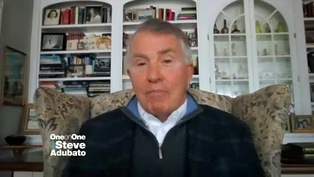
NewAuthor Jack Ford commemorates the journalist Lee Carson
Video has Closed Captions
Clip: S2026 Ep2912 | 15m 40s | Author Jack Ford commemorate the journalist Lee Carson (15m 40s)
 New
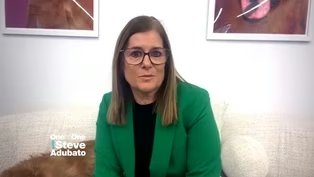
NewHow can we support independent adults living with autism?
Video has Closed Captions
Clip: S2026 Ep2912 | 11m 6s | How can we support independent adults living with autism? (11m 6s)
Providing Support for PBS.org
Learn Moreabout PBS online sponsorship
- News and Public Affairs

Top journalists deliver compelling original analysis of the hour's headlines.

- News and Public Affairs

FRONTLINE is investigative journalism that questions, explains and changes our world.












Support for PBS provided by:
One-on-One is a local public television program presented by NJ PBS