State of Affairs with Steve Adubato
Jane F. Bokunewicz, PhD; Jessica Kitson; Mike Hornbostel
Season 9 Episode 33 | 27m 35sVideo has Closed Captions
Jane F. Bokunewicz, PhD; Jessica Kitson; Mike Hornbostel
Dr. Jane Bokunewicz, Faculty Director at Stockton University, explores how Atlantic City’s casino industry shapes their economy. Jessica Kitson, Director of Legal Advocacy, Volunteer Lawyers for Justice, talks about fighting for justice by providing free legal services. Mike Hornbostel, Member at the Adler Aphasia Center, talks about turning his experience with aphasia into a mission of advocacy.
Problems playing video? | Closed Captioning Feedback
Problems playing video? | Closed Captioning Feedback
State of Affairs with Steve Adubato is a local public television program presented by NJ PBS
State of Affairs with Steve Adubato
Jane F. Bokunewicz, PhD; Jessica Kitson; Mike Hornbostel
Season 9 Episode 33 | 27m 35sVideo has Closed Captions
Dr. Jane Bokunewicz, Faculty Director at Stockton University, explores how Atlantic City’s casino industry shapes their economy. Jessica Kitson, Director of Legal Advocacy, Volunteer Lawyers for Justice, talks about fighting for justice by providing free legal services. Mike Hornbostel, Member at the Adler Aphasia Center, talks about turning his experience with aphasia into a mission of advocacy.
Problems playing video? | Closed Captioning Feedback
How to Watch State of Affairs with Steve Adubato
State of Affairs with Steve Adubato is available to stream on pbs.org and the free PBS App, available on iPhone, Apple TV, Android TV, Android smartphones, Amazon Fire TV, Amazon Fire Tablet, Roku, Samsung Smart TV, and Vizio.
Providing Support for PBS.org
Learn Moreabout PBS online sponsorship- [Narrator] Funding for this edition of State of Affairs with Steve Adubato has been provided by Congress Hall.
A Cape Resorts property.
PSEG Foundation.
NJM Insurance Group.
Serving New Jersey’s drivers, homeowners and business owners for more than 100 years.
The Turrell Fund, a foundation serving children.
The Russell Berrie Foundation.
Making a difference.
South Jersey Industries.
The parent company of South Jersey Gas, and Elizabethtown gas.
Horizon Blue Cross Blue Shield of New Jersey.
The New Jersey Economic Development Authority.
And by Bergen New Bridge Medical Center.
Promotional support provided by ROI-NJ.
Informing and connecting businesses in New Jersey.
And by NJ.Com.
Keeping communities informed and connected.
[INSPRATIONAL MUSIC] - We're now joined by Dr.
Jane Bokunewicz who's a faculty director of The Lloyd D. Levenson Institute of Gaming, Hospitality and Tourism at our higher ed partner at Stockton University.
Doctor, good to have you with us.
- Thank you for having me.
- We'll put up the website for Stockton and also for the institute for people to find out more.
Hey, what's going on in AC with our casinos, and how has it been impacted by legalized sports gambling?
- Well, Atlantic City casinos have seen tremendous growth in internet gaming and sports betting, but the brick and mortar revenue has been relatively flat over the last couple of years.
Even though sports betting is so popular and everybody sees the high growth rate, it still represents a fairly small percentage of the overall industry.
It's around 8% of the total gaming revenue.
So Atlantic City casinos are still very focused on increasing that brick and mortar gaming.
- New York City about to have casinos, correct?
- Correct.
- Connecticut has casinos, Pennsylvania has casinos.
What the heck do our casinos in AC need to do to be more competitive, doctor?
- Well, Atlantic City has been a regional destination that people come to for a lot more than just the casinos.
In the summer, we can see the increases in revenue because of the attractiveness of the beach and the boardwalk and all the summer activities.
But also Atlantic City is heavily focused on entertainment in the showrooms, food and beverage, you know, upscale food and beverage operations, beautiful hotel rooms.
So Atlantic City is more of a getaway type destination that people visit for many reasons outside of the casinos.
- Let me ask you this, I'm curious about the gambling issue on a lot of levels, but the NBA, the National Basketball Association gambling scandal, there's actually something going on in Major League Baseball as we speak.
We're talking in mid-November.
What the heck do you believe, professor, the connection is, or the impact of these scandals in sports, what do you think the potential impact will be on sports gambling?
Because a lot of these have to do with the prop bets, not just who wins a game and how much they win it by, but all the prop bets, meaning the bets inside the game, which people apparently can play games with illegally distorting the outcome.
It's a long-winded way of getting to how the heck can we trust legalized gambling in sports moving forward?
- Well, the good news when gambling is legalized, as it is now with the online sports betting and sports betting in general, is that they can track the unusual betting patterns, and that's why these recent scandals were discovered.
Whereas, gambling has existed on sports for many, many years illegally, and in the illegal market, it's very difficult to track that type of behavior.
So it is, you know, there's always gonna be a chance of scams and scandals, but the best thing that operators can do is to put the protections in place to try to identify those scandals and to prevent them.
- Let me ask you, Stockton University, as I said, one of our long time higher ed partners, what is the interest, and let people understand the geography of Stockton.
Where are you as it relates to Atlantic City?
- Well, the main campus is in Galloway Township.
It's about six or seven miles outside of Atlantic City, but we now have a campus right in Atlantic City, and it's a really great benefit for Stockton students because we have a rich hospitality program and many of our students end up working in the casinos, both for internships, for summer jobs, for their full-time career.
So Stockton and the industry has a very good partnership where we can benefit each other.
The LIGHT Institute is, Levinson Institute is a great example of that.
We provide research for, that benefits the industry, and we have all of the industry leaders both in the gaming industry and outside of gaming on our advisory board, and they help to shape the research that we do that is relevant to the industry.
- Talk about economic development, meaning, I'm actually have to go down as we speak right now in a couple weeks for a seminar I'm leading in Atlantic City, and I often think to myself, there's, you're on the boardwalk, it's great to be there.
Atlantic Ocean right there.
Casinos are great.
A few blocks away, people know this, it's been conversation forever.
It's like two different worlds.
The economic impact of the casinos on the rest of the city, where are we, professor?
- Well, the tax revenue generated by the casinos, I guess that's on a statewide basis though, has been increasing tremendously in recent years because of the growth of sports betting and internet gaming, which are taxed at a higher rate.
So that tax revenue is very important overall to the state of New Jersey.
Atlantic City is trying to solve the problem that you just described and the way that, the best way that that can happen is to improve the housing market in Atlantic City.
As more people live in the city, then, those areas will become more developed and more appealing, so it will benefit the city as a whole.
And the one opportunity that Atlantic City has in its favor is a lot of land available for development.
Most shore towns are fully developed at this point, but Atlantic City has a great opportunity to redevelop some of those empty spaces with housing and with other amenities that can make it a more attractive place to live and to work.
- Last question.
In the casinos, the jobs, which are incredibly important to not just those who are working there, but their families, right, supporting their families, what is your sense and what is your understanding, professor, as to what percentage of the jobs in Atlantic City and the casinos go to Atlantic City residents?
- It is a smaller percent.
There is more, more of the jobs go to residents in Atlantic County overall.
There's about 23,000 jobs right now that are created by the casino industry, and I believe it's about 8,000 of those that are Atlantic City residents.
- Real quick on this, before I let you go, your interest in Atlantic City comes from where?
- I had a wonderful career in Atlantic City.
I moved down here right after I graduated from college, and I got a job at Playboy Casino, and then I rose up through the ranks and I moved to Tropicana and I was a vice president there for 12 years before I entered the academic world.
My husband was a casino dealer, so our family really benefited from the industry, and I can't say enough about all of the great opportunities it provides.
So you know, for me personally, I love the industry.
- Doctor, thank you so much for joining us and breaking down the situation in AC.
- Thank you.
- Okay, thank you.
- You got it.
Stay with us, we'll be right back.
(grand music) - [Announcer] To see more State of Affairs with Steve Adubato programs, find us online and follow us on social media.
- We're now joined by Jessica Kitson, director of legal advocacy at the Volunteer Lawyers for Justice Organization.
We'll put the website up.
Jessica, great to have you with us.
- Thanks so much, Steve.
Great to be here.
- Website's up, tell everyone what Volunteer Lawyers for Justice is all about.
- Sure, Volunteer Lawyers for Justice, or VLJ as we often go by, is a civil legal services organization.
We're based in Newark, New Jersey.
We're about to celebrate 25 years of providing free legal services to New Jerseyans.
- Who are the folks who need the legal services you're talking about?
- You know, VLJ's mission is to ensure access to justice for people living in poverty.
And so the people most in need are the people who can least access legal services and yet are forced to interact every day with a legal system that was designed by lawyers for lawyers.
And so we focus our efforts on the most vulnerable New Jerseyans, the people who are in poverty and couldn't possibly hire their own attorney to help them.
- We're taping this program actually on Veterans Day.
Shout out to all of our veterans.
We thank you for your service to our nation.
In that spirit, your organization also has an initiative that deals directly with veterans: the Veterans Legal Program.
Please talk about that, A and B, what are some of the needs as it relates to civil law issues, legal issues having to do with civil, whatever, but I wanna stay we're staying away from criminal, correct?
- Yes, we do entirely civil work at VLJ.
- Okay.
- One of our programs and one of the issues that we help veterans with is criminal record expungement.
And so it's tangential certainly to the criminal legal system, but our Veterans Legal Program was started in 2012 in partnership with PSEG.
It has now grown to a program where we, twice a month, have free legal clinics for veterans to come and talk about their legal issues.
The issues that are most common, and in fact, a report in the past couple of years from the Department of Veterans Affairs said that seven of the 10 top needs for veterans are legal issues, including eviction defense, consumer debt issues, driver's license restoration, and criminal record expungement, among several others.
And so those are the issues that VLJ focuses on.
- Go back to criminal record expungement.
What is that and why?
What would be the need to expunge someone's criminal record?
- Right.
So it is not uncommon for someone to have a record for minor issues that have happened over the course of their lifetime.
Criminal legal involvement, unfortunately, is not all that uncommon.
And so what happens though is that someone has completed their sentence or paid the fines that they were ordered to pay, and yet they are plagued by a record that follows them every time they try to get a job, every time they try to get housing, to go to school to further their education.
And so New Jersey, along with most other states in the country, have expungement laws that allow people, after a certain amount of time and under certain conditions, to clear that record, give them a clean slate, and allow them to move forward and rebuild.
- Real quick follow up on this, we'll put up your website again, people go on your website.
They want help.
They need help.
How do they navigate it, Jessica?
- Yep, so our website allows someone to apply for services and they can fill out a quick form and that tells them that they're, you know, seeking information from us.
We streamline it so that if it's an issue we can't help with, we're not wasting anyone's time and we let them know right away and then they'll get a call from our office and they'll be scheduled to either talk directly to an attorney right away or be scheduled for one of our many legal clinics where either in person or virtually they come and have the opportunity to meet with some of our volunteers.
One of the things that VLJ does that we're so proud of is that our mission is to work directly with the private bar.
And so we work with volunteers from across the state who dedicate their time and provide free legal services so that we can increase the number of clients that are being served.
And that's true in our veterans program more than anywhere else.
We've been partnering with corporations like PSEG, Panasonic, and others for quite some time.
- Also, I know the Horizon and New Jersey manufacturers to our underwriters are engaged as well with volunteer and Lawyers for Justice.
Speaking of volunteers, 2024, some statistics that your organization, they've provided, 665 volunteers, donated more than 6,000 hours in free legal services valued at $2.2 million.
Who the heck are these lawyers and why are they volunteering, Jessica?
- They are the heroes, Steve.
They are people who are incredibly busy in their day-to-day life.
They are at some of New Jersey's leading law firms, leading corporations, solo practitioners, you name it, we are working with them and they have decided that they understand that we cannot have access to justice if people are forced to navigate the legal system alone.
And so they come to our legal clinics, they take cases for full representation, some of which, you know, take maybe a couple months, some take a couple of years, and they're giving free legal services and they are making sure that people have access to that person standing beside them at court.
- Last question, to what degree has the immigration, deportation, ice-related issues expanded the need of your services for those who are on the other end of trying to navigate immigration and immigration processes?
It's incredibly complex.
- It's incredibly complex and we are seeing it not only with individuals who seek out services for immigration help directly, but for immigrants who are facing other civil legal challenges and who maybe are afraid to go to the courthouse when they need to, you know, enforce a child support payment or- - Tell folks why they'd be afraid to go to the courthouse, Jessica.
- I think, right, an increase in enforcement activities certainly leaves folks much more concerned about engaging in public places and unsure about what the result will be, even if what they're going for has nothing to do with immigration.
And we're seeing this for folks who are undocumented, but also folks who are, right, documented, who have green cards, and there's just a lot more fear right now for folks to interact with the legal system.
- Jessica Kitson is director of legal advocacy at the Volunteer Lawyers for Justice Organization.
The website's been up.
Check it out.
Jessica, thank you so much for joining us.
We appreciate it.
- Thanks so much for having me, Steve.
Take good care.
- You got it, same to you.
We'll be right back.
(grand music) - [Announcer] To see more State of Affairs with Steve Adubato programs, find us online and follow us on social media.
- We are now joined by Mike Hornbostel, who is on the board of directors and also a member at the Adler Aphasia Center, one of our longtime partners to create greater public awareness around aphasia.
Mike, great to have you with us again.
- Good to be here.
- Mike, by way of background, let's tell folks, 11 years ago you had a stroke.
- Yeah, yeah.
- At the time, describe your life, what you were doing professionally and your family, talk about that.
- Oh, I have a wife and two kids.
At the time they were in junior college and stuff, and I was working for Pearson as an editor, and I've been doing like IT and stuff like that, I've been all over the the company basically.
And at the time I was working for Pearson for high school doing textbooks and digital stuff for it as well.
Mostly for high school at that point which was cool because we did a lot of the other stuff like the... Like, umm... Sorry.
Tests and stuff over the computer and digital.
Like we did the first eBooks at that time, it was 11 years ago at this point.
Like, it was pretty new at the time.
And I did stuff for, at the time it was American government which I knew nothing about so I had to like learn stuff on the fly, which was cool because, you know.
I like knowing about history and stuff.
- Mike, sorry for interrupting, but I wanna ask you this.
For people who don't know what aphasia is, and this series is called Voices of Aphasia, your communication, your ability to communicate, not a question of how you think.
- No.
- But rather from a communication point of view- - Yeah.
- it has impacted your ability to communicate in a significant way.
Is that a fair description, Mike?
- Oh, yeah, totally.
When I first got the stroke, I couldn't talk at all.
The words would come out, but it would be like gibberish basically where it was almost like random.
And over time, I got a little bit of it back to really like talking with a speech therapist.
I got some of it back, but I didn't really, because it was so, I didn't really talk to people at that point, just 'cause, you know, I was shy, basically.
- How about now, Mike?
- Much better.
I mean, on a really good day, people don't even know that I have aphasia.
I'm nervous right now, that's why, you know, but- - That makes two of us.
- Yeah.
(both laughing) - But Mike, here's the thing, you now lobby and advocate for people dealing with aphasia and for family members with the Adler Aphasia Center, you're out there speaking publicly all the time.
Why have you decided to be the advocate and the lobbyist that you are, Mike?
- I guess I've always wanted to help people.
I mean, that's what the Center is about, is helping people to talk again and to speak.
And I just wanna... You know, I was almost going to be a Sensei teaching karate and stuff.
But then, you know, my wife was pregnant, and so we had to go back to Pearson, but- - Hold on one second, one second, Mike.
Before the stroke, you wanted to be a Sensei?
- I mean, it was a little while ago, but, yeah, yeah.
- Okay.
- About 10 years ago before the stroke, I was gonna be... I was working for Tiger Schulmann ’cause I wanted to be a Sensei, basically.
Like I had my black belt and all that.
- And just, again, teaching people was, it's what I did.
- So let me ask you this, Mike, we've known each other for a while, I've hosted the Adler Aphasia Center Annual Fundraiser, the gala, which has been an honor, and to meet people like you as I said, the series, the graphic will come up Voices of Aphasia, what's the most important message you wanna share with everyone watching right now who didn't know you before the stroke 11 years ago, but you want them to understand about aphasia and about those like yourself dealing with aphasia, growing, fighting, improving, helping, making a difference every day, go ahead, Mike.
- Well, just basically, you know, you can come back from having a stroke and having aphasia and be a member of society again.
You don't have to just like close the door and like look at TV and like never talk to anybody again, you can still be active.
I mean, a lot of people who have aphasia, you can't do the things that you used to do just 'cause, you know, aphasia also impacts, like writing and stuff as well.
So for me, like being an editor wasn't really, it wasn't possible.
But by coming here to the Adler Center, I was able to like pick up other skills, basically- - Acting?
Sorry for interrupting again Mike.
- Yeah.
- Acting?
You act in the plays at the Adler, was that in your plan to be an actor?
- Oh, not at all.
I mean, I had been part of like, since like high school when I was like one of the tech team, like building sets and stuff, but being an actor, that wasn't me, like at all.
And Ginny would bug me all the time, every day being- - Who's that Mike?
Who's that?
- Ginny was a person who used to work here.
- She- - Okay, at the center?
- Yeah, yeah, she retired.
- And she would bug you, bug you to do what Mike?
- Oh, just be like, "Just have a little.
You don't have to act a lot, just a little bit.
You can be in the background."
Just, you know... She just bugged the heck outta me all the time about this stuff.
And finally I was like, "Okay, fine, I'll be in the play, but no singing and no dancing."
(Steve laughing) And so I ended up being one of the gangsters in- - I know.
- Yeah.
- I saw the video, Mike.
- Yeah.
- You're very, very good.
- Yeah.
- Very good.
But no singing and no dancing.
- No, no, not at all, even before the stroke.
- Hey, hey, Mike.
Listen, I just wanna thank you and the folks at the Adler Aphasia Center for connecting us, and more importantly for you to join us to share your thoughts, your experiences, and be a powerful voice of aphasia but you're a lot more than that, but an important voice.
Hey, Mike, thank you, and wish you and your family all the best as you continue to get stronger and more confident in the work you do every day.
Thank you, Mike.
- Okay.
- Thank you.
- Great job.
I'm Steve Adubato.
That's Mike Hornbostel, voice of aphasia.
- See the play.
See the play.
- Okay, hold on.
You're so confident now you're plugging the play.
Tell everyone the name of the play.
- They haven't told me yet what it is for next year.
- Okay.
- I always bug them about it, but yeah.
- Yeah, go on the website, you'll find out more.
That's Mike, he's got more to say.
We'll see you next time.
(Steve laughing) - [Narrator] State of Affairs with Steve Adubato is a production of the Caucus Educational Corporation.
Funding has been provided by Congress Hall.
PSEG Foundation.
NJM Insurance Group.
The Turrell Fund, a foundation serving children.
The Russell Berrie Foundation.
South Jersey Industries.
Horizon Blue Cross Blue Shield of New Jersey.
The New Jersey Economic Development Authority.
And by Bergen New Bridge Medical Center.
Promotional support provided by ROI-NJ.
And by NJ.Com.
- (Narrator) Public service.
It's what we do, at the PSEG Foundation Through volunteer hours, partnerships and our other contributions.
We're committed to empowering communities.
We work hand in hand with you, our neighbors, to educate young people, support research, environmental sustainability and equitable opportunities, provide training and other services all over New Jersey and Long Island.
Uplifting communities.
That's what drives us.
The PSEG Foundation.
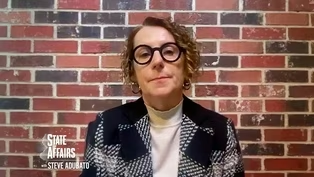
How the Atlantic City casino industry is shaping the economy
Video has Closed Captions
Clip: S9 Ep33 | 8m 51s | How the Atlantic City casino industry is shaping the economy (8m 51s)
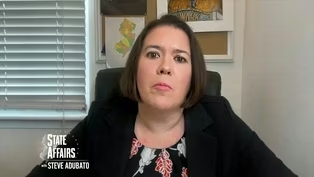
How this organization provides free legal services in NJ
Video has Closed Captions
Clip: S9 Ep33 | 8m 10s | How this organization provides free legal services in NJ (8m 10s)
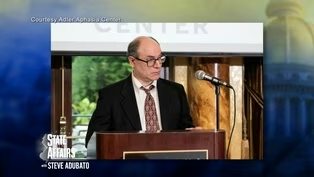
Living with aphasia: a story of advocacy and empowerment
Video has Closed Captions
Clip: S9 Ep33 | 11m 19s | Living with aphasia: a story of advocacy and empowerment (11m 19s)
Providing Support for PBS.org
Learn Moreabout PBS online sponsorship
- News and Public Affairs

Top journalists deliver compelling original analysis of the hour's headlines.

- News and Public Affairs

FRONTLINE is investigative journalism that questions, explains and changes our world.












Support for PBS provided by:
State of Affairs with Steve Adubato is a local public television program presented by NJ PBS