
May 15, 2024 - PBS NewsHour full episode
5/15/2024 | 57m 46sVideo has Closed Captions
May 15, 2024 - PBS NewsHour full episode
May 15, 2024 - PBS NewsHour full episode
Problems playing video? | Closed Captioning Feedback
Problems playing video? | Closed Captioning Feedback
Major corporate funding for the PBS News Hour is provided by BDO, BNSF, Consumer Cellular, American Cruise Lines, and Raymond James. Funding for the PBS NewsHour Weekend is provided by...
Support provided by:

May 15, 2024 - PBS NewsHour full episode
5/15/2024 | 57m 46sVideo has Closed Captions
May 15, 2024 - PBS NewsHour full episode
Problems playing video? | Closed Captioning Feedback
How to Watch PBS News Hour
PBS News Hour is available to stream on pbs.org and the free PBS App, available on iPhone, Apple TV, Android TV, Android smartphones, Amazon Fire TV, Amazon Fire Tablet, Roku, Samsung Smart TV, and Vizio.
Providing Support for PBS.org
Learn Moreabout PBS online sponsorshipAMNA NAWAZ: Good evening.
I'm Amna Nawaz.
GEOFF BENNETT: And I'm Geoff Bennett.
On the "NewsHour" tonight: President Biden and former President Trump agree to debate, as the latest primary results offer a fresh glimpse into voters' minds ahead of November's election.
AMNA NAWAZ: Ukrainian President Zelenskyy pleads for more weapons as Russian forces advance in the Northeast.
TAMAZ GAMBARASHVILI, Vovchansk Military Administration, Ukraine (through translator): The situation in Vovchansk is very dire.
For the sixth day in a row, the enemy has been bombarding the city with all possible weapons and munitions, rockets, artillery and bombs.
GEOFF BENNETT: And a look at the transmission of bird flu to cows and why scientists are concerned we're not watching the virus' spread closely enough.
(BREAK) GEOFF BENNETT: Welcome to the "NewsHour."
President Biden and former President Trump have agreed to debate one-on-one, but without the involvement of the Commission on Presidential Debates, which has run those debates since 1988.
AMNA NAWAZ: Their agreement came after Biden's campaign laid out terms and dates in a letter this morning, and Biden issued this challenge.
JOE BIDEN, President of the United States: Well, make my day, pal.
I will even do it twice.
So let's pick the dates, Donald.
I hear you're free on Wednesdays.
AMNA NAWAZ: To which Mr. Trump replied online - - quote -- "Let's get ready to rumble."
Both have accepted offers from CNN and ABC to take part in June and September debates, respectively.
For more on this, I'm joined by Republican strategist Kevin Madden and Democratic strategist Faiz Shakir.
Great to see you both.
Thank you for being here.
KEVIN MADDEN, Republican Strategist: Great to be here.
AMNA NAWAZ: Before we jump into the conversation, I think it's worth reminding everyone what it was like when these two faced off back in September of 2020 in their first debate.
Here's a clip.
DONALD TRUMP, Former President of the United States (R) and Current U.S. Presidential Candidate: You want to put a lot of new Supreme Court Justices.
Radical left.
JOE BIDEN, President of the United States: Will you shut up, man?
DONALD TRUMP: Listen, who is on your list, Joe?
Who's on your list?
CHRIS WALLACE, Moderator: Gentlemen, I think we've ended this.
JOE BIDEN: This is so unpresidential.
DONALD TRUMP: He's going to pack the court.
He is not going to give a list.
AMNA NAWAZ: Faiz, why did the Biden campaign decide to do this now?
FAIZ SHAKIR, Democratic Strategist: Well, there's a lot of reasons, of course, Amna.
One is, I think they have a sense that they're behind at the moment.
You have got to have a debate with Trump.
You have got to re-remind people about Trump's record.
You have got to engage him on the debate.
What would you do about the economy?
What's your tax plan?
All those basic questions, they have got to do sooner, rather than later.
That's the other element.
They'd like it to happen faster, so that they can go bring some intensity and energy back into this race among their Democratic coalition.
AMNA NAWAZ: So, Kevin, the terms as they have laid out, that the Biden campaign has laid out, we don't know if Mr. Trump has agreed, but the terms are no audience in a TV studio with a moderator.
The mics get cut off after an allotted time.
Will Mr. Trump agree to those and will he stick to those?
KEVIN MADDEN: Well, look, yes, I think he will agree to them because he does want a debate.
I think, first of all, though, one of the important things about campaigns and debates in campaigns is managing expectations.
I think we have to manage the American public's expectations around whether or not this is going to be a very substantive-driven debate.
And you see it now with the candidates, the way that they're sort of framing the terms of it.
It has a little bit more of a WWF match quality to it than a real substantive debate.
But Trump really wants to demonstrate that he has better command, better control over the issues.
And he can put Joe Biden, in his view, on the defensive and also, I think, draw the age contrast, which he thinks works in his favor.
AMNA NAWAZ: Well, we will see.
In the meantime, there are some primary results this week that show us what this race could look like, some of the issues, and where Mr. Biden and Mr. Trump could face challenges ahead.
If you look at Nebraska's results, in particular, Kevin, they showed Mr. Trump the clear winner here, right, 80 percent of the vote.
But Nikki Haley pulled nearly 18 percent.
She dropped out in early March, Kevin.
She's been racking up sizable numbers in GOP primaries since then, 22 percent in Indiana, 16 percent in Pennsylvania.
Who are those voters?
And why don't they like Mr. Trump?
KEVIN MADDEN: It's a good question.
And it's an interesting trend line that she keeps holding that 20 percent line all the way through this late in the game.
Look, these are conscientious objectors inside the Republican Party.
They're not happy with Donald Trump as the nominee, and they're sort of offering protest vote for that.
This should be an alarm bell for the Trump White -- for the Trump campaign.
But it is not necessarily a death knell right now.
This is his charge.
From here all the way through to November, he has to figure a way to get these voters back.
The good news for the Trump campaign is that the issues that are really motivating these voters are issues like inflation and immigration.
So he has a message frame that I think is still going to be able to bring these voters back into his fold by Election Day.
The big risk is that they stay home.
AMNA NAWAZ: Faiz, as you know, Mr. Biden faces some headwinds with Black voters, in particular.
There was some new numbers from the New York Times/Siena poll this week that showed, in key battleground states, 63 percent of Black voters went for President Biden, 23 percent for President Trump.
But while Mr. Biden has the clear majority, the analysis showed that 23 percent would be the highest level of Black support for any Republican presidential candidate since the enactment of the Civil Rights Act in 1964.
What does that say about the campaign right now?
FAIZ SHAKIR: Well, it's not only concerning among Black voters.
If you look at Latino voters in Nevada, it's also a concern.
You look at young voters, of course, we know that there's some challenges there.
Biden's got to start performing more strongly.
I use that word advisedly, strong, because, at this moment, one of the challenges that Trump has on Biden is the question of who's a strong leader.
And I think for all of the progressive policymaking that you have seen President Biden do, it hasn't been coupled with the politicking.
If you look at the fact that his FTC and the DOJ, they take on these big cases, we do junk fees, we have got Pete Buttigieg going after airlines, do you see the fact that this policymaking is taking on powerful interests, that this president is strong to take them on, big pharma, you name them?
He's got the agenda.
But the politicking doesn't match that agenda yet.
And he's got to dial up the question of, am I a strong leader with a strong, firm hand on the steering wheel in a vision for the next four years in the politicking, not so much on the agenda, just reassuring that voting base, who is largely driven by an economic narrative, that this president is strong and ready to take them on.
AMNA NAWAZ: There's a few Senate primary results I want to put to you, too, because, as you know, it's currently a 51-49 split, Democrats in the majority there.
In Maryland, Angela Alsobrooks beat David Trone in the Democratic primary.
She's now going to face Republican Governor Larry Hogan for a seat that a Democrat is freeing up, Ben Cardin.
In West Virginia, meanwhile, Jim Justice, the governor, won the Republican Senate primary.
That's also going to be an open seat being vacated by Joe Manchin.
Kevin, when you look at those results, Maryland is particularly interesting because Hogan is popular because he's kept things local and he's focused on his state.
He will surely be pulled into national politics.
How will he fare there?
KEVIN MADDEN: Well it is a -- I think it's a tough challenge right now for national Democrats.
And they look at that state.
That should be a traditional Democratic stronghold.
But you do.
You have a very popular governor, somebody who's seen as more of a moderate, somebody who is focused on a lot of the pragmatic issues that really drive suburban voters that I think are going to be important in that state.
So I think one of the big challenges for the Democrats is, how much resources do they really put into that state?
And if those resources are going into Maryland, are they not going to a state like Ohio or a state like Montana, which is really going to affect the balance of the Senate map?
So I feel like it's advantage Republicans right now when you look at the overall Senate map.
Maryland is still a very tough, traditional Democratic state.
This is going to be a race that's pretty hard-fought.
But the fact that you're taking resources from other states, I think, bodes well for the Republicans.
AMNA NAWAZ: Could Dems lose control of the Senate?
FAIZ SHAKIR: I'm not too worried about Maryland.
I think Alsobrooks is a strong Democratic contender.
And I think I would have been more worried had it been David Trone, a person who spent $61 million of his own money and didn't win people over.
So I think you have got a stronger candidate.
Biden will overperform, beat Trump by a lot.
In order for Hogan to win, he'd have to way overperform Trump, but he's going to be dragged by his own problems of being challenged to defend Trump's record.
I think the map in general, if you look at Democrats, it's hard to maintain the majority.
However, it's still lined up where you have a very strong chance to maintain a status quo.
I think, if you look at Ohio, Montana, the places that Republicans were hoping for pickups, Democrats are in strong positions there.
You look at Wisconsin, where Tammy Baldwin is the senator, Bob Casey in Pennsylvania, continue to maintain strength.
Where Kyrsten Sinema is retiring, Ruben Gallego, a good candidate who I think will maintain that seat against Kari Lake.
So I think it's still set up, but the fact that you're losing Joe Manchin West Virginia, it's not clear where the pickup for a Democrat would be this cycle.
I mean, there's some outside-of-the-box candidates, and one is in Nebraska, Dan Osborn, independent candidate.
Unclear who he would side with, but I think a pro-union guy who's running against Deb Fischer.
That's my outside-of-the-box race.
AMNA NAWAZ: We will take outside-the-box takes any time.
Faiz Shakir, Kevin Madden, always great to see you both.
Thank you.
KEVIN MADDEN: Good to be with you.
FAIZ SHAKIR: Thank you.
GEOFF BENNETT: In the day's other news: The U.S. Supreme Court is ordering Louisiana to hold congressional elections this year using a House map with a second mostly Black district.
That's despite a lower court ruling that called the map illegal based on racial gerrymandering.
About a third of the state is Black, and the ruling is seen as helping Democrats' chances of gaining control of the closely divided House if it's not challenged by further appeals or another court decision.
Slovakia's prime minister was shot multiple times today in an assassination attempt that has shocked his country and the region.
Robert Fico had been attending a meeting of his government before the shooting.
A 71-year-old suspect is now in custody.
The country's interior minister said the attack was politically motivated, and Slovakia's president expressed her outrage.
ZUZANA CAPUTOVA, President of Slovakia (through translator): I'm shocked, we are all shocked by the terrible and vicious attack on Prime Minister Robert Fico.
A physical attack on the prime minister is, first of all, an attack on a person, but it is also an attack on democracy.
GEOFF BENNETT: Fico's anti-American position has made him a divisive figure both at home and abroad.
He's called for an end to funding for Ukraine, which has worried European leaders ahead of regional elections in three weeks.
The number of drug overdose deaths in the U.S. fell last year.
Initial data from the CDC shows there were around 107,000 such fatalities in 2023.
That's down 3 percent from the year before, but experts warn the decline is relatively small and that it's too soon to determine what was behind the fall.
The trial of Senator Bob Menendez got under way in a New York courtroom today after more than two days of jury selection.
In their opening salvos, prosecutors called the New Jersey Democrat corrupt, while his lawyers called the prosecutors dead wrong.
Menendez is charged with accepting bribes of gold bars, cash and a car in exchange for helping the governments of Qatar and Egypt.
He has maintained his innocence.
Congress has passed a broad aviation bill aimed at increasing air safety and protecting consumers.
The measure requires the FAA to hire more air traffic controllers.
It also prohibits airlines from charging families to sit together, and it mandates refunds for canceled or significantly delayed flights.
The bill now goes to President Biden to be signed into law.
In the Middle East, there's been intense fighting across the Gaza Strip, including in the southern city of Rafah.
An Israeli government spokesperson said today that Israel will eliminate the four remaining Hamas battalions there, but not necessarily every Hamas fighter.
Separately, an Israeli airstrike hit a residential building in the Jabalia refugee camp near Gaza City.
Medics say at least three people were killed and 20 others injured.
This all comes as Palestinians marked 76 years since the Nakba, or catastrophe, which refers to their mass expulsion from what today is Israel.
Some displaced Gazans say the war now is even worse.
FARIDAH ABU ARTEMA, Displaced Palestinian (through translator): My mother and father told me about the Nakba, but this here is worse.
This is destruction.
What we have seen, no one else has seen.
Every day is a catastrophe, the catastrophe of hunger, the catastrophe of illness.
Every day, we move from place to place.
The children are sick.
I don't know what to say.
GEOFF BENNETT: The U.N. says more than 80 percent of Gaza's population have fled their homes since the start of the war.
Many have relocated more than once.
Experts in Brazil are warning that floodwaters in the country's southernmost state could take weeks to recede.
Parts of Rio Grande do Sul have been walloped by 25 inches of rain so far this month.
The flooding has killed 148 people and forced more than half-a-million Brazilians from their homes.
Forecasters say the timeline depends on rainfall, but it might not ease completely until mid-June.
In Texas today, a barge crashed into a bridge connecting the city of Galveston to a small island nearby.
Aerial footage shows the scene of the collision and the streak of oil that was released into the surrounding water.
Officials say a tugboat that was pushing the barge lost control due to bad currents and high tide.
There were no immediate reports of injuries.
On Wall Street today, stocks bounded higher after a reassuring update on inflation.
The Dow Jones industrial average jumped nearly 350 points to close at 39908.
The Nasdaq added more than 230 points to close at a new record.
And the S&P 500 gained 61 points, also ending the day at a new high.
And it's part tradition, part challenge, part spectacle.
The U.S.
Naval Academy hosted the annual Herndon Climb this morning.
Dozens of freshmen known as plebes worked together to climb the 21-foot Herndon Monument which had been coated in 200 pounds of lard.
It took two hours and 19 minutes and a lot of slipping for someone to reach the top and replace a plebe's cap with an underclassman's hat.
The annual event marks the end of their first year at the institution.
Still to come on the "NewsHour": a key indicator shows inflation cooling, but worries about high prices still dominate Americans' view of the economy; Judy Woodruff has another installment of her Crossroads series; and a South African musical group continues to spread Nelson Mandela's message of reconciliation and healing.
Israeli Prime Minister Benjamin Netanyahu pushed back today against criticism of his Gaza strategy from within his own government.
Israel's defense minister accused Netanyahu of indecision and leading Israel down a -- quote -- "dangerous course."
The public infighting comes as the Biden administration this week said Israel did not have a political plan for what's next in Gaza.
Nick Schifrin has been following this, and he's here with us now.
So, Nick, what happened today in Israel?
It looks like the private infighting has burst into public view.
NICK SCHIFRIN: For months, the Israeli military has been pushing Benjamin Netanyahu to look beyond individual military operations and lay out a political plan for the future of Gaza, lay out the goals that the military operations that he's ordered are designed to achieve.
And, today, Gallant, the defense minister, said that, since October, he and military commanders have been pushing for a plan to have governance in Gaza led by Palestinians with international actors, and that would presumably require the Palestinian Authority to participate.
And, today, Gallant said that his proposal was never even debated and no alternative had ever been proposed.
YOAV GALLANT, Israeli Defense Minister (through translator): Indecision is, in essence, a decision.
This leads to a dangerous course which promotes the idea of Israeli military and civilian governance in Gaza.
This is a negative and dangerous option for the state of Israel, strategically, militarily and from a security standpoint.
We must make tough decisions for the future of our country, favoring national priorities above all other possible considerations, even with the possibility of personal or political costs.
NICK SCHIFRIN: Those personal or political costs that he's speaking about is a direct reference to Netanyahu.
There are senior U.S. officials who I speak to, Geoff, who are increasingly concerned that Netanyahu is prolonging the war in order to remain prime minister.
Netanyahu, of course, denies that.
And he said today that his plan was to install Gazan families unaffiliated with either Hamas or the Palestinian Authority, but that plan had been blocked by Hamas.
BENJAMIN NETANYAHU, Israeli Prime Minister (through translator): Therefore, all the talk about the day after, while Hamas remains intact, will remain mere words devoid of content.
Contrary to what is being claimed, for months, we have been engaged in various efforts to resolve this complex problem.
In any case, there's no alternative to military victory.
The attempt to bypass it with this or that claim is simply detached from reality.
There's one alternative to victory, defeat, military, diplomatic and national defeat.
NICK SCHIFRIN: Detached from reality.
He's speaking about his own defense minister's comments there.
It's important to note that Netanyahu is worried about his coalition staying intact, members of which have been called -- have called for the reoccupation of Gaza and a much more punishing military operation in Gaza.
One of them today, National Security Minister Itamar Ben-Gvir, tweeted this.
He said that "Gallant failed on October 7.
He continues to fail now and must be replaced."
GEOFF BENNETT: So, how does the Biden administration view all of this?
NICK SCHIFRIN: The Biden administration has been pushing Netanyahu to accept the Palestinian Authority to run Gaza after the war, and that would unlock some of the larger proposals that the Biden team has been pursuing, especially unlocking Arab participation in the day-after plan.
And, this week, Jake Sullivan made another criticism public.
He said that Netanyahu needed to embrace some kind of political strategy, those goals to -- that he wanted to achieve in order to win this war.
And U.S. officials tell me that call has not been heeded.
GEOFF BENNETT: Meantime, Nick, Israeli forces are expanding their operation in Rafah.
Is this the same operation that the Biden administration has been advising Israel against?
NICK SCHIFRIN: U.S. officials tell me that the operation so far has been targeted at the border in order to prevent Hamas from smuggling both weapons and people in, and U.S. officials say they have been doing that, as well as in the eastern part of Rafah.
Netanyahu said today that half-a-million people from Rafah had fled and that -- quote -- "The humanitarian catastrophe that's been spoken of has not been realized, nor will it."
But we spoke to Dr. Adam Hamawy, one of 10 American doctors who's stuck in a hospital in Southern Rafah.
He's been stuck there since Israeli forces seized the border and closed the border.
He served in Iraq, and he helped save the life of Senator Tammy Duckworth in 2004 when she was injured.
That injury cost her both her legs.
And Hamawy said today that the conditions in his hospital were both dire and tragic.
DR. ADAM HAMAWY, Palestinian American Medical Association: The hardest thing for me is, honestly, the little children that are coming in with life-changing injuries.
It's the boy that I took care of today that lost an arm, two legs, and part of his remaining hand.
I took care of both U.S. military, Iraqi military.
I took care of contractors.
I took care of civilians that were injured in the fight.
But the degree and the level of casualties that are innocent civilians, most of my patients have been young children, women and elderly people that are in their 60s and 70s.
NICK SCHIFRIN: Israel blames Hamas for all of those civilian casualties, Geoff.
And Duckworth says she's appealing to both the Israeli government and the U.S. government to try and get him out.
GEOFF BENNETT: OK. Nick Schifrin, thanks for that great reporting.
We appreciate it.
NICK SCHIFRIN: Thank you.
GEOFF BENNETT: Inflation cooled somewhat last month.
That's according to new numbers from the Bureau of Labor Statistics.
The Consumer Price Index rose at an annual rate of 3.4 percent.
That's in line with expectations.
But, overall, inflation hasn't yet come down quite to the levels that many people have been hoping for.
Our economics correspondent, Paul Solman, has the story.
PAUL SOLMAN: The latest CPI data prices, of goods and services did rise last month, but at a slightly slower pace.
CHRISTOPHER CONLON, Associate Professor of Economics, New York University Stern School of Business: I think this is good news, particularly because what the Federal Reserve generally looks at is core CPI, and that's down to 3.6 percent year-on-year, which is actually the lowest level since April 2021.
PAUL SOLMAN: Core CPI, in other words, explains New York University's Chris Conlon, everything but food and fuel prices.
CHRISTOPHER CONLON: One of the things that's been pushing up CPI this month has been the increase in gasoline prices.
PAUL SOLMAN: But we shouldn't necessarily be looking at that?
CHRISTOPHER CONLON: yes, I think there are a lot of reasons why gasoline prices tend to be volatile, particularly this time of year, that have nothing to do with sort of overall inflation.
Crude prices are actually been heading downward.
PAUL SOLMAN: And food prices can be similarly jumpy, for short-term reasons, in contrast to the longer-term causes of, say, the great COVID inflation that started all this, though, by now, you may be as tired of hearing them and seeing the footage as we are, backed-up supply chain ships due to the stuck-at-home spending spree, stimulus checks, labor shortages, firms hiking prices above their own costs.
But, today, that's pretty much behind us, according to the Harvard Business School's Alberto Cavallo.
ALBERTO CAVALLO, Professor of Business Administration, Harvard Business School: Goods inflation has come down significantly.
And we are back to pre-pandemic levels.
What still remains is the impact of shelter inflation, or rents, which is a category that tends to lag a lot.
PAUL SOLMAN: Shelter costs, measured mostly by rents, are more than a third of the CPI and a clear source of lag, says Cavallo.
ALBERTO CAVALLO: Landlords putting their houses, for rent, they don't have a very good idea of what's happening with supply, with demand.
They may test high rents for a while, and it takes longer for them to internalize and realize that the conditions will require lower rents.
And, naturally, that makes the inflation rate take longer to come down.
MAN: Go, NASA.
PAUL SOLMAN: Economists have a phrase to describe this, says Chris Conlon, rockets and feathers.
CHRISTOPHER CONLON: When costs go up, prices go up like a rocket.
They go up really fast.
And when costs go down, prices fall like a feather, that is, they float to the ground really slowly.
PAUL SOLMAN: But though inflation has swooned since peaking above 9 percent in 2022, we remain preoccupied.
Why?
STEFANIE STANTCHEVA, Professor of Political Economy, Harvard University: People tend to associate inflation with a bad economy.
We feel like it is eroding our living standards.
PAUL SOLMAN: Harvard researcher STEFANIE STANTCHEVA.
STEFANIE STANTCHEVA: When I ask people what emotions do you feel when you see rising prices, predominantly, it's very negative emotions such as anger, fear, and stress.
And while they're quite widespread, they're especially concentrated among lower-income respondents.
PAUL SOLMAN: And, crucially, that's because inflation hits different folks differently, says Cavallo.
ALBERTO CAVALLO: We all tend to focus on what we call average inflation for an average consumer.
But each one of us experiences an actual different inflation based on the products we do buy.
We have, for example, low-income households consuming a lot more food than high-income households.
If there's suddenly a lot of inflation in food, the low-income households actually experience more inflation.
PAUL SOLMAN: So, yes, the data show price hikes tapering, but not for everyone equally, echoes Stantcheva.
STEFANIE STANTCHEVA: We know there's inflation inequality, where the basket of goods that people consume will vastly shape the inflation experience.
So, I think this is very important to bear in mind when thinking about people's stress responses, reactions, lived experience that might just not well be captured by our official statistics.
PAUL SOLMAN: Which may help explain why consumer sentiment sank in may, many Americans feeling that inflation hasn't dropped fast enough and could even get worse.
For the "PBS NewsHour," Paul Solman.
AMNA NAWAZ: Today, Ukrainian troops fell back to defensive lines amid one of Russia's largest offensives since the beginning of the full-scale invasion more than two years ago.
President Volodymyr Zelenskyy has postponed all foreign travel, and the U.S. secretary of state announced new weapons deliveries while in Ukraine.
But, as Nick Schifrin reports, in Northeast Ukraine's Kharkiv, the front is fragile.
NICK SCHIFRIN: Along the Ukraine-Russia border, Ukrainian troops try to hold the line.
This is the Kharkiv region, where Ukraine long ago pushed Russia out.
Now it needs reinforcements to hold Russia back.
Vovchansk is just two-and-a-half miles from Russia, and the center has been ripped apart.
A Ukrainian soldier fighting in the city sent us videos of Russian shelling and Russian troops on the city's edge.
He says, with the help of drone attacks on Russian tanks today, they push Russian troops back.
But he still fears Russia could take the city.
TAMAZ GAMBARASHVILI, Vovchansk Military Administration, Ukraine (through translator): The situation in Vovchansk is very dire.
For the sixth day in a row, the enemy has been bombarding the city with all possible weapons and munitions, rockets, artillery and bombs.
NICK SCHIFRIN: Tamaz Gambarashvili is the regional administrator in Vovchansk.
He says the defensive lines built in other areas, including trenches and anti-tank dragon's teeth aren't as robust near Vovchansk.
TAMAZ GAMBARASHVILI (through translator): After the deoccupation in September of 2022, military and engineers built defensive lines.
But because we are so close to the Russian border, and because of the constant fighting and constant shelling, perhaps we were not as successful in putting these defensive lines in as we were in other areas.
NICK SCHIFRIN: The Russian offensive that began late last Thursday has captured more territory than any point since February 2022.
U.S. and Ukrainian officials say Russia's goals are to push far enough into Kharkiv region to be able to reach Kharkiv City with artillery and to draw Ukrainian forces away from fierce fighting in the Donbass.
Inside Vovchansk, soldiers go door to door to try and convince villagers to evacuate, including Natalia Yurchenko, who's been in hiding.
NATALIA YURCHENKO, Vovchansk Evacuee (through translator): For five days, we never left the house.
We did not see anyone.
We were so afraid to go out, we never even opened the door.
ANDRII SEMENKO, International Rescue Committee: It's pretty hectic, and there are a lot of shellings, and it's almost everywhere in Vovchansk.
NICK SCHIFRIN: Andrii Semenko is a humanitarian worker with the International Rescue Committee.
The IRC and other aid groups provide medical and psychological support to thousands of the newly displaced, including the most vulnerable.
ANDRII SEMENKO: Some of the children, their moods are up and down, and they might start crying straight away without any reasons.
From the sound of if the door closed kind of very loudly, they would get like a fright reaction, and they would -- some of them burst into tears, and you would have to calm them down, so that you are safe and you're OK. NICK SCHIFRIN: Kharkiv City's scars from Russia's 2022 campaign haven't yet healed.
But, today, the buildings bear new wounds and residents flee with only their most precious belongings.
MAKAR, Kharkiv Resident (through translator): There was an explosion, then a cloud of dust.
This is what our life looks like.
Our building was hit, but we will get over it.
NICK SCHIFRIN: In Kyiv today, Foreign Minister Dmytro Kuleba and Secretary of State Antony Blinken paid tribute to Ukrainians killed fighting Russia since its initial invasion in 2014.
ANTONY BLINKEN, U.S. Secretary of State: I'm here as part of a show of support.
NICK SCHIFRIN: And Blinken announced $2 billion of additional weapons deliveries.
Ukrainian officials watched Russia's buildup on the Kharkiv border, frustrated by U.S. demands not to fire U.S. weapons into Russia.
Today, Blinken said that policy wouldn't change.
ANTONY BLINKEN: We have not encouraged or enabled strikes outside of Ukraine, but, ultimately, Ukraine has to make decisions for itself about how it's going to conduct this war.
NICK SCHIFRIN: U.S. officials have faith that Ukraine can protect Kharkiv City.
But weapons and manpower shortages means it remains vulnerable, and Russia is determined to keep inflicting pain.
For the "PBS NewsHour," I'm Nick Schifrin.
GEOFF BENNETT: The continuing outbreak of bird flu in the U.S. has alarmed researchers and prompted new efforts to track the virus that's already caused the deaths of tens of millions of birds from Europe to Antarctica.
But, as William Brangham reports, as H5N1 continues to jump into mammals, most recently dairy cows, many scientists are concerned that we're not watching closely enough as this virus continues to spread.
A warning: This story contains scenes of animals in distress.
WILLIAM BRANGHAM: Evolutionary biologist Michael Worobey at the University of Arizona is one of many scientists around the world trying to untangle bird flu's latest twist, how and when it spread to dairy cows.
MICHAEL WOROBEY, The University of Arizona: The jump into cattle probably took place between mid-November and mid-January, and so we're months into this already.
WILLIAM BRANGHAM: And since then, it's spread like wildfire, infecting dairy cows in at least 46 herds across nine states.
MICHAEL WOROBEY: It seems to be spreading cow to cow in some fashion, but we don't know exactly how that is.
For example, it could just be mechanical transmission as one cow leaves a milking machine, leaves virus on it, and then the next cow comes in.
Or is this going respiratory, like flu does with humans?
WILLIAM BRANGHAM: In late April, the USDA mandated that milking dairy cows being transported across state lines need to be tested for bird flu.
Do you think we have got now enough surveillance out there to know what this virus is doing and where it's moving?
MICHAEL WOROBEY: I think we still have a long way to go, honestly.
We are still sort of dealing with a pretty limited number of samples from a limited number of farms.
And that limits exactly how much we can understand.
For example, you can actually figure out, just like we did with COVID, the number of people infected is doubling every two days.
We still don't know that with cattle.
WILLIAM BRANGHAM: But even the initial discovery that bird flu had jumped species and was now circulating in cows was thanks to a bit of epidemiological work by a handful of veterinarians.
DR. DREW MAGSTADT, Clinical Associate Professor, Iowa State Veterinary Diagnostic Laboratory: The main common denominators with the cattle were a sudden decrease in feed intake, a sudden decrease in milk production, variable fevers, variable manure consistency.
WILLIAM BRANGHAM: Dr.Drew Magstadt is a veterinarian at Iowa State'S Vet Diagnostic Lab.
He was helping colleagues in the Texas Panhandle and Kansas who were dealing with a bunch of sick cows, but then a new clue emerged.
On these same farms where cows were sick, a lot of cats had gone missing, gotten sick, or had died.
So, you thought, we have to check H5N1, the bird flu, because it's been in this area, but you really didn't think that was going to be the case.
DR.DREW MAGSTADT: Well, yes.
And we didn't end up ruling it out.
We ended up finding the virus.
The intriguing part here is that this virus in cattle doesn't seem to be causing any mortality.
After several weeks, the animals recover.
It's very different from the infection in other mammalian species.
WILLIAM BRANGHAM: In fact, unlike cows, this bird flu has been deadly to the nearly two dozen other mammal species that have been infected in this U.S., from a polar bear in Alaska, to a mountain lion in Colorado, to raccoons and foxes.
Many of those animals were likely infected by eating dead animals that were carrying the virus.
But, by far, the biggest impact here in the U.S. has been on birds.
Since this strain of avian influenza first arrived in the U.S. in early 2022, brought here by migratory birds, more than 90 million domestic birds, mostly chickens and turkeys, have died or been intentionally killed across 48 states.
And unlike previous outbreaks, this variant has affected more wild birds and spread across a wider geographic area, crossing down into South America at the end of 2022.
DR. RALPH VANSTREELS, University of California, Davis: I think the alarm really went off when it reached Peru, and that's a massive seabird community, and we saw just unprecedented mortality in the seabirds there.
WILLIAM BRANGHAM: U.C.
Davis' Dr. Ralph Vanstreels is a wildlife veterinarian based in Argentina, and he watched as the virus arrived and decimated bird populations, and then made another jump into mammals.
An estimated 24,000 sea lions died from the outbreak.
It was one of the earliest known mass mortality events from bird flu in mammals.
DR. RALPH VANSTREELS: At first, we weren't sure if each of those sea lions was getting infected by eating a bird.
But it became pretty obvious pretty quick that this was spreading from mammal to mammal.
WILLIAM BRANGHAM: In Argentina, Dr. Vanstreels estimated that the virus killed 17,000 elephant seal pups and an unknown number of adults, a blow to that population that may take decades to recover.
DR. RALPH VANSTREELS: It's definitely very distressing, I can say.
We have worked with these animals for many years.
So we have known these populations, we have seen these colonies.
And on the one hand, we are prepared, because we expected it.
On the other, nothing can prepare you for it.
WILLIAM BRANGHAM: Earlier this year, researchers confirmed that bird flu had spread all the way to Antarctica, primarily affecting birds known as skuas, but, so far, Antarctica's iconic penguins haven't been affected.
DR. RALPH VANSTREELS: But this virus can mutate quite quickly, right as it did when it started infecting mammals.
So it could mutate again and start infecting penguins.
So we're not quite out of the woods yet.
WILLIAM BRANGHAM: And it's that possibility of mutation, where the virus adapts and becomes better suited to spreading from mammal to mammal, that has many on edge, particularly now that H5N1 was discovered spreading in all those dairy cows.
While experts stress it's still very unlikely that this outbreak will lead to the next human pandemic, and government officials say pasteurization kills the virus in milk and dairy products, there are real risks for those who work in close contact with cows.
In March, a farmworker in Texas was infected, but had mild symptoms and recovered.
The CDC says it's monitoring people exposed to infected cattle, but admits that only 33 people have been tested.
MICHAEL WOROBEY: What we have is a situation where the virus, in a sense, has more shots on goal to jump from a related species, a mammal like us.
And now people are no doubt being exposed on a daily basis in pretty large numbers.
WILLIAM BRANGHAM: Worobey says it's a stark reminder that we have not learned as much as we hoped from the COVID pandemic.
MICHAEL WOROBEY: We need to be spending billions more to do things like routinely monitor not the tip of the iceberg of cattle who are visibly ill, but routine monitoring to just find, OK, is there something that shouldn't be spreading in this animal species or in humans?
And we are still not doing that.
WILLIAM BRANGHAM: And with more than nine million dairy cows in the U.S. alone, getting eyes on where this virus may go next remains a monumental challenge for animal and human health.
For the "PBS NewsHour," I'm William Brangham.
AMNA NAWAZ: Latino Americans make up nearly 20 percent of the U.S. population, and this year are expected to be a critical constituency for both Republicans and Democrats in swing states.
And yet, as Judy Woodruff reports, the very idea of Latinos voting as a bloc betrays the diversity of history, culture, and perspectives within that community, which may also help strengthen it against the polarization we see in the country more broadly.
This report is part of her ongoing series, America at a Crossroads.
JUDY WOODRUFF: This is your parents, your mom.
SYLVIA GONZALEZ ANDERSH, Latino Voter: My mom, my dad.
JUDY WOODRUFF: Sylvia Gonzalez Andersh is a 67-year-old United States Air Force veteran.
SYLVIA GONZALEZ ANDERSH: Well, we were considered Mexican Americans.
That's what everybody called us.
RAFAEL POLO, Latino Voter: I am getting promoted to lieutenant commander.
JUDY WOODRUFF: Raf Polo is a 73-year-old United States Navy veteran.
RAFAEL POLO: At home, we spoke Spanish.
We drank the Cuban cafecito.
Have you ever had that?
(LAUGHTER) RAFAEL POLO: You go -- when we left the house, from the moment we stepped out, we were Americans.
JUDY WOODRUFF: They both live in Tucson, Arizona.
They consider themselves Latino, and they are both politically active.
But when it comes to the issues, like undocumented immigration, they simply don't see eye to eye.
How do you view the people who are trying to come into this country without documentation?
SYLVIA GONZALEZ ANDERSH: They must be pretty desperate to walk thousands of miles to get here and to go through all that agony.
But, as far as being on the border, I have been down there.
I mean, we're 100 miles from Nogales, from the border.
We're not getting overrun by millions of immigrants.
JUDY WOODRUFF: That's not how Polo sees it.
RAFAEL POLO: I think they need to come in legally.
A lot of the folks that are coming through, a lot of them are not good people.
They're rapists, murderers.
And I'm pretty convinced that terrorists are here.
JUDY WOODRUFF: When it comes to former President Trump, who famously launched his campaign by denigrating Mexicans... DONALD TRUMP, Former President of the United States (R) and Current U.S. Presidential Candidate: They are bringing drugs, they are bringing crime.
They are rapists.
And some, I assume, are good people.
JUDY WOODRUFF: ... and has repeatedly disparaged immigrants as he calls for more restrictive policies... SYLVIA GONZALEZ ANDERSH: His first comment was that all Mexicans are rapists and murderers.
Well, what, I supposed to open and -- have open arms?
That's not true.
My family is nothing like that, and most immigrants are nothing like that.
I'm not going to stand by and let them say Mexicans are terrible or Latinos are terrible.
That's -- that's not acceptable.
That is not American.
RAFAEL POLO: You know, I'm from New York, so I grew up with people like Donald.
So it doesn't bother me.
JUDY WOODRUFF: And do you think he'd be a good president again?
RAFAEL POLO: I think he'd be outstanding.
JUDY WOODRUFF: That division reflects one playing out across the country.
And while Latinos have long been a key constituency of the Democrats, recent polling shows that the gap between the parties is tightening, with 44 percent of registered Latino voters favoring Donald Trump and 52 percent supporting Joe Biden.
SAMARA KLAR, Professor, University of Arizona School of Government and Public Policy: The Latino community is so diverse that we want to look at every group really based on their country of origin, more than anything else.
JUDY WOODRUFF: Samara Klar is a professor at the School of Government and Public Policy at the University of Arizona.
She tells us these differences of opinion should not come as a surprise.
SAMARA KLAR: To say how do Cubans compare with Mexicans is almost saying, like, how do Canadians compare with Japanese immigrants?
I mean, these are two completely different countries, people who come here at different times under different circumstances.
JUDY WOODRUFF: She studies how an individual's personal identities and social surroundings influence their political attitudes and behaviors, and says, because of common experiences among Latinos, she sees less partisan hostility.
SAMARA KLAR: So, for white Democrats and white Republicans, there's not a lot that really bonds them.
For Latino Democrats and Latino Republicans, we see linguistic ties.
We see religious ties.
We see experiences with discrimination.
We see experiences as a minority or as an immigrant.
JUDY WOODRUFF: So, as you think about Latinos as a voting bloc, what should we think about it?
SAMARA KLAR: Well, first, I would not think about Latinos as a voting bloc.
Latinos are an incredibly diverse community of people.
We have Latinos who come from dozens of countries all over the world,different nationalities, different backgrounds, different histories, different immigration patterns, different immigration eras.
It can be a little confusing, because it makes it harder to understand voting patterns within this very diverse group of people.
JUDY WOODRUFF: At the same time, the sheer size of the Latino community hasn't always translated into political power or representation.
MARIE ARANA, Author, "LatinoLand: A Portrait of America's Largest and Least Understood Minority": We're very often not made to feel that we fit in.
We're not in the schoolbooks.
We're not in the textbooks.
So this is really wonderful representation because... JUDY WOODRUFF: Marie Arana is an award-winning author, journalist, and the former inaugural literary director at the Library of Congress, where we met.
In her new book, "LatinoLand," Arana she has taken on an admittedly difficult task by attempting to cover 500 years of Latino history in the United States.
MARIE ARANA: Even though there are we have a great number, millions of eligible voters, we do not necessarily register to vote.
And that is a problem for us.
That is a real problem.
JUDY WOODRUFF: Where does that come -- stem from?
Where does that come from?
MARIE ARANA: Well, it comes from the fact that you're -- prejudice, discrimination, a sense of not fitting in.
There is this sense that, why should we vote?
We're not paid attention to anyway.
JUDY WOODRUFF: But now she believes that, during this polarized period in our country, a diverse Latino community can help moderate American politics.
MARIE ARANA: There is within the Latino population itself, we represent diversity within -- within us because of the many races that we are.
And I think, in general, we are a moderating force.
JUDY WOODRUFF: Back in Tucson, Professor Klar says her research bears that out, showing a key difference between most Latinos and non-Latino white voters.
SAMARA KLAR: We find that, for Latinos in Arizona and elsewhere across the country, they express much warmer feelings toward the other party.
Their feelings toward their own party are about the same.
So it's not like they're cheerleaders for every party.
But there's much less affective polarization or personal dislike between the parties within the Latino community.
JUDY WOODRUFF: And what is this over here on the left, upper left?
2020?
RAFAEL POLO: Yes.
JUDY WOODRUFF: That is true Raf Polo.
He says he hasn't let politics get in the way of his relationships.
Can you talk to your friends who are Democrats about issues?
RAFAEL POLO: Yes.
Yes.
We're all educated.
We're experienced, successful people that don't need to use short words to express themselves.
JUDY WOODRUFF: You haven't built a wall between your house and a neighbor who's a Democrat or a liberal or something?
RAFAEL POLO: No.
No, no, no.
It's -- God, we have got a bunch of liberal -- liberals right down the street.
(LAUGHTER) JUDY WOODRUFF: But Sylvia Gonzalez Andersh prefers to steer clear of politics with her Republican neighbors.
She told us she has family members who support former President Trump, and that she struggles with the fact that other Latinos have a more negative view than she has toward new immigrants.
SYLVIA GONZALEZ ANDERSH: Well, I could get really dark about that.
I could really think, well, if you are willing to do -- to turn against your own people and pull up the ladder behind you, that means that you have the same traits as, you know, somebody that just wants to get ahead at any cost.
It's just a lack of empathy, a lack of -- I got mine and you don't - - I don't care if you get yours.
JUDY WOODRUFF: It's anyone's guess how this will break in such a hard-fought election year, but what is clear is that both campaigns will be making their case to the 36.2 million eligible Latino voters.
For the "PBS NewsHour," I'm Judy Woodruff in Tucson, Arizona.
AMNA NAWAZ: South Africa recently celebrated 30 years since its first racially integrated elections, marking the official end of apartheid and making Nelson Mandela the nation's first Black president.
Here in the U.S., a South African musical group continues to spread Mandela's message of racial reconciliation and healing, while also reminding us that the fight for equality in both nations is far from over.
Special correspondent Megan Thompson reports for our arts and culture series, Canvas.
MEGAN THOMPSON: Dance lines, whistles, electric guitars, and the full Minnesota Orchestra.
The house was packed with schoolchildren at this recent performance in Minneapolis by the South African Group 29:11 International Exchange.
(CHEERING AND APPLAUSE) MAN: The country of South Africa was ruled and governed by a system of racial discrimination and segregation known as apartheid.
MEGAN THOMPSON: Today's themes also included inequality, resistance, and reckoning with history.
ROSHANE SOLOMONS, Vocalist, 29:11 International Exchange: We stand for truth.
We stand for transparency.
We stand for openness to speak about difficult topics like race.
BONTLE NXOYI, Vocalist, 29:11 International Exchange: We are here initiating forgiveness and reconciliation, not to just look at each other in color, but look at each other as the human race.
MEGAN THOMPSON: 29:11, whose name comes from a Bible verse, has been working with the Minnesota Orchestra since it toured South Africa in 2018.
BRENDON ADAMS, Co-Founder, 29:11 International Exchange: Good morning, everybody!
MEGAN THOMPSON: Musician and 29:11 co-Founder Brendon Adams grew up in a poor Cape Town neighborhood during apartheid, not allowed to even enter a music hall.
BRENDON ADAMS: As a child, I have seen a lot, which any child should not see.
MEGAN THOMPSON: When Adams was 8 years old his best friend was killed in front of him by white soldiers.
BRENDON ADAMS: It was that time where I realized that my skin color is a sin.
MEGAN THOMPSON: Apartheid ended in the early 1990s, and Adams eventually met and married an American, Gaylene.
He moved to her home state of Minnesota in 2000.
Adams wanted other South African musicians to have the opportunities he had in the U.S., so he and Gaylene started 29:11 International Exchange.
BRENDON ADAMS: 29:11 was founded to create hope where there seems no hope.
And it's also to make sure that people understand Africans from a deeper place.
MEGAN THOMPSON: Adams now spends four months a year in Cape Town rehearsing with the group, which is as diverse as South Africa itself.
Members hail from five different tribes and there are two refugees from Congo.
The group arrived in the U.S. in January for four months of performances and workshops around the Midwest... MAN: One, two, three.
MEGAN THOMPSON: ... including visits to more than 60 schools.
At Cityview, an elementary school in a low-income section of North Minneapolis, 29:11 partnered with the University of Minnesota to provide an after-school music and movement program.
MAN: There we go.
MEGAN THOMPSON: Adams sees himself in these students and aims to instill a sense of connection and pride, even buying them drums with money the group raised for its tour.
BRENDON ADAMS: That excites us, the opportunity to actually tell the truth better than any history books.
MEGAN THOMPSON: In addition to African songs, the group performs original pieces about their lives, struggles, and lessons learned.
BRENDON ADAMS: I thought America was free.
MEGAN THOMPSON: Adams says it didn't take him long to realize he had not escaped racism when he came to the U.S. more than 20 years ago.
He wrote the song "Still Love" about his fury at the killings of Black men like George Floyd at the hands of police and the unity he witnessed at the peaceful vigils that followed Floyd's death.
BRENDON ADAMS: It wasn't a thing of black and white.
It was one tribe, one culture.
And there is forgiveness happening.
All I can say is still love, still peace, still have your joy.
MEGAN THOMPSON: This daily work of singing and talking about forgiveness has helped the groups members heal too.
Growing up, Nisa Mlondleni experienced trauma during childhood that led to alcoholism as an adult.
NISA MLONDLENI, Vocalist, 29:11 International Exchange: As I was spreading the word of reconciliation to different people in America, I felt the forgiveness in me and I felt the peace.
MEGAN THOMPSON: Mlondleni says 29:11 has kept her sober and the monthly $500 stipend she earns on tour helps support her three kids back home.
She'd never traveled outside South Africa before she joined the group five years ago.
Now she's soloing in front of a major American orchestra.
NISA MLONDLENI: 29:11 has helped me know my self-worth.
MEGAN THOMPSON: The final piece was "Shosholoza," a song of unity sung by protesters during apartheid.
BRENDON ADAMS: And here it is, years later, still a joyous occasion, and you see other cultures singing it, not only singing, but celebrating it.
That is a good feeling.
(MUSIC) (CHEERING AND APPLAUSE) MEGAN THOMPSON: For the "PBS NewsHour," I'm Megan Thompson in Minneapolis, Minnesota.
AMNA NAWAZ: We will take a little music and hope as we say goodbye.
(LAUGHTER) AMNA NAWAZ: And that is the "NewsHour" for tonight.
I'm Amna Nawaz.
GEOFF BENNETT: And I'm Geoff Bennett.
For all of us here at the "PBS NewsHour," thanks for joining us and have a good evening.

Democratic and GOP strategists on Biden-Trump debate plans
Video has Closed Captions
Democratic and GOP strategists discuss what to expect from the Biden-Trump debates (8m 29s)

Inflation cools but prices still dominate view of economy
Video has Closed Captions
Inflation cools but rising prices still dominate Americans' view of economy (4m 23s)

Israel defense minister criticizes Netanyahu's Gaza strategy
Video has Closed Captions
Israeli defense minister publicly criticizes Netanyahu's Gaza strategy (5m 53s)

Music group spreads Mandela’s message of reconciliation
Video has Closed Captions
South African music group spreads Mandela’s message of reconciliation and healing (6m 23s)
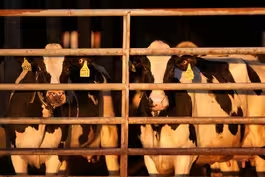
Scientists concerned about transmission of bird flu to cows
Video has Closed Captions
Why scientists are concerned about the latest transmission of bird flu to cows (7m 47s)
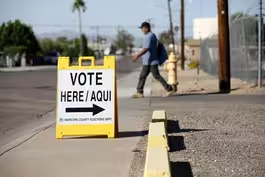
Understanding the politically diverse Latino community
Video has Closed Captions
How the politically diverse Latino community can help moderate U.S. polarization (8m 38s)

Zelenskyy pleads for support amid Russian offensive
Video has Closed Captions
Zelenskyy pleads for more support amid one of Russia’s largest offensives of the war (4m 24s)
Providing Support for PBS.org
Learn Moreabout PBS online sponsorship
- News and Public Affairs

FRONTLINE is investigative journalism that questions, explains and changes our world.

- News and Public Affairs

Amanpour and Company features conversations with leaders and decision makers.












Support for PBS provided by:
Major corporate funding for the PBS News Hour is provided by BDO, BNSF, Consumer Cellular, American Cruise Lines, and Raymond James. Funding for the PBS NewsHour Weekend is provided by...