
November 6, 2026
11/6/2026 | 55m 20sVideo has Closed Captions
Jennifer Siebel Newsom; Barbara Kingsolver; Jim Morrison; Jimmy Chin
California First Partner and filmmaker Jennifer Siebel Newsom examines social media's impact on girls. Author Barbara Kingsolver discusses “Partita,” her novel about a piano prodigy confronting grief. Ski mountaineer Jim Morrison and director Jimmy Chin discuss “Everest: The Other Side,” documenting Morrison and partner Hilaree Nelson's attempt to ski and climb down Everest's north face.
Problems playing video? | Closed Captioning Feedback
Problems playing video? | Closed Captioning Feedback
November 6, 2026
11/6/2026 | 55m 20sVideo has Closed Captions
California First Partner and filmmaker Jennifer Siebel Newsom examines social media's impact on girls. Author Barbara Kingsolver discusses “Partita,” her novel about a piano prodigy confronting grief. Ski mountaineer Jim Morrison and director Jimmy Chin discuss “Everest: The Other Side,” documenting Morrison and partner Hilaree Nelson's attempt to ski and climb down Everest's north face.
Problems playing video? | Closed Captioning Feedback
Where to Watch Amanpour and Company
Amanpour and Company is available to stream on pbs.org and the PBS app.
Watch Amanpour and Company on PBS
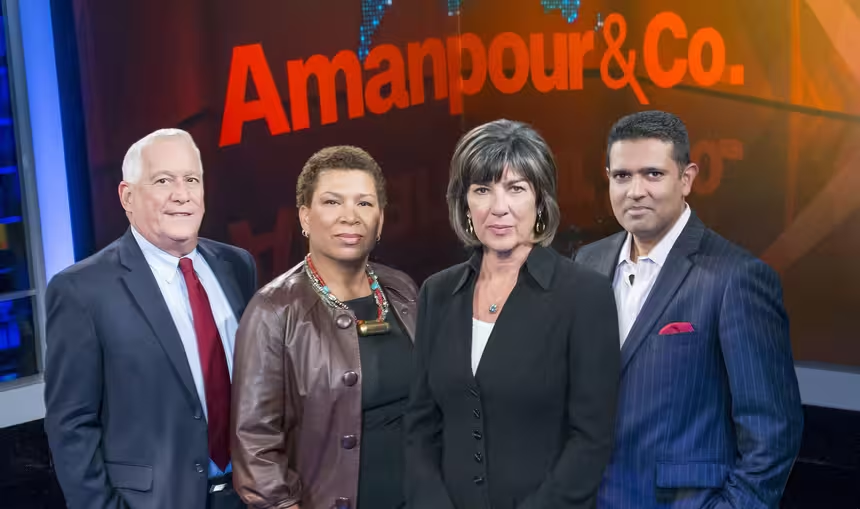
PBS and WNET, in collaboration with CNN, launched Amanpour and Company in September 2018. The series features wide-ranging, in-depth conversations with global thought leaders and cultural influencers on issues impacting the world each day, from politics, business, technology and arts, to science and sports.Providing Support for PBS.org
Learn Moreabout PBS online sponsorship(dramatic music) - Hello everyone, and welcome to Amanpour & Co.
Here's what's coming up.
- With the like button, we started to see a downturn in girls and women's mental health.
- The dangers of social media and AI laid bare.
Filmmaker Jennifer Siebel Newsom tells me about her new project, Misrepresentation Rise Up, revealing the dark world of misogyny and harassment that young girls are being subjected to online.
Then, the problem with rural America is that we don't feel seen, we don't feel heard.
Our problems have not been on the radar.
One of America's most successful writers returns with her new novel, Partita.
I talk midterms and what's next for the US with Barbara Kingsolver Plus.
It's not just about climbing and skiing Mount Everest.
It's about overcoming your own Everest.
Director Jimmy Chin and mountaineer Jim Morrison on their new documentary, "Everest, The Other Side."
The story of Morrison and his partner's attempt to conquer the mountain's most dangerous face.
♪♪ The Amanpour & Co.
is made possible by... committed to bridging cultural differences in our communities.
And by contributions to your PBS station from viewers like you.
Thank you.
- Welcome to the program, everyone.
I'm Christiane Amanpour in London.
Dire warnings of immediate and real-world dangers, and yet artificial intelligence continues to run rampant, outstripping and outsmarting the policies intended to contain it.
It is feeding an equally vicious machine, social media, piling on the devastating consequences, especially for young people.
In 2011, the filmmaker Jennifer Siebel Newsom released "Misrepresentation," an exploration of media misrepresentation of women and girls and the damage it can do and has done.
Now she is back 15 years later with a follow-up, "Misrepresentation Rise Up," which shows the dark and disturbing realities that girls continue to face online, including harassment, bullying, and misogynistic AI images.
Here's a short clip.
I definitely feel like I'm more self-conscious after getting on social media.
You'll never be pretty enough, you'll never be skinny enough, you're never gonna be enough.
We are putting young women through the most severe mental health crisis that the country has ever experienced.
They stole pictures from my social media, they strategically doctored them through AI to turn them into pornographic images.
They wanted to silence me.
It should not be part of my job to be harassed, to see pictures of me nude spread around.
We form a new technology and we immediately find a way to oppress women.
Now, the filmmaker also happens to be married to California Governor Gavin Newsom, and she spoke to me from Sacramento about this week's midterms and her latest film.
Jennifer Siebel Newsom, welcome to our program.
Thanks so much for having me.
So you have a very important new documentary out.
It's a follow to one you did back in 2011, and we're going to talk about this.
But I cannot not ask you about your reaction to the midterms.
Oh, I was ecstatic.
What a blue wave.
The people of America spoke up loudly and proudly.
And we have 17 female governors in our country, which is so exciting.
So many firsts.
Deb Haaland, the first Native American governor of any state.
My friend Gina Hinojosa, the first Latina governor of Texas.
The first female governor in Georgia, Ohio.
My friend Amy Klobuchar is the first in Minnesota.
It is so exciting.
Let's talk about the issues that you address in the follow-up to Misrepresentation.
As I said, it's 15 years since you did that one.
This one is called Rise Up.
What is it that you felt you needed to focus on now?
What happened in those interfering 15 years, or didn't happen, that you wanted to focus on?
Right.
Well, so we were making so much progress with the first misrepresentation.
More and more women and girls were aspiring towards leadership.
More women were running for elected office.
Girls and young women were outperforming and outgraduating in college and graduate school.
So all of that was really positive.
We had the Me Too movement, we had Time's Up, but we weren't paying enough attention to the downside of social media.
The Like button was introduced when Misrepresentation premiered at Sundance Film Festival and sold to Oprah Winfrey Network.
And with the Like button, we started to see a downturn in girls' and women's mental health.
We also saw an advent of the dark web and the beginning of the manosphere.
Donald Trump became our president in 2016, beat out the most qualified individual to run for the presidency, and who happened to be a woman.
And then we started to see, you know, the overturn of Roe v. Wade and the stripping away of women's rights across the country.
Again, Girls and Women's Mental Health came out in 2021, suggesting that 57% of girls were seriously feeling persistent sadness and hopelessness, one in three seriously considered suicide.
And we had again with Trump 2.0, the normalization of rape culture in the highest office in our country, despite so much progress that we felt had been made.
And so it was time to look at the fact that AI and social media have been weaponized to silence women's voices, harming our mental health, our safety, and our political power.
And it's happening at an unprecedented rate and at scale, because technology is the new cultural communicator of our time.
I'm going to dig deeper into that in a moment, but first I want to play a clip about what you're talking about.
This is focusing on the mental health crisis that you're describing.
Here's a clip.
It's immeasurable how much pressure there is to conform to a certain idea of teen woman.
I think a lot of girls, they're scared to speak up.
They're scared of making a mistake.
They're scared of being judged.
And with social media, you not only have to deal with the opinions of people within your own school, but also the opinions of the entire society sitting on their toilets and coming en masse at you.
It is really extraordinary.
And when you said the advent of the "like" button has precipitated, or, you know, at least quantified, this horrendous lack of self-confidence and feelings of sadness, isolation, and, you know, mental health, it's really quite something to think that an ordinary feature on a phone or whatever it is can have this amount of social and personal disruption.
And I just don't know whether you have the answer to how does one, if not roll that back, control that?
Well, look, it depends on who's designing the technology.
It's why we need more people with empathy and leadership and tech companies on their boards.
It's why we need more women in leadership designing technologies and on their boards.
It's why we need girls involved in creating these technologies that ultimately weren't made by or for them.
It's why we need more allyship in our country.
It's why we need more fathers of daughters to design and companies, but also to support and uplift products that actually can benefit their girls and ensure that they have an opportunity to realize their dreams and to frankly achieve the American dream.
And we need leadership in government in our country that's not bought and paid for by these tech lobbyists and tech titans, that's not in bed with them, that knows that this has been one of the most destructive contributors to the mental health crisis that we have in this country.
>> You know, Jennifer Siebel Newsom, you are a major filmmaker, but you also happen to be the partner of a very powerful politician, i.e., the governor of California, Gavin Newsom, who -- or, rather, in whose state you have all this tech, you know, tech stuff -- tech bros, AI, all of that stuff.
None of these people have actually voluntarily -- certainly in the social-media aspect -- none of them have had governance.
None of them have restricted what has been deemed to be their harmful practices.
Most of them deny it.
It was only a court case that held one of the companies liable.
What do you think is the role for government in limiting the extent to which these companies, who make billions of dollars, as you say, limiting their harmful practices?
So, we need legislation, we need regulation at the federal level, but I'm actually proud of what we've done in California, and I've been advocating for this and championing this from the get-go, because remember, I'm a mother of four.
I see what technology has done to my own children and to my friends' children.
And I delayed giving my children phones until they were 14, and I was so proud of myself and thought I was so smart and clever, and it didn't matter.
It was still too early.
Our children, like Jonathan Haidt says, should not have access to social media until they're, and iPhones for that matter, really, until they're 16, they should not be in our schools, et cetera, et cetera.
But I'm really proud of the legislation that we have signed into law and of our legislatures that has partnered with the governor on this.
We were the first to sign legislation on age-appropriate design code, on online privacy for children.
We've banned addictive social media before age 16.
We are holding tech creators accountable.
They're liable for harms done on their platforms.
These are all in -- Some of them are newer.
Some got stalled in the courts.
But I'm really proud that this is like a baseline and that other states, but, frankly, the federal government needs to follow suit.
-And when you mention these things, for instance, in other parts of the world, like here in the U.K.
and Australia and elsewhere, they are legislating about the age of being able to have phones, and 16 is the one that they are legislating about.
And it's really interesting to see where this is going.
Also, I'm always shocked when I hear these major tech bros saying that they don't let their own kids on these smartphones, because they know the danger of this.
So, in your film, you also, you know, talk about the added danger of AI, which is, I guess, social media on steroids and threatens a whole 'nother raft of not just mental health but existential crises.
Where do you see that going, and what are you trying to say about that in the film?
So, you know, we spent time with Sabrina Javayana, who was one of the first, the youngest LGBTQ-elected, equivalent of supervisor, then mayor, in Florida, and experienced deepfakes, unwanted pornographic deepfakes, that really destroyed her and her family.
And we also spent time with Nina Jankowicz, who's been the target of threats, death threats, rape threats, doxing, harassment online.
She worked in the Obama National Security Division and later for President Biden.
And what we've learned is that our foreign adversaries see American misogyny as a threat to our democracy.
And they have had no problem joining in on the chorus of bots and, you know, going after women who speak truth to power, who are advocating for themselves and leadership.
And our misogyny is a threat to our democracy.
A democracy requires women to have seats at the tables of power, women to engage in the political process, and to be safe.
And it is a weakness in America.
And our foreign adversaries know this and have exploited this.
And it is a danger.
And America needs to value women and center women in the political process and protect us from these technologies that are trying to harm us and ultimately benefit our foreign adversaries.
- That is so interesting when you put it in that way and in that context.
So I just wondered whether, given that, and we know how many women in public office or in public life get so attacked online.
Some have to have special security details, there's death threats, there's all these things.
And yet in America, on this round of elections, as we just said, there were a lot of women who ran and a lot of women who were elected.
Do you think that things may be changing?
I mean, are we potentially at a changing point?
And I'm going to ask you a follow-up, because you can see the "manosphere," so-called, all the, you know, the podcast guys who brought Trump in and made him, you know, electable or knowable to young, white American males, they sort of have turned against him now.
They're kind of mocking him and all the rest of it.
And I just wonder whether you see a moment where maybe the scales are sort of balancing or things may be moving on.
Maybe I'm being too optimistic.
- I love the optimism.
We need hope.
I will say one of the characters in "Hotel Mud," an incredible woman who ran for office in Tennessee and lost the first time, just ran her campaign and had unwanted AI deep fakes of her face and her body on pamphlets mailed to all of the constituents, again, unbeknownst to her, unapproved by her.
She ended up winning, which is so exciting.
But this was a challenge during her campaign, because there was so much misinformation out there.
And so while enough of the population is aware of AI, it is very harmful to us, potentially, in our country.
We saw it with James Tallarico, who, yes, he survived.
And so now those who've been elected into leadership, they need to hold these AI and tech companies, these social media companies, accountable once and for all at the federal level.
And once we do that, we will be in a better place.
But I am I'm still very concerned.
My hope is that enough mothers and fathers with conscience are in leadership and they're going to say enough is enough.
Our humanity is more important than this technology.
And we must put constraints and guardrails around this innovation.
And you can have innovation with guardrails and oftentimes it is the best, most successful innovation.
But that's what we need right now for our future for our humanity.
Yeah you know I'm just reading also these these notes like in the documentary you speak to the mother of a teenage girl Alexandra Hinks she died by suicide after being exposed to online harm and the mum talks about the lack of guardrails the algorithms that she believes her daughter and others obviously you know are pushed into this kind of harmful content and into this self-harm so you know I guess I'm just gonna ask you you know let's let's say you a first lady of the United States let's say your present your father your husband runs for president is this something that somebody of that ilk could actually tackle because no matter how much is put in front of the people who own these companies they somehow managed to slither out of responsibility It's a great question and I am, remember California is the fourth largest economy in the world and so we play a big role in the global economy and what we do actually matters.
I've spent a lot of time in Europe with different leaders who have been so upset about what's been happening in our country and are so concerned about how we've let these companies go.
about how we've let these tech titans off scot-free.
And I think that, I mean, you know better than anyone what the world said on Wednesday morning, the relief, the gratitude that America finally decided to hold this administration in check.
And in holding this administration in check, we're going to hold the greed and the corruption and the tech titans in check, and we're going to allow them to innovate, but with proper guardrails that anchor the safety and well-being of women and children and marginalized communities and that ensure that our democracy can thrive.
>> And, honestly, you know, in view of everything we've discussed, it's not gone unnoticed that one of the biggest tech titans, Elon Musk, was really held accountable by the American people.
He put, you know, close to a billion dollars into Republican contests, and the voters said no, whether it was in Texas and elsewhere.
And I think that's not gone unnoticed amongst foreign adversaries or even allies, that actually there's a limit to the power people want to see these tech titans accumulate that's unaccountable.
So, that's just my commentary.
But, Jennifer Siebel Newsom, thank you so much indeed.
>> Thank you so much for having me.
It's always nice speaking with you.
I'm a big fan of yours.
>> "Misrepresentation Rise Up" is now playing in select theaters and will continue its rollout across North America throughout the fall.
Now, it is one of the literary events of the year, one of America's most best-selling writers, Barbara King-Solver, releasing her new novel.
It is called Partita, and it follows a woman called Livia, who after starting out as a piano prodigy, finds herself struggling in later life with grief and regret and injury.
It is King-Solver's first novel since the Pulitzer Prize-winning Demon Copperhead back in 2022, and both books share a razor-sharp awareness of how class and growing up in rural areas shape people.
We spoke this week as the midterm results were coming in all over the United States.
Barbara Kingsolver, welcome to the program.
- Thank you, I'm glad to be here.
- I have to start by asking you, because your books have been, you know, not just massive hits, but also, you know, political about the American condition in various different forms, cultural certainly.
What is your reaction to the incredible tsunami by the Democrats this week in the midterm elections?
- It's a really happy morning to wake up in the United States of America.
And I'm gonna say that for several reasons.
One is that we saw that money cannot buy elections.
Texas is a really good example where I think Elon Musk spent $500 million to try to buy that election and that election was won by integrity.
That's Texas.
The same has happened in a lot of rural parts of this country which gives me a lot of hope.
I'm a rural person.
I represent in my writing rural America and I think that we've gotten a bad rap.
I think that we've shown our true colors today.
- Well, interesting because your latest book, "Partida" is about rural America to an extent, but I wanna ask you just to follow up on what you just said.
President Obama posted that this was a message that America needs to heal, that all sides need to get back together again, that there's just so much poison, so much division that has been sowed.
Do you feel the same way and do you think it's possible, certainly from where you're sitting in rural America?
- I absolutely think it's possible.
I think the problem, the problem with rural America is that we don't feel seen, we don't feel heard.
Our problems have not been on the radar of either political leaders or cultural leaders.
We don't see ourselves represented.
We don't see our problems, our nuanced lives, our generosity, the things that are important to us just don't show up in American culture.
And that's why I write from the place I live, as a Southern Appalachian rural person, to try to help, try to, try to help, try to represent these lives.
You know, before again, I go to Partita, let me follow up on what you've just said, because your book "Demon Copperhead," which was a massive, multi-million-dollar-selling book, Pulitzer Prize-winning, and it did address a major issue, which was the opioid addiction crisis, the deaths of so many people in America, that I remember in "Trump 1.0," they promised to deal with, and Trump came to power because he convinced people in rural America, by and large, and "Russ Belti America" and "Flyover State America," quote, unquote, that he would hear them and he would represent them.
What happened to the opioid, I guess, victims?
Well, we have, we have, the opioid crisis has not gone away because we have a generation of kids orphaned by that, by that crisis.
And I don't know that Trump necessarily promised to do anything about it.
I don't think that's why people voted for him.
I think what he promised was to see rural people, to help get rural people back to work and not to come to send, which is what we're so accustomed to.
But he obviously he failed.
He didn't do any of those things and he has been, you know, too busy painting his room's gold to care about us.
And that's what we've just seen.
So my job is to write stories, to tell stories that can be both mirrors and windows.
I write from rural America so that rural people can see themselves represented with, you know, not in a stereotyped way, but in a realistic way, but also as a window for people outside of these regions to look in and see what life is like and what we really need and who we really are, so that this problem of condescension, of cultural condescension, which has really divided us, I think that's the root of the problem.
We feel that outsiders dismiss us.
That's what I'm trying to get at through my fiction, that we are much more interesting and nuanced and smart than we're given credit for.
And I think that healing, as Obama has so importantly pointed out, healing does need to happen.
And the way that happens is through empathy and compassion for people who are different, who come from a different place and living different lives.
That's what fiction can do.
I'm sure that my publicist would like for me to mention the title of my novel, Partida.
This is, most everything I've written for the last decades has come from rural America.
This is another kind of Appalachian.
She's not, nobody in her family is addicted to opioids, but she faces the problems that we face here.
Her family does not have health insurance.
It's very, very difficult, if not impossible for kids from this region to get to college.
And if they do, they can feel marooned because they're class migrants, because of the class barriers between a rural kid and the life that they might dream about.
So, the protagonist of Partita is Livia, and she is from rural Appalachia, and she does get a scholarship to a music conservatory at university.
It's a really wonderful book.
Now, I am two-thirds of the way through, so no spoiler alerts.
No spoiler alerts, 'cause I'm really loving it.
But clearly I know enough about, I know enough about the story already, and I've got to the place where she is grievously wounded, but I haven't got further than that.
So you were talking about, what are you saying through Livia?
- Well, her particular story, coming from a difficult family background, a background of trauma, that's because it's a novel.
Things have to happen in a novel, including bad things, mainly so that we have a plot and the readers can see how characters have overcome their challenges.
And the important thing about this book and the way it's constructed is that it's a woman looking back on broken parts of her life and trying to put them together.
That's universal.
I think anybody from anywhere can relate to that and can hopefully, you know, gain some wisdom from a story like that and can apply it to their own lives.
Now, what's particularly Appalachian about Livia's story is where she's coming from and the fact that in going to college, in going to university, through this extraordinary skill she has as a pianist, she finds herself in a place she doesn't feel really very welcome.
And a larger, another part of this story is about art and accessibility and fine art and what art does for us.
Why do we need music in our lives?
Why do we need art?
It's kind of a huge love story about this eternal human craving for art and beauty and what it does for us.
And I think that's really important, you know, in terms of social realism, I think that's very important in the cultural and economic moment of people feeling precarious, economically precarious, and looking to what's necessary in their lives, you know, the things they need, food and shelter.
And it's kind of a caution about jettisoning those things, the beauty and the art that might be seen as as unessential, as optional.
My argument is that they are essential too, that art in, you know, whether it's in a civic orchestra or in a second grade music class, it gives us things we desperately need as humans.
It helps us like our lives better.
Yeah.
Um, you know, I was just so transported by the way you write about music and all the intricacies of piano and the notes and everything.
And then I read that you yourself left Appalachia for Indiana, like Livia, on a piano scholarship.
And like Livia, but not quite, you also have a situation which makes it more difficult for you physically to play.
I just find that fascinating because the quality of your experience is absolutely in the telling in the book.
- Well, I can tell you happily that my life is very different from Livia's.
First of all, I am not the pianist that she is in the novel.
I found out, I sort of by accident got this scholarship and very quickly figured out within one semester that I was not going to make it as a pianist.
I didn't have the right stuff.
That was not the life for me.
I moved into studying other things, science, actually.
Likewise, much, much later in life, in my late 50s, early 60s, I started being troubled by a genetic hand condition called Dupuytren's contracture.
So these are two different things that I know about from experience.
I know what it's like to be a pianist and to be in that very, really rarefied, cloistered place in a music conservatory, even though I didn't last very long.
I know what it's like.
I also know what it's like to have to give up things because your hands won't do what you want them to do.
So these are just two ingredients of my life.
I've also, you know, I've done a lot of jobs.
I've worked as a house cleaner.
I've worked in a scientific laboratory.
I've worked as an x-ray technician.
I've done a whole lot of different things in my life, and I pull these ingredients from my pantry, you know, once I decide on the soup that I want to make.
I can use pieces of my experience, but I always also have to do a lot of research because the soup I'm making is not autobiographical.
It's something that will mean something important, I hope, something valuable in the world to my readers.
It's not about me.
I'm not that important.
>> You've had, you know, an amazing life, as you said, going from piano to science and now to writing.
You write about her great love of music, obviously, Livia's, but also she's having a very hot love affair with Sigurd, who is not a student but is a union organizer and tossing around Marxist tracks and things like that.
Anyway, that becomes a recurrent theme through the book, and the book starts with her receiving a call from him out of the blue, and I'm not yet towards the end, so I don't know the final, so no spoilers.
But you write about Bach and Ravel and Chopin as kind of hot.
You say, "Music is made of tension, little tense moments, "one after another, each one a building block "of tightness or unease that makes your body "lean towards something, want it, even long for it, "until that yearning is answered with release."
Pretty hot.
- Very steamy, right?
- Very sexy.
Very much, yeah, steamy.
And all the reviewers have focused on their steaminess.
(laughs) - Well, you know, it's a love story.
And if I was going to do all these, you know, terrible things to Livia, she has to live through a lot of trauma and damage.
But, you know, fundamentally, this is a love story on several levels.
It's a story of youthful passion and how crazy making that can be, how destabilizing first love, young love can be.
But also I have the advantage of being the age that I am and looking back at that across a lot of years of different kinds of love, a different, a more mature kind of love that is really the opposite, that's very stabilizing, you know, that's made of profound affection and trust and accommodation and forgiveness.
And I thought it would be interesting to contrast those two kinds of love that go by the same name, but are opposite in their effect on our lives.
And then ultimately, the bigger love story, the biggest love story of all, which is our love of art, of beauty.
The biggest love story.
I like the way you put that.
But as a last question out of the past, before you became a writer, you were working towards a PhD, studying altruistic behavior in termites.
Now that is very niche.
So I want to know, what did you learn from studying the termites?
That is still kind of, you know, gives you pause for thought today.
Well, I was studying evolutionary biology at a time when people were very interested in sociobiology and the sort of the genetic basis of altruism, not just in termites but in all kinds of animals, in social animals, including humans, studying the scientific basis of community service basically.
And there, it was really very interesting research at the time.
I chose the organism that I did, termites, because it was, you know, mathematically it was a very interesting project.
But I was deep into it when I suddenly realized that when I finished my dissertation, there were maybe about 12 people in the world who would read it.
And I thought to myself, I bet I could reach for a larger audience than that.
And you know what?
I found it.
- You certainly did.
Millions and millions and millions of people all over the world.
Barbara Kingsolver, thank you very much indeed for being with us.
Thanks for having me.
And Partita is in bookstores now.
A nearly impossible journey to achieve what's never been done before, all caught on film.
Everest has been summited over 13,000 times.
But only five people have ever climbed the direct North Face, and no one in the world has ever skied it.
It's this huge goal of ours, and to do it with somebody that you're in love with, it just felt special.
- Hazardous stuff.
Everest, the other side, follows Jim Morrison and his partner, Hilary Nelson, as they attempt to ski and climb down the North Face of Everest.
It's the most difficult and dangerous route on the mountain.
It's a story of determination and tragedy, all captured by filmmaker Jimmy Chin.
He and Morrison spoke to Hari Sreenivasan about this remarkable project.
- Christian, thanks, Jimmy Chin, Jim Morrison, thanks so much for joining us.
Jim, I wanna start with you.
I mean, this film starts out with what seems to be already an incredibly difficult goal.
It's not just about climbing Mount Everest, but it's to do it on the north face, which just looks like almost a straight wall.
And then you're gonna ski down it.
I mean, only five people in history had, before this trip, had ever even climbed that face of the mountain.
But I think the basic question is what drew you and your partner, Hilary Nelson, to just the idea of even doing this?
Well, I think we both were just drawn to big, beautiful mountains.
And, you know, this is the tallest mountain on planet Earth.
And it just happens to hold an incredible ski line that splits the north face of it, which is typically the big, steep, shadowed face in the Northern Hemisphere.
And after Hillary and I skied a mountain just next to Everest, Lhotse, the fourth highest mountain in the world, in 2018, this was just the one thing that was left that was bigger and badder and scarier.
And so we started to work together to figure out how we could try to do it.
We want to ski the most direct line on the tallest mountain on the planet, the Ruppelt.
It's a lot bigger.
From a skier's standpoint, it's just like, there's the Lhotse Kuar, and then there's, you know, the North Face of Everest.
The North Face of Mount Everest.
It's the ultimate ski run on planet Earth.
Jimmy, you've literally climbed the biggest mountains in the world.
What is so, you know, for somebody who's not a mountaineer, tell us the challenges of climbing the North Face versus the route that we kind of are familiar with, where we see these long lines of people getting to the top.
And I mean, what's so different about it?
- Well, first of all, there's just so much less information and less infrastructure on the South Side.
You know, it's been ascended over 10,000 times, you know, and there's a lot of people being guided up it every single year.
It's very, very familiar.
There's a lot of fixed lines, and there's a lot of people to build that infrastructure on the south side.
The north face, which is, you know, in the northern hemisphere, the colder face, the darker face, 'cause it gets less sun, is this, like you said, it's like a giant 9,000 foot tall wall that starts, you know, the base of the route is at 20,000 feet, almost the height of Denali, you know?
So you're starting at 20,000 feet just to start, and then you have to climb 9,000 vertical feet up to the summit at 29,000 feet.
It's very steep and relentless.
There's a reason why people aren't guided on that route because it's very technical.
Like you pretty much have to be a professional climber to even think about ascending.
- Jim, you know, in this film, we see one of the most tragic things I've ever seen.
And that is in 2022, when you and your partner, Hillary, are climbing, uh, Manaslu, I think, and it's the world's eighth highest mountain.
And we see some of the last moments of her life.
Take us back a few weeks, maybe after when we see you also processing her passing, but then your decision to come back and try this, this goal that the two of you shared, but you know nobody would fault you if you said I don't ever want to see the Himalayas again.
Well certainly in the beginning I wanted to quit.
I didn't know how I would get through the next hour or day of my life.
And I was just totally devastated and broken.
But over time I started to go back outside.
And in the beginning it was my dog that coaxed me to take him out and take him for a walk.
And then he wanted to go a little farther and it had snowed in Telluride, Colorado.
And we went and walked on our skis.
And the mountains just provided so much for me in my lifetime, the beauty of nature and the feeling of being out in wild places.
And as I began to ski again and began to climb in the mountains again, I just had this inner drive to go back and to try to complete this project.
And I really loved the idea of finishing it in her honor and finishing it and remembering her and her legacy.
And this felt like a really honorable way to do that.
- Jim, I can't imagine that kind of loss, but what's striking as people learn in the film is that unfortunately this is not the first time you've had to deal with this.
And I said, wow, how is it possible that in a human brain, the human heart can not just deal and process, but then push yourself to this other place?
And I don't know where that comes from.
- Well, Hari, we were getting to really the why of why I wanted to do this and why I wanted to make this film with Jimmy and why we wanted to tell the story.
And that's just because I felt really drawn to sharing.
You can be through terrible loss and terrible adversity and many of us are gonna confront something really difficult in our lifetime, whether that's loss of a loved one or sickness.
And it's not just about climbing and skiing Mount Everest, it's about overcoming your own Everest and overcoming the things in your life.
And you, even after the worst of circumstances, can begin to put one foot in front of another and build an incredible team, surround yourself with good people, and live your best life and continue on.
And I've chosen to do that to the best of my ability and carry those loved ones, my wife and children and Hillary forward.
And I really appreciate the opportunity to sort of share their stories and keep their story alive and keep them close to my heart.
- Jimmy, tell me about kind of the decision as a filmmaker to include the scene where we see that tragedy play out.
How did you come to the conclusion to say that this should be in the film?
- I thought about it quite a bit.
And I've been around a lot of people who've lost people, family, people that are very close to them, and including Jim, but where they never had a chance to see them.
Like they disappeared after they passed.
And not just in the mountains, you know.
And that haunts people to not know.
And, you know, the big question for me was, if this was me, would I rather have my children see it and know it and not spend the rest of their lives imagining what it was, or would I want them to see it?
And given my experience, that was a decision that was pretty clear to me.
And because that was the hard question because Hillary's boys were gonna see it, her family would see it.
And we screened it for the boys and Hillary's family before we really kind of took the film out.
And they understood why.
It was really cathartic for them.
And to know what happened and to not have to imagine over and over.
It's like it's like they could close that box.
And I think it's hard to see, but a lot of things are hard up front, but in the longterm, it's what's best.
And I did believe that that was the case here.
- Jim, we see in the film, we see these young boys turning into young men just in the matter of the years that it's taken to make this film.
And we see images of them watching their mom on screen.
And there's a quote in there, she says, "I know that that's not convenient or great for the people around me."
She's talking about Everest and climbing.
"But I just, I can't let go of it.
Do better, be stronger, try harder, go faster.
It isn't that vastly significant, you know, who cares?
But it means the world to me to see if I can do it.
And I wonder now, as these boys have grown up, and the fact that this document exists of their mom, how has that affected them?
- Yeah, I think that the boys are tremendously proud of Hillary and really, really proud of mom.
And one thing that she just wanted to instill in them was to have a passion.
And it wasn't super important what it was, but she was really driven to have that passion as a compass in her life and something to guide her through the ups and downs that we all go through, through life.
that is clear and present to her children in a sort of magnificent way with mom, but mom not being here is really, really hard.
And I think they have wrestled and will continue to wrestle with the decisions that she made and wish that she was still here.
- Jimmy, you and I have talked about these kind of trade-offs and what is the line and what you're willing to do.
And, but this is the first time we're kind of seeing, you know, little glimpses of the conversations that happen in your own family.
And there's this really kind of poignant scene where Chai is asking you, your partner and filmmaker, and it's telling you, "Hey, how many times, how many people have eaten at our dinner table who have died?"
And you had to pause to think about it because there's actually more than one, and that would be scary for anybody.
What did you want audiences to understand about these trade-offs?
What would you tell people on how you make these decisions?
I mean, I think we're looking at one of the great paradoxes of life, right?
You know, it's like, what are you willing to risk to pursue your dreams?
What is the cost if, you know, you risk too much?
And it's really impossible to reconcile when things go wrong.
When things go right, people say, "That was amazing.
You've inspired all these people.
You've got someone that's really pushed the human potential, expanded our understanding of the human experience, and yet there's still extraordinary risk."
So I don't know how you justify it.
If something does go wrong and they don't come back, is it justifiable to do that?
'Cause there's this idea, you know, in my line of work and in many lines of work, the sense of exploration, of doing things that nobody's ever done before.
That's an instinct I think a lot of people have, whether it's a scientist or a doctor or an artist or a writer, you know, there's this instinct to kind of push the edge of what's been done before.
to quell that instinct?
It's very personal.
I think it's a personal decision.
I think what's, for me, interesting is when people don't consider that maybe people who've chosen these occupations have actually thought really deeply about it.
(indistinct radio chatter) (dramatic music) - These are the worst snow conditions I've ever seen in my life.
Jim, I mean, just the physical strain, like I think putting in the kind of wear and tear that your legs have gone through just to get up would be brutal on most human beings.
But then skiing down some of these incredibly steep faces on very suboptimal conditions, there was just huge chunks of crunchy ice that we could hear, and you're, you know, flipping side to side.
And I'm just thinking, how is he physically able to do this?
Because that was, it wasn't like a 10-minute zip line down.
I mean, this was three, four hours that you were going downhill.
Yeah, it took a little over four hours to get down.
And I think it's important to note that I built an incredible team to help me get up.
And I didn't do that just to achieve it.
I did it also so that I could get to the top physically in a place where I could still put my skis on and still ski down.
I put a tremendous amount of time and effort into training for this and really trained for it my entire life.
And then I got to the dream run of my lifetime, the hardest, steepest, scariest, most consequential, maybe the most difficult conditions of any ski run I've ever made.
And it was my one and only opportunity to achieve this.
And as I skied down, I just took one turn at a time.
I focused on what was right in front of me.
And I didn't think about, oh, this is what is a thousand feet below me.
I thought about what was right in front of me.
And I relished the opportunity that I was doing it.
And I tried to make every turn count, tried to link as many turns together and really have the run of my life.
And then I crossed the Berkshire on at the bottom and I too was just in awe and astonished that I was still standing.
There's a section where Hillary says in the film, and why I keep coming back to these high altitude mountains is because it feels like you're so close to whatever it is that separates, not particularly religious, but our spiritual world from our physical world.
You can almost reach through to the other side.
And Jim, we hear about the previous tragedy that you experienced in your life where you lost your wife and kids in a plane crash years ago.
And you said that, you know, there's something magical that sort of happened to you in previous trips.
And I wonder what you experienced on this trip as well.
Yeah, I mean, Hillary and I spoke a lot about that other side.
And when you're when you're up there above 8000 meters, you're in such an ethereal space, it feels as if you could almost reach through to the other side.
And it certainly feels like if you sat down and you relaxed and you let your heart rate slow down, and you slowed your breathing down that you might never get back up.
And if you make a mistake, you're, you're not going to make it.
And there's something that has brought us closer to that spiritual sort of alternate part of our universe.
And as I climbed to the summit, focused on the task, focused on my team, focused on what we were doing.
As I stepped onto the summit, I looked off into Nepal and I looked at these mountains that I'd climbed with Hillary and spent months of my life on.
I just had a and overwhelming feeling of her support, feeling like she was there watching us, feeling like she was really proud of the fact that we had kept going and we pushed through all the adversity to achieve this so that the title gives a look at the other side of the mountain and the other side of mortality and the other side of life and Maybe the other side of you know, what what we're all willing to do Jim Morrison and Jimmy Chin, thank you both for joining us.
Thank you.
Have a nice day.
>> Thank you.
>> Chin is obviously drawn to the extreme side of climbing.
He and his former partner, Elizabeth Chai Vassaheli, won an Oscar for "Free Solo," which was a harness-free ascent of El Capitan in Yosemite National Park.
That's it for our program tonight.
If you want to find out what's coming up every night, sign up for our newsletter at pbs.org/amanpour.
Thanks for watching, and goodbye from London.
 New
Jim Morrison on Becoming the First Person to Ski the North Face of Everest
Video has Closed Captions
Ski mountaineer Jim Morrison and director Jimmy Chin discuss their film, “Everest: The Other Side." (18m 25s)
Providing Support for PBS.org
Learn Moreabout PBS online sponsorship New Episode
- News and Public Affairs

Top journalists deliver compelling original analysis of the hour's headlines.
 New Episode
- News and Public Affairs

Today's top journalists discuss Washington's current political events and public affairs.


 New Episode
 New Episode
 New Episode

 New Episode



 New Episode
 New Episode
Support for PBS provided by: