
Sept. 29, 2026 - Full Show
9/29/2026 | 26m 50sVideo has Closed Captions
Watch the Sept. 29, 2026, full episode of "Chicago Tonight."
Alderpeople strike a new deal on Chicago’s parking meters. And the Federal Reserve raises interest rates — what that could mean for the housing market.
Problems playing video? | Closed Captioning Feedback
Problems playing video? | Closed Captioning Feedback
Chicago Tonight is a local public television program presented by WTTW
WTTW video streaming support provided by members and sponsors.
Sept. 29, 2026 - Full Show
9/29/2026 | 26m 50sVideo has Closed Captions
Alderpeople strike a new deal on Chicago’s parking meters. And the Federal Reserve raises interest rates — what that could mean for the housing market.
Problems playing video? | Closed Captioning Feedback
Where to Watch Chicago Tonight
Chicago Tonight is available to stream on pbs.org and the PBS app.

WTTW News Explains
In this Emmy Award-winning series, WTTW News tackles your questions — big and small — about life in the Chicago area. Our video animations guide you through local government, city history, public utilities and everything in between.Providing Support for PBS.org
Learn Moreabout PBS online sponsorship>> Hello and thanks for joining us on Chicago Brandis Friedman.
Here's what we're looking at.
>> When we talk about it.
The deal of the century.
For whom?
For the first time ever, we're going to get a share of the profits.
>> Chicago's parking meters are sold again.
What the new deal means for the city and taxpayers.
Mortgage rates are on the decline.
We explore the potential impact on the housing market.
And new data on the history of Chicago's ward maps.
How redistricting impacts voting current more.
First off tonight, 18 Chicago City Council members and 20 state lawmakers all agree they oppose the most recent rate hike request from people's gas.
>> This massive spending has shown no discernible impact on system safety.
In fact, aggressive pipeline replacement has been shown to undermine system safety.
>> The group of elected officials all signed onto a letter to the Illinois Commerce Commission, asking it to reject the 144 million dollar request.
If approved, the average residential customer would see a 7 to $8 monthly bill increase.
But consumer advocates say it adds up to a 71% rate increase over the last 4 years.
In a statement, the utility provider says People's gas tries to balance market conditions and affordability postponing essential infrastructure work, though, is not a solution that would greatly increase safety risks and costs.
Downtown commuters.
You may need to leave early or to avoid the semi-annual bridge lifts that start tomorrow.
That's when bridges along the main and south branches of the Chicago River are lifted to allow voters to move their vessels from the marinas out to winter storage facilities.
The Chicago Department of Transportation says they'll be lifted in succession from DeSalvo, Lakeshore Drive to 18th Street.
One of the time each lifts taking about 8 to 12 minutes.
Cdot says they typically occur on Wednesdays and Saturdays through mid-November for more on dates and times.
Visit our website.
Creating art for public spaces.
Repatriating remains of migrants who died along the Texas Mexico border in creating novel new technologies for drug delivery.
These are just a few of the complex disciplines being recognized with the MacArthur Foundation's annual fellowship.
Also known as the Genius Award.
>> I feel my symmetrical models attempt to describe unusual systems like swarm robots, biological tissues, your own networks.
And I try generalize and modified the techniques of radical physics wideout to >> So physicists tensions over Tele is the only Chicago win in this year's class of 20.
He's a professor at the University of Chicago whose work builds theoretical frameworks to describe the behavior of meta materials, soft materials and more environmental scientist.
Tide won at the University of Illinois in Urbana, also received the honor, which comes with $800,000 for recipients to spend.
However, they please.
Up next, older people approve a much-debated need or deal had.
A Sharon has the details right after this.
>> Chicago tonight is made possible in part by the Alexander and John Nichols family.
The Pope Brothers Foundation.
And the support of these donors.
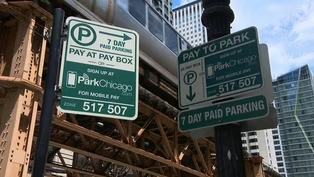
>> Congo's parking meters have been sold again.
City council members voted 46 to 3 today to allow a New York based investment firm to buy the city's 36,000 parking meters.
Here's some of that to be.
>> We Take our streets bat history will judge us pour le just it is just council.
>> We've got the opportunity today.
Colleagues to write a new chapter.
>> Our Heather Sharon joins us now with more.
Heather, that's a pretty lopsided vote to cap off months of controversy.
What changed?
Well, nobody doesn't think the 2008 deal is a lemon, but the city council agreed today that they've made lemonade, even though it was pretty better.
The main sweetener is the 75 million dollar payment that will come the city's way after the sale closes at the end of the year.
If it does is expected, of course, also the firm that purchased the meters for 2.5, 3 billion dollars agreed to sell on the air.
That airline had carried out long-haul deportations for the Trump administration's mass deportation effort.
Several older people more than a dozen said they would not vote to approve the sale unless that happen.
will this mean we all have to pay more?
No, I think known.
not yet.
Now the sale doesn't include any change to what you pay for the meter.
However, as you heard all the police say Chicago now shares in the profits from the meters.
This deal calls for Stone Peak the city 5% of its annual profits.
So that means that prices go up at the meeting, the city get more money.
So that gives the city Council and incentive to raise those rates in there.
Some proposals out there that would tie meter rates to inflation.
That, of course, is going to be controversial.
And the mayor stopped far short of endorsing that Clinton today, right in another city council to find the mayor approved a measure that is designed to make it more difficult for the city to borrow money.
>> What will change?
Well, right now, you only need a simple majority of the city council or 26 votes to borrow more money.
This measure is it takes effect, would require 30 votes of the city council, which, of course, has 50 members.
Now, mayor Van Johnson said today that this is exactly the wrong thing for the city to do.
And he's didn't say whether he would veto it, but he said it would make it harder for the city to invest in the South and the West Science.
And of course, that is the central promise of his time in office to get city money flowing to those neighborhoods that suffered from distance meant for decades.
So we will have to wait and see what the mayor doesn't.
Weather heat issues, 8, 4th veto of his what he hopes will be his first term in came the Sharon.
Thanks so much.
Thanks.
Brand U.S.
>> And you can read his full story on our website.
It is all at W T Tw Dot com slash news.
Costs are climbing for people getting home loans.
Last week, the U.S.
mortgage rate top 7% for the first time since January 2025.
That's after the Federal Reserve hiked interest rates by a quarter of a percentage point earlier this month.
The Fed says the increase was driven by rising inflation, but it could spell bad news for an already strained housing market.
Here to break it all down our David Boyd, president of the Real Estate Development group, Chicago neighborhood Initiatives.
So Radar Chapman, director of applied Research at the Woodstock Institute.
And Dennis Rock in residential real estate reporter for Crain's Chicago Business.
Welcome Back, everyone.
Thanks for joining So Dennis, as we said, the Fed raised interest rates earlier this month for the first time since 2023.
How's that going to impact the housing market?
>> Well, it most likely will make the cost of borrowing higher.
Mortgage rates have gone up, but not quite as much as the Fed's benchmark rate has gone up.
The thing we're seeing in Chicago, though, not really having much of an impact when rates went up in 2022, we didn't see.
But buying fall off quite as much as it did in other cities and throughout this relatively high rate climate, we've continued to see a large number of and prices rising.
Unlike what's going on in most other big cities.
Yeah.
What I want to come back to that the radar want to get you in here because federal lender, Freddie Mac a place the U.S.
mortgage rate at above 7% for the first time.
>> Since January 2025.
What does that mean to someone who's trying to buy a home?
This will increase their monthly housing costs.
>> For those that are answering the market would also limit the supply, the people that are currently in their homes will be less likely to sell.
So by a game at a higher rate.
So they have that lock in effect.
Currently will push the debt to income ratio for potential borrowers up.
Reducing their purchasing.
Power are already saying that age of first-time home buyers is at a historic high at 40.
And we're also seeing that people are forming fast forming families later in life.
So that is going to impact the delay of people buying homes.
All that, okay, David, according to the Illinois Realtors Association, the state faces a shortage of 142,000 homes.
We have talked about this before.
>> Could this decision by the Fed exacerbate the shortage?
Oh, absolutely.
I mean, I think when you look at the impact of any kind of rate increase, looking at both the building and the by side and on the build site.
>> You're going to see construction materials continue to increase, whether that's because a tariff or highest interest rates.
You've also you know, the costs to borrow.
So that all gets pushed onto these construction projects.
And that's on the build site on the Buy side is that it's mentioned you, you know, for every uptick, you see mortgage rates, you disqualify families.
So for every quarter point interest rate, you know, across America, you're limiting over a million people Chicago.
That's 10's of thousands of people that are not qualify for mortgages when they see interest rates go up.
>> Dennis, the housing market, it wasn't in the best place before the Fed increased rates, especially in Illinois.
So the median sale price for homes in Chicago hit $425,000 in July.
That is according to data from Illinois of Realtors.
That's a 13.3% increase from last year.
What's been driving that increase?
>> Take inventory.
The lack of homes to buy.
There are so few homes on the market in August of 2026. in the city, there were 23% fewer homes to look at.
If you are buying then a year before Metro wide, there was 11% less in August 26, then in August 2025.
I've got to get a house because I just got a job on the other side of the metro area.
We just had more children.
We've just formed a family.
I need a house.
So I'm going to pay whatever it takes.
I have to pay up.
I have to pay premium.
We're seeing a very large proportion of homes sell for more than 100% of the asking price.
That's really the bottom now on property comes on.
The market is 100% is the least you're going to pay and you're going to go up from there.
And this is even with, as I said earlier, interest rates rising home prices, rising interest rates rising.
That's a double double whammy, but we're still seeing sales.
What does that tell you?
Just?
I mean, if people are still able I mean, are they buying within their means right of people are still able to pay that much.
They're paying a premium both on the cost of the house itself and the cost of borrowing but there still and they're doing it because they need 2 people are still getting into the houses.
Anyway.
Well, as David said, some people have been eliminated as prices rise.
Some people decide well, that I guess I have to keep renting or >> I guess I need to double up or something like that as interest rates go up.
Some people who were thinking of buying decide they'll go ahead and rent.
But what we're seeing is that it's not turning everybody off.
I'm finding a way if I'm a young by may be getting more money from may parents that I would have in the past.
My parents may have said, boy, this is really going to cost you a lot.
I was going to give you this money Graterol give it to you now and there are other ways people wealthy.
People drawing on the stock market.
I may have crypto wealth.
People are finding ways to afford homes as both sides of the equation rise interest rates and prices.
>> David, how does this interest rate hike impact developers?
Does that make it more expensive to build?
Yeah.
Makes it more expensive bill that makes expensive more expensive to borrow money and and the commodities and and labor costs continue to go up.
So I think, you know, to Dennis's point, I mean, the biggest factor in not seeing growth in supply its construction costs.
And when construction costs out pace, affordability, you get this huge gap between what it cost to build on what people can afford.
And that's unfortunately the situation rain in Chicago now is those that have means that have resource is yes, they can afford homes.
Those that are low and moderate-income get stressed and either have to defer or altogether for go the opportunity to buy a home.
So Sir, 8 or something you mentioned, millennials are the current generation driving most of the home sales.
Your research looks at what the unique challenges that they face in the home market as well.
Tell us about that.
Yes, I'm Millennials are currently 63% of Illinois's mortgage market.
So that 25 to 44 year-old is 63% of the mortgage market.
>> Where we're finding is that the disparities, the historic disparities still exist.
But we're also finding that the debt that millennials Kerry is non-work into debt.
So that includes the student loan.
That's the consumer loan that's in the installment loans which also create a barrier for the debt to income ratio, making them less desirable or higher risk for lenders.
So if we have a generation of borrowers that is not financially equipped to all the home.
>> And even if they do get in their home, they could be cash strapped so they get into their home.
And then all of in their finest breaks, etc.
We're creating a environment of financially fragile borrowers and then they might find themselves taking on debt to cover the cost of the furnace or air or whatever it might David, Howard developers have keep building despite increased costs.
>> Well, I think they just keep raising prices, whether that's home sales or rents.
It's it's a good thing to be a homeowner and a good thing to be a landlord these days.
It's not a good thing to to be to surrenders point to be a first-time home buyer.
And so I think builders are, you know, trying to find ways to cut costs.
We've we've looked into modular housing and manufactured housing as a way to maybe start to think about cutting costs.
I think the city can be doing more in terms of entitlement reform and zoning reform, helping get permits.
Push through quicker.
But there has to be an all-out attempt try to get costs down.
If we're going to see the supply start to increase the rate of even policy makers, policymakers should prioritize to bring down the cost of housing.
>> So I think initially it is a supply side, David, and then as have both said that that is fundamental.
If we do not create enough affordable housing people won't be able to get homes, but also think that we have to invest in mortgage, ready pipelines, so investing in the housing counseling agencies that work directly with communities create those mortgage, ready borrowers.
There's also some things that we can look at as far as the CRA and community investment policies.
>> Making sure that they still have their accountability to invest and Ella Mai communities, incentivizing best innella, my communities strengthening and not weakening the CRA.
And so everybody knows al in mind so moderate income, low to moderate Thank you so much.
All right.
That's where we'll have to leave it.
Thanks to all 3 of you for joining us.
Tennis Racquet, David Chapman, Thank you for >> Up next, how the history of Chicago's word maps tells a deeper story than you might think.
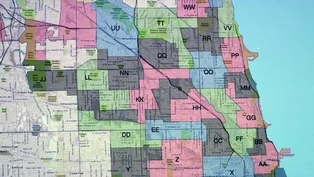
New research released today shows how 100 years of ward redistricting shapes things like voting resources and crime rates.
Researchers at you, Chicago Justice Project found that 15% of the city's land highlighted in blue on your screen has never changed wards while other neighborhoods are repeatedly divide it up on the map, Chicagoans prepare to vote for mayor and City Council early next year.
The data helps shine a light on who gets a seat at the table.
Joining us to break down the findings is Robert Vargas, sociology professor at the University of Chicago and director of the U Chicago Justice Project.
Welcome Chicago Tonight.
Thanks for joining us.
Thanks for having me.
So tell us about your research.
How do the implications of settler colonialism that gerrymandering redlining, how they all still show up today in the ward boundaries yet.
So my research up to this study was studying the consequences of redistricting for things like crime and 3, 1, 1, requests.
Because what we were finding was that >> communities that were split up across 4 or 5 different awards higher crime rates and had slower 3, 1, 1, >> Responses.
I stopped to wonder like if you if I could, if I could digitize all the ward maps going back to the city's history, what that tell us about how this question about the relationship between redistricting and inequality and could unfold over the entire history.
And so digitize it.
Took us many years to find the digitize them.
And what we discovered was the importance Chicago's center colonial history.
So it's important remember, remember that in the 18 30's when Chicago was founded, it was much, much smaller than it is today and neighborhoods that we know like.
Lakeview Rogers Park High Park were also their own settlements.
Through a long history that we've uncovered.
That settlement.
History helps to explain over time how those communities continue to be protected over protected from redistricting.
>> So 15% of the city's land has never changed wards.
What does that mean for those areas?
>> That means a couple of things.
I think that.
Historically it's changed quite a bit.
And so initially you think of the neighborhood of like High Park.
That representation in the city council helped ensure that whatever taxes that they were contributing, Chicago that was growing in the 18, 100's at the time that they would get their fair share.
And then when you go up to the time of the 1950's and 60's 70's, which is the emergence of the first daily political machine.
Those that stable political representation help to become the basis.
The aldermanic that helped daily covered and that those same wards have consistently.
When you look at the history of the city's political coalitions, those words have consistently been part of the core political coalition to at that has decided some of the major policy decisions in the city.
So it's it's a story of path dependence of the past kind of shaping the president who are some of the people who live in those areas that >> Been in the same ward, all this tool for It should be of no surprise to many people have.
Bridgeport is one of the communities because it yes, that's the home of the Daley machine that to 2 generations in the mayor's office high park which houses the University of Chicago Edison Park.
And it's important to remember many of these settlements were founded over some of that the major investors of real estate in those communities.
And so Rogers parking believes was was named after will.
Fred Rogers, for example.
And you go down the list.
And, you know, there's been a lot of change in those neighborhoods for sure.
But structurally that position that they've had and has enabled those communities to continue to have more powerful.
And so the city politics then on the flip side of that, a key part of your findings is that it the board redistricting in Chicago has disproportionately impacted black, Latino immigrant working class communities.
>> What are impacts for the folks, you know, in those neighborhoods when they are repeatedly getting redistricted?
Yeah.
So the their cup, there's a lot going on there.
That just goes be on the history of settler colonialism.
So in the 1960's with the Voting Rights Act.
>> Wright local governments where being forced to account for racial equity and population equity to across Aborts and in the end, the process of trying to create a majority minority ward like a board that has a majority number of black or Latino residents is a lot harder than you would think because that requires you to draw very oddly shaped districts to get those numbers.
And so that's one reason in addition to other, traditional gerrymandering concerns going to protect incumbency.
But that's that's one of the factors that's going on here.
And so it's it's kind of like in the spirit of trying to maintain and provide racial racially fair maps.
consequence of this is the dividing up and splitting of communities.
I think what's really crucial now is that with the rolling back of the Voting Rights Act, which we've seen at the Louisiana verse Cali.
people who are concerned about racial equity are having to go back to the drawing board.
And I think that these histories not just of the city council, this kind of study could be with the state legislature could be done with congressional districts.
These hands of history's, I think can create different kinds of conversations about how to draw racially equitable maps.
We're redistricting.
It's based on population, but that means, you know, that some neighborhoods get divided into multiple awards.
I can take it in wood, for example, when I think sits across 4 or 5 wards.
>> How might that impact the residents who live in those areas?
Well, you know, a couple of right where I live in the West Loop as well is split up across a couple of boards and >> a neighbor of mines child was hit by a car at an intersection where one alderman represented a to the block and another on and on the other and the process of trying to get a simple traffic study done to do something about that troublesome intersection has been incredibly difficult for our friends.
Imagine how complicated is in community like Angola split up across 4 or 5 different awards has to deal with gun violence that has to deal with a number with crime and a number of issues.
And there have been others who've written about this.
I think they've been some of the news articles about the challenges they include has faced.
And I think some of the older ones have tried to organize across the board meetings.
That's logistically difficult because you have to get the buy-in of 4, 5 alders.
you know, just really, really hard And so just I think when you put that in the scope of history, imagine how communities to have to redo over and over again over decades and then juxtapose that with communities that have had that stable representation from the beginning.
That helps explain a lot about Chicago's inequities.
Just, you know, 30 seconds left.
You know, Chicagoans are going to vote for city Council mayor in February.
What do they need to keep in mind as they vote for their next older person?
>> You know.
>> Historically city council members have been looking out for their self interest the drawing maps.
I would look to the state legislature because Chicago history shows that and the way that the laws work, the state of Illinois has a lot of power over how cities and local governments can can govern themselves can actually do that in November.
The midterm election, but it's all right.
Yes, yes, yes.
Robert Vargas, thank you so much.
We appreciate it.
>> Thanks for having me.
And that's our show for this Tuesday night.
Stay connected with our reporters and what they're working on by following us on Instagram at W T Tw Chicago.
>> And join us tomorrow night at 5, 30 10.
Some immigrants are set to lose Medicaid coverage this week.
A look at the impact in Illinois.
Now for all of us here in Chicago Brandis Friedman, thank you for watching.
Stay healthy and safe and have a good night.
>> Closed captioning is made possible by Clifford and Clifford Law offices, personal injury, law firm.
gives back
 New
NewChicago’s Parking Meters Have Been Sold, Again. Here’s What to Know
Video has Closed Captions
New York-based Stonepeak Partners is set to be the new owner of the city’s more than 36,000 meters. (2m 59s)
 New
NewMortgage Rates Are on the Rise. What That Could Mean for the Housing Market
Video has Closed Captions
Last week, the U.S. mortgage rate topped 7% for the first time since January 2025. (8m 44s)
 New
NewNew Research Shows the Impact of 100 Years of Ward Redistricting
Video has Closed Captions
University of Chicago researchers looked at voting, resources and crime rates. (7m 52s)
Providing Support for PBS.org
Learn Moreabout PBS online sponsorship New Episode
- News and Public Affairs

Top journalists deliver compelling original analysis of the hour's headlines.
 New Episode
- News and Public Affairs

Today's top journalists discuss Washington's current political events and public affairs.

 New Episode
 New Episode
 New Episode
 New Episode
 New Episode


 New Episode
 New Episode
Support for PBS provided by:
Chicago Tonight is a local public television program presented by WTTW
WTTW video streaming support provided by members and sponsors.