
September 29, 2026 - PBS News Hour full episode
9/29/2026 | 57m 46sVideo has Closed Captions
September 29, 2026 - PBS News Hour full episode
September 29, 2026 - PBS News Hour full episode
Problems playing video? | Closed Captioning Feedback
Problems playing video? | Closed Captioning Feedback
Major corporate funding for the PBS News Hour is provided by BDO, BNSF, Consumer Cellular, American Cruise Lines, and Raymond James. Funding for the PBS NewsHour Weekend is provided by...
September 29, 2026 - PBS News Hour full episode
9/29/2026 | 57m 46sVideo has Closed Captions
September 29, 2026 - PBS News Hour full episode
Problems playing video? | Closed Captioning Feedback
Where to Watch PBS News Hour
PBS News Hour is available to stream on pbs.org and the PBS app.
Providing Support for PBS.org
Learn Moreabout PBS online sponsorshipGEOFF BENNETT: Good evening.
I'm Geoff Bennett.
AMNA NAWAZ: And I'm Amna Nawaz.
On the "NewsHour" tonight: After meeting with top tech CEOs about the future of AI, President Trump says companies should regulate themselves.
GEOFF BENNETT: House Democratic Leader Hakeem Jeffries on the midterm elections and what Democrats would do if they win control of the House.
REP.
HAKEEM JEFFRIES (D-NY): We're going to make sure that dealing with the affordability crisis is a top priority.
AMNA NAWAZ: And we report from Poland, where leaders are preparing for a potential confrontation with Russia that could test NATO's resolve.
(BREAK) AMNA NAWAZ: Welcome to the "News Hour."
Top executives from the leading tech companies in the U.S.
met with President Donald Trump today to discuss the future of artificial intelligence amidst growing concerns over AI models losing control.
GEOFF BENNETT: The meeting came after the president unveiled a new A.I.-powered Web site designed to help Americans navigate government services.
The president is also pushing a new name for artificial intelligence, superintelligence, as he argues the technology is transforming the economy and that the U.S.
cannot afford to lose its lead over China.
DONALD TRUMP, President of the United States: This is one more example of why I will never stifle the growth of technology that will be bigger than the Industrial Revolution.
President Xi knows that.
We're leading by a lot.
And we don't want to mix it up too much either.
Somebody said, oh, let's do a joint venture.
Let's work together with China.
But if we do that, we're going to be giving a lot of secrets that -- that we have that they just would want to have or anybody else.
And, frankly, there is nobody in third place.
I mean, it's all between us and China.
GEOFF BENNETT: That push for innovation comes amid growing calls from researchers and lawmakers for stronger safeguards and growing concern about whether those protections can keep pace with the technology.
For more on the future of AI, we're joined now by Gary Marcus, professor emeritus at New York University.
He's also the author of "Taming Silicon Valley" and the Substack Marcus on AI.
Thanks for being with us.
GARY MARCUS, A.I.
Researcher: My pleasure to be here.
GEOFF BENNETT: So we have heard on this program from AI researchers and experts who have warned about the potential for catastrophic, even existential risks from AI.
You have pushed back on some of those warnings.
What do you see differently?
GARY MARCUS: So I don't think extinction is a real likely risk for humanity.
All of the scenarios, the so-called doom scenarios where AI just wipes us out like in "The Terminator," all assume that we won't fight back, and we will.
They all kind of miss some details about how we are geographically diverse, genetically diverse.
They're just fantasies and not realistic.
So extinction is not likely, but catastrophe might be likely.
So we already had an incident where an AI reported something wrong and almost led to a war.
And we will see more of those, because these systems make errors and hallucinations.
We're seeing lots of cyber hacking.
And that might lead -- excuse me -- to, for example, the temporary takedown of an electric grid that leads to the temporary takedown of a hospital.
We saw something like that with the WannaCry virus in the U.K.
a few years ago.
So, there are lots of vulnerabilities.
There may be serious damage.
I just don't -- I don't think that extinction is actually one of the things that should keep us up at night.
GEOFF BENNETT: And it raises the question of what to do about it.
The president, as he met with those tech leaders at the White House today, he seems focused on self-regulation.
In fact, he says the industry is capable of what he calls tremendous self-regulation, and they signed a voluntary agreement focused on AI safety reviews.
Is self-regulation enough?
GARY MARCUS: It's certainly not enough.
And trusting these companies is insane.
The New York Times just broke a story saying that OpenAI was aware of the problems that gave rise to the Hugging Face incident that everybody is talking about months before it even happened, and they didn't do anything because they wanted to rush their products to the market.
That's exactly why we can't rely on self-regulation and why we need outside regulation, just like we have in aviation and food and drugs and everything else.
It's absurd to exempt the AI companies, when they have shown time and again that they are not responsible.
GEOFF BENNETT: How do you regulate these companies without simply giving China an advantage?
GARY MARCUS: I think the race against China is a little bit overblown.
China actually does have regulation, has licensing regime around its own software products.
And we race in industries all the time, but still have some kind of regulation around them.
We don't make terrible cars just because we want to beat China on cars.
Right now, the U.S.
AI industry is building deeply problematic software, and we need to make sure that the companies make sure that it is safe.
And this kind of race against China is not a reason not to do that.
Moreover, the race against China is really going to end in a tie.
It's going to be like Coke and Pepsi.
Both nations are going to have their own so-called sovereign AI, but neither is going to completely wipe out the other.
And so the whole race aspect makes it zero sum, and that's really not what we should be doing.
GEOFF BENNETT: You have been calling for a dedicated federal AI agency for years.
What power should the government have that it doesn't currently have?
GARY MARCUS: What we really need most of all is independent evaluation of new software products, the same way we have for new drugs.
You should have to, if you're the maker, show that the benefits outweigh the risks.
This should be like 101 and obvious.
Right now, the White House is actually doing a lot of that, but without independent oversight with a secret framework that they haven't revealed to the public.
So they did actually preclude one system, which was Mythos by Anthropic.
They delayed it.
They didn't delay OpenAI's latest system, which actually has, I think, more problems in some way.
And so this is happening, but in an idiosyncratic way, which means customers can't trust U.S.
AI right now.
They don't really know what's going to be released, what's not.
It's not transparent.
We need a public, clear set of criteria like we have for drugs and so forth.
That's the number one thing that we need.
The other thing we need is auditing once systems are released.
We need full disclosure of incidents and things like that.
GEOFF BENNETT: Do you think Washington is capable of imposing meaningful rules on this industry before there's a major crisis?
GARY MARCUS: I mean, that's the, you know, what is it, $3 trillion question is whether this is going to happen before or after there's a major incident.
The Hugging Face hack -- and it turns out there were tens of thousands of similar incidents -- is really a wake-up call.
And one of those incidents -- most of them won't be harmful, but one of them could be very harmful.
And we really are racing the clock here to see whether the government can do anything about it before something really bad happens.
GEOFF BENNETT: Gary Marcus, great to speak with you.
Thanks for joining us.
GARY MARCUS: Thanks for having me.
AMNA NAWAZ: In the day's other headlines: The prosecutor who led criminal investigations of President Trump for the Department of Justice is in the spotlight today.
Former special counsel Jack Smith faced questions from Senate Republicans over his handling of two probes.
One focused on the president's efforts to overturn the 2020 election and the other on the president's alleged mishandling of classified documents after leaving office.
Our justice correspondent, Ali Rogin, reports on today's hearing.
SEN.
CHARLES GRASSLEY (R-IA): The testimony you're about to give before the committee will be the truth, the whole truth, and nothing but the truth, so help you God.
ALI ROGIN: Nearly two years after criminal charges against President Donald Trump were dropped, the prosecutor who brought those charges said he'd do it all again.
JACK SMITH, Former Special Counsel: If asked whether to prosecute a former president today, based on the same facts, I would do so regardless of whether that president was a Republican or a Democrat.
ALI ROGIN: Republicans argued Smith's prosecutions against the president were politically motivated, and then directly attacked him.
SEN.
ERIC SCHMITT (R-MO): You will go down as a total dirtbag.
SEN.
JOHN KENNEDY (R-LA): You have no personal feelings?
You make me want to throw up in my mouth.
ALI ROGIN: Senators questioned Smith's decision to seek congressional Republicans' phone records in the lead-up to the attack.
SEN.
TED CRUZ (R-TX): You subpoenaed records associated with my phones, both personal and office.
And you sought and obtained a court order to prevent me from knowing about it.
SEN.
DARLINE GRAHAM (R-SC): Do you know what I think?
I think you're just trying to bully my brother and other allies of President Trump.
ALI ROGIN: And multiple Republicans accused Smith of lying to Congress, including Missouri Senator Josh Hawley.
SEN.
JOSH HAWLEY (R-MO): It's the worst abuse of prosecutorial power in the history of the United States.
If it were up to me, I'd charge you with perjury.
ALI ROGIN: Senator Eric Schmitt also accused Smith of lying, but got his facts wrong.
He said Smith traveled to Georgia to collude with prosecutors who were conducting a separate criminal investigation against the president.
Schmitt pointed to a series of text messages which he said was a smoking gun.
SEN.
ERIC SCHMITT: What would you say if I had a series of text messages from your team that said you were in Atlanta at a Warriors-Hawks game on February 3, 2024?
I will give you a second to process it so you don't perjure yourself.
ALI ROGIN: But Smith said he hadn't visited Georgia in that time and that he attended a different basketball game on that date in a different city, featuring a team with a slightly different name.
SEN.
AMY KLOBUCHAR (D-MN): Could it then be that University of Iowa is the Hawkeyes?
Could that be it, and maybe before we show this kind of thing?
JACK SMITH: It was because Caitlin Clark was coming to Maryland to play.
SEN.
AMY KLOBUCHAR: I know.
ALI ROGIN: Democrats on the committee said their colleagues were more focused on attacking Smith's record than seeking justice.
SEN.
CORY BOOKER (D-NJ): This committee has not done what we should be doing, which is investigating the crimes.
And yet we're putting on trial the investigators.
ALI ROGIN: Smith also criticized the Department of Justice under the current administration for firing career prosecutors who worked alongside him on January 6 investigations.
JACK SMITH: If you fire people who have the expertise to conduct investigations properly and to represent the United States in court properly, you are making our country less safe.
ALI ROGIN: Today's hearing was the latest in the fight over politicization of the Department of Justice.
House Judiciary Committee Chairman Jim Jordan called on the Department of Justice to prosecute Smith after accusing him of lying to the House during a closed-door hearing last December.
For the "PBS News Hour," I'm Ali Rogin.
AMNA NAWAZ: Also, today the Supreme Court is allowing the Trump administration to continue deporting migrants to countries other than their own for now.
Today's order temporarily lifts an appeals court decision that said migrants should get a chance to object before being sent to so-called third countries.
It's a win for the Trump administration, which has argued that the practice is necessary to remove dangerous criminals.
An estimated 25,000 migrants have been deported to more than two dozen countries during President Trump's second term.
The justices will hear arguments on the issue in December.
In the meantime, in Texas, federal prosecutors are charging a Venezuelan delivery driver who was shot by an ICE officer earlier this month with assaulting a federal officer.
The criminal complaint includes images which claim to show the side-view mirror of a car driven by Wilber Rafael Garces Perez striking an officer's torso.
He's been charged with one count of assaulting, resisting and impeding a federal officer.
Bodycam footage from the incident shows the 28-year-old being treated after he was shot in the back.
Garces Perez was facing a final removal order from the U.S.
If convicted, he faces up to 20 years in prison.
Dutch police say they have arrested a suspected member of the ShinyHunters group that claims it hacked the FBI's jobs database.
In a statement, authorities say the 24-year-old was arrested earlier this month, and a court in Rotterdam today ordered him held for 90 days.
Last week, ShinyHunters said it stole -- quote -- "very sensitive data" on thousands of FBI employees and applicants.
Director Kash Patel says that, based on the arrest, FBI teams are actively working to follow more leads.
And, in a video message, a separate FBI official urged the remaining members of ShinyHunters to turn themselves in.
BRETT LEATHERMAN, Assistant FBI Director: The longer you stay in this, the more we learn about you.
You know how to find us and we know how to find you.
I suggest you reach out first while the choice is still yours.
AMNA NAWAZ: Meantime, a separate breach at the Pentagon reportedly exposed information on near nearly three million people, including their Social Security numbers and other data.
Defense officials say they found no evidence so far that the information has been misused.
In Massachusetts, Lindsay Clancy's lawyers asked a judge today to dismiss her murder charges, even casting doubt on whether evidence existed to establish that she killed her three young children, saying the entire case is -- quote -- "based on speculation."
KEVIN REDDINGTON, Attorney For Lindsay Clancy: Where is the admission?
Where does she say that she did this?
AMNA NAWAZ: The striking shift in argument came during Clancy's first court appearance since her trial ended in a deadlocked jury earlier this month.
The defense had argued that she bore no criminal responsibility because she suffered from postpartum psychosis.
Prosecutors called today's remarks -- quote -- "laughable."
Another hearing is set for early November.
Hurricane Polo crossed into mainland Mexico today, a second landfall, after first lashing the Baja Peninsula overnight as a strong Category 2 storm.
Polo packed winds reaching 110 miles an hour and dropped an estimated six to 12 inches of rain in some areas, flooding the streets.
Residents say they're leaving and taking no chances with the rising waters.
ISRAEL VELEZ, Puerto San Carlos, Mexico, Resident (through translator): The water is coming in from behind.
We need to protect ourselves and get out before it's too late.
AMNA NAWAZ: As the storm moves inland, parts of Northern Mexico have canceled all nonessential work and many schools are closed.
Polo will continue to weaken, but what's left of the storm will combine with a separate weather system to threaten tens of millions in the Southwestern U.S.
with heavy rains and the chance of life-threatening flash floods.
The Trump administration's ban on a billion dollars' worth of Canadian imports went into effect today.
The restrictions cover Canadian dairy products, motorcycles and alcoholic beverages, among other items.
President Trump has justified the ban by citing what he's called Canada's discrimination against similar American goods.
The amount covered is a small fraction of the nearly $900 billion in annual trade between the two nations, but it's just the latest in the ongoing trade war between the longtime economic and political allies.
The Premier League says Manchester City is guilty of nearly all 115 financial charges it faced in one of the biggest scandals in English soccer history.
An independent commission found the club created sham contracts and artificially boosted its income by more than a billion dollars over nearly a decade.
The Abu Dhabi-backed team now faces punishments ranging from points deductions to fines to even expulsion from the league.
City denies all charges, saying the findings contain -- quote -- "errors of law, principle, and fact."
It has until Friday to file an appeal.
On Wall Street today, stocks slipped again.
The Dow Jones industrial average gave back about 130 points.
The Nasdaq posted a modest loss of around 20 points.
The S&P 500 also ended slightly in the red.
And actor Dennis Haskins, best known for playing principal Richard Belding on "Saved By the Bell," has died.
DENNIS HASKINS, Actor: Hey, hey, hey, hey, what is going on here?
AMNA NAWAZ: With his famous catchphrase and friendly demeanor, Haskins tried to bring order to chaos in the fictional halls of Bayside High during the sitcom's initial four-season run and later spinoffs.
He also appeared on "The Twilight Zone" and "Magnum, P.I."
and later had guest roles on "The West Wing" and "Mad Men,' among others.
His agent confirmed his death today, though no cause of death has been provided.
Dennis Haskins was 75 years old.
Still to come on the "News Hour": prosecutors reopen a 2-year-old sexual assault case against members of a Cornell fraternity; a Pulitzer Prize-winning author blurs the lines of fiction with a character named after himself; and journalist Nikole Hannah-Jones joins our podcast to discuss why she sent her daughter to an underperforming school and the impact that had on her education.
An investigation into an alleged gang rape in 2024 at Cornell University has been reopened after the woman who reported the assault sued the school and others.
Identified only as Jane Doe in the case, the woman said officials didn't do enough in light of the allegations that during a party at the Chi Phi fraternity, she was given alcohol and pressure to snort ketamine before multiple men assaulted her and invited others to join in.
At the time, no criminal charges were filed, though Cornell said it invested and took disciplinary action, including suspensions and expulsions.
The Chi Phi fraternity was closed that year and banned from campus.
The Tompkins County district attorney said on CNN today that the details in Jane Doe's original statement did not support criminal charges.
MATTHEW VAN HOUTEN, Tompkins County, New York, District Attorney: The young men who engaged in that conduct were morally wrong.
It was disgusting.
And so she reported that to the police, and the police investigated it.
That does not mean, if it's morally wrong or disgusting or offensive, all those things, it does not mean that the penal law was violated.
AMNA NAWAZ: Brian Mann is based in New York.
He's been covering the story for NPR, and he joins us now.
Brian, welcome back to the "News Hour."
Thanks for joining us.
BRIAN MANN, National Public Radio: Thanks for having me.
AMNA NAWAZ: Let's start with the timing here.
As you mentioned, the incident was reported to university police almost two years ago.
That was a few weeks after the alleged rape took place.
Do we know what led to this civil complaint now being filed earlier this month and the investigation being reopened?
BRIAN MANN: Yes, so this woman who describes herself in the lawsuit as Jane Doe has really laid out a case that something truly horrific happened that night in October 2024.
And she also claims that Cornell University failed to respond appropriately, failed to investigate what happened appropriately.
She says these seven men, students at the time, abused her over a period of hours, often in truly brutal ways.
Now she's seeking compensation for that.
This is a sweeping lawsuit.
As you just heard, there were never any criminal charges filed.
And it's also still unclear at this point what exact disciplinary actions these seven students faced.
AMNA NAWAZ: Prosecutors are now saying they're going to present their case to a grand jury.
Do we know how quickly that's going to move forward?
BRIAN MANN: We don't know the timing, and, honestly, we don't know what the outcome will be.
I have been speaking with people on campus, but I have also been speaking with the defense attorney for at least one of these men, who says he does not actually believe that criminal charges will follow.
One of the things that's raising concern here and, in fact, a lot of criticism here is that this alleged gang rape was only investigated by Cornell campus police.
It was never brought to the attention to -- of Ithaca police or of State Police investigators.
The mayor of Ithaca, the city has called that handling irresponsible.
He says this was a miscarriage of justice.
We have also had New York Governor Kathy Hochul come out today saying she has deep concerns about how this was all handled.
She's calling for an independent probe of Cornell University's actions here.
AMNA NAWAZ: And, as we noted there, Brian, the university said they did take disciplinary actions back when the incident was first reported.
But what is happening now on the university?
How are they responding to this latest step?
BRIAN MANN: Well, clearly, Cornell University feels under siege right now.
This blew up into a global online phenomenon spread by major media celebrities and politicians on Instagram and other platforms when the civil lawsuit was filed.
I have tried repeatedly to interview members of Cornell University's leadership.
They have declined.
They have sent very brief statements saying that they do think significant disciplinary action happened.
They say there were not just slaps on the wrist here.
But it is possible, according to our reporting, that some of these seven men were allowed to remain on campus as students.
The woman involved, Jane Doe, in the civil lawsuit did leave campus.
But it appears that at least some of these men were allowed to continue pursuing their studies here after this alleged rape occurred.
AMNA NAWAZ: Brian, as you know, The Cornell Daily Sun named all seven young men who are civil defendants in this lawsuit.
Some of those young men have even reportedly lost their jobs this week.
How is all of this resonating on campus?
BRIAN MANN: Yes, there's a lot of anger and frustration.
And there is a strong opinion on campus that these seven men should have faced more investigation and possibly more punishment.
While I was on campus today, I also heard from a lot of students real compassion and sorrow for the young woman, Jane Doe, who's named in this civil lawsuit.
Women in particular who I talked to say they believe she went through a real ordeal in this investigation, the way that the case was handled by Cornell, by campus police.
And the fact that she wound up leaving the school, while at least some of these young men were apparently allowed to continue their studies, I heard anger and sadness over what's happened to her.
AMNA NAWAZ: That is Brian Mann of NPR joining us tonight.
Brian, thank you so much.
BRIAN MANN: Thanks for having me.
GEOFF BENNETT: The latest national polling shows Democrats with a solid shot of regaining control of the House of Representatives in the midterm elections.
If they do, Congressman Hakeem Jeffries could go from minority leader to speaker of the House, with debates over the economy, government funding, and President Trump's agenda all unfolding.
House Democratic Leader Hakeem Jeffries joins us now.
Thanks for being with us.
REP.
HAKEEM JEFFRIES (D-NY): Great to be with you.
GEOFF BENNETT: I want to start with AI, what with President Trump meeting with those tech leaders at the White House today.
You have said that Congress needs to lean in on AI safety.
What does that mean in practice?
What guardrails should Congress put in place?
REP.
HAKEEM JEFFRIES: Well, our fundamental responsibility as members of Congress is to protect the general welfare, the health, the safety, and the well-being of the American people.
And you have industry stakeholders raising alarms that the pace of AI development is going so fast that the ability to make sure we ensure the safety of the American people is in question.
And that, of course, in our view, means that congressional action that is decisive, working with all of the relevant parties involved, is important.
Unfortunately, Donald Trump has come to the conclusion that self-policing is appropriate.
It is not.
This is a nation of laws.
And Congress is here for a reason, to ensure, yes, of course, that science and innovation and technology can continue to develop at a pace that exceeds what's going on in China with the Chinese Communist Party.
At the same period of time, we also want to make sure we protect the American people from bad actors and harms that could befall them.
GEOFF BENNETT: Let's shift our focus to the economy, because Democrats are making affordability central to the midterm argument.
What would Democrats actually do with control of the House that would make life less expensive for the American public?
REP.
HAKEEM JEFFRIES: Well, life is far too expensive for the American people, and everyday Americans need us to decisively act in order to make life more affordable.
There are too many people, they're working hard, they're playing by the rules, they can't thrive and can barely survive.
People are drowning in this failed Trump economy and have had enough.
There are a variety of different things that need to happen.
One, we need to end the Trump tariffs, which have cost everyday Americans thousands of dollars per year in additional expenses, particularly as it relates to groceries and goods.
We need to stop this reckless war of choice in Iran, which has skyrocketed gas prices on the American people and also had an impact on increasing food prices because of the increase in fertilizer expenses, as well as the increase in diesel prices.
And, certainly, we need to reverse the Medicaid cuts, which have ripped health care away from more than 10 million Americans or is threatening to do so.
And at the same period of time, we certainly need to restore the Affordable Care Act tax credits, so we can reverse the increases in health insurance premiums that tens of millions of Americans are experiencing.
GEOFF BENNETT: Another fight playing out in Washington right now is over Congress' power of the purse.
And I raise this because, for the second year in a row, President Trump is trying to cancel money that Congress has already approved, this time more than $800 million.
If this money expires before Congress or the courts can act, hasn't the White House found a way around Congress' power to appropriate funds?
REP.
HAKEEM JEFFRIES: Well, it has been incredibly unfortunate that my Republican colleagues have become nothing more than a reckless rubber stamp for Donald Trump's extreme agenda.
And as opposed to behaving like separate and coequal parts of a branch of the federal government that is not subservient to Donald Trump, but is coequal to the executive branch, they continue to allow the president to try to get away with anything he wants to do, including changing the allocation of funds that Congress previously appropriated in a bipartisan way.
And so, in connection with the upcoming spending debate and agreement that we will need to reach by December 11, certainly, I think it's important for the American people that Congress reasserts its authority.
GEOFF BENNETT: If the White House can simply refuse to spend parts of a bipartisan funding agreement, I'm sure people will ask the question, why should Democrats ever make another deal, another spending deal with Republicans?
REP.
HAKEEM JEFFRIES: Well, it certainly is the case that we cannot proceed in entering into an agreement when it's clear that the other side of the aisle is not going to, in good faith, adhere to that agreement.
It's going to be one of the things that certainly will be part of the discussion as we move forward, because when decisions are made to allocate taxpayer dollars in ways that are designed to uplift the health and the safety and the economic well-being of the American people, that money should be spent in a manner consistent with what the law says should happen.
And when that doesn't occur, of course, Congress is going to have to respond, in our view, and certainly the courts are going to have to respond, as they have previously done in other instances.
GEOFF BENNETT: If Democrats retake control of the House come November, what's the first bill a Democratic House under your leadership would pass?
REP.
HAKEEM JEFFRIES: Well, we will have that discussion at the appropriate time.
Right now, we are running through the finish line, but we're going to make sure that dealing with the affordability crisis is a top priority.
And we have established working groups in five different areas where we believe action needs to be taken on affordability.
That's housing, that's health care, that's gas and utilities and energy affordability, it's groceries and goods, and it's caregiving.
And we believe that decisive action needs to be taken, at minimum, in all five of these areas, and that certainly will be our intention.
GEOFF BENNETT: On accountability, there are some Democrats who are already talking about impeachment.
Of course, as you well know, you were a former House impeachment manager.
The president was impeached twice, acquitted twice in the Senate.
How are you thinking about an impeachment or more broadly accountability if Democrats take control of the House?
REP.
HAKEEM JEFFRIES: Well, we certainly haven't ruled anything in, and we haven't ruled anything out, because our focus is going to be delivering accountability in areas where you have individuals who have stolen from the American people, are shortchanging the American people, or have been screwing over the American people.
And when you have people in high office who are so focused on enriching themselves, their family members, their friends, or their donors, then what it means is that they're not actually doing the job to make life more affordable, more comfortable, and more livable for everyday Americans.
And so we have promised on the accountability front, beginning on day one, to make sure that we're holding the crooks accountable.
We will follow the facts, apply the law, be guided by the Constitution, and then, of course, let the chips fall where they may, in the best interests of the American people.
GEOFF BENNETT: House Democratic Leader Hakeem Jeffries, thanks again for joining us this evening.
REP.
HAKEEM JEFFRIES: Thank you.
AMNA NAWAZ: Today, Estonia formally accused Russia of an arson attack on a robotics company this past August that it said was staged by Moscow's Secret Services, part of a wave of Russian sabotage across Europe.
In Poland, leaders are warning that Russia is planning a major attack to test NATO.
The foreign minister tells the "News Hour" they have credible intelligence to back that up.
From Poland's border with Russia's Baltic enclave, Kaliningrad, Malcolm Brabant reports.
MALCOLM BRABANT: On the outer limits of NATO territory, a Border Patrol checks for breaches in the razor wire that separates the alliance from Vladimir Putin's Russia.
Ever since Russia's invasion of Ukraine, there's been a cold war here, but now it's heating up.
Five yards to my left over there, behind the razor wire is the Russian enclave of Kaliningrad, and, on this side, it's Poland and the European Union.
Now, things may seem extremely peaceful right now, but the sensitivities are such that we're not allowed to point our camera towards Russian territory.
And things are quite hot along this long border with Kaliningrad.
In the past day or so, there has been a Russian helicopter which has come across into Polish airspace.
Polish aircraft was scrambled to send it away.
And the Ministry of Defense in Warsaw said this was yet another example of Russia testing NATO's defenses.
LT.
COL.
MIROSLAWA ALEKSANDROWICZ, Polish Border Guard (through translator): As far as the border is concerned, it is stable.
MALCOLM BRABANT: Lieutenant Colonel Miroslawa Aleksandrowicz is spokeswoman for the border force monitoring a 140-mile-long stretch of frontier.
LT.
COL.
MIROSLAWA ALEKSANDROWICZ (through translator): It is important for us that this is the external border of the European Union.
And we must be ready, prepared for protection, no matter what time of day it is, what day of the week it is.
MALCOLM BRABANT: Three miles from the border is the town of Bezledy, where residents aren't at all fazed by the escalating rhetoric.
MAN (through translator): With Russia, you know it's dangerous everywhere, but here in Bezledy, it's peaceful.
It's good.
MAN (through translator): It's safe here.
It's fine.
We have lived here our whole lives and it's cool.
MAN (through translator): We lived here so many years, so it's nothing special for us.
WOMAN (through translator): Sometimes, there's a moment when I think about war, and then I'm a bit scared.
But I try not to think about it, that it won't be like Ukraine.
MALCOLM BRABANT: But, yesterday, more Polish aircraft were scrambled as Russia launched a drone attack on Ukraine.
The Poles on high alert for a potential attack on their soil.
RADOSLAW SIKORSKI, Polish Foreign Minister: Well, we gather intelligence from all kinds of sources.
We have learned in this country for 500 years that, when the Russians threaten, you can trust them.
MALCOLM BRABANT: Radoslaw Sikorski is Poland's foreign minister.
RADOSLAW SIKORSKI: In Europe, we have incidents almost every day.
There are assassinations.
There are arsons.
There are attacks on critical infrastructure.
And there are drone and cruise missile incursions.
And there are strikes on border crossings with Romania, with Moldova, with Poland.
And the Russians seem to be preparing some kind of augmentation of this tactics.
Clearly, we don't know exactly what, because only one person knows.
MALCOLM BRABANT: And that person, of course, is President Vladimir Putin.
FILIP BRYJKA, Polish Institute of International Affairs: Russia is still trying to maintain some sort of plausible deniability despite the fact that it's totally uncredible.
MALCOLM BRABANT: Defense analyst Filip Bryjka is a specialist in hybrid warfare.
FILIP BRYJKA: In my personal overview, it's more than certain that Russia will intensify its sabotage campaign in Europe, but at the same time, we should be prepared for more drone and missile incursions, probably combined with disinformation psychological operations claiming that Russia is not responsible for that.
MALCOLM BRABANT: Earlier this month, Vladimir Putin responded to such fears with a poker face.
VLADIMIR PUTIN, Russian President (through translator): I have spoken already about some European leaders.
In order to justify their position and their excessive spending on the war in Ukraine, they are willing to use anything and everything.
In particular, one of their main arguments is the alleged threat from Russia.
I want to state once again Russia has no aggressive intentions towards Europe or European countries.
There are simply no grounds for this whatsoever.
We are ready for cooperation and for restoring relations with our European neighbors.
JACEK SIEWIERA, Former Head of Polish National Security Bureau: Question of how far is the war, war is around us.
MALCOLM BRABANT: Jacek Siewiera is the former head of Poland's National Security Bureau.
Do you think that Putin's playing games with NATO and Poland?
Is he just teasing you?
Or is he serious, do you think, about having a confrontation?
JACEK SIEWIERA: I'm absolutely sure that Putin is serious about confrontation, which should lead to Russian domination over the European part of NATO.
Putin is a realist about his capabilities to dominate entire NATO, but he believes that he can dominate European part of it, especially Central Europe, and, following that fact, also the Western Europe, because then the spirit of NATO already will be broken.
MALCOLM BRABANT: Poland's history of invasion and repression by the former Soviet Union makes it perhaps NATO's most strident critic of Russia.
It's building a military capable of backing up its rhetoric with action.
With 220,000 people in uniform, it has the biggest armed forces in the European Union.
The ferocity of yesterday's attack on Kyiv was another reminder of the drone threat to Ukraine's NATO neighbors, as Polish Prime Minister Donald Tusk told Parliament earlier this month.
DONALD TUSK, Polish Prime Minister (through translator): There is a real risk that drones or other types of projectiles will enter the territory of one or several countries on the eastern flank and even cause destruction, and the official narration will be that it's an accident, and there is no reason for NATO to think about a response.
MALCOLM BRABANT: And Poland's foreign minister issued a rallying cry to his NATO allies.
The message to Moscow is that the alliance will not be intimidated.
RADOSLAW SIKORSKI: Ukraine is a country with one-tenth of Russia's GDP, and yet Ukraine has been heroically and effectively resisting Russia and confounding Putin's plans.
Poland has half of Russia's GDP, so five times the challenge, Europe 10 times Russia's GDP, NATO 25 times Russia's GDP.
So Putin can still kill a lot of people, but he can't win.
MALCOLM BRABANT: The frontier with Kaliningrad is one of NATO's trip wires.
The profound hope here is that it remains this peaceful.
For the "PBS News Hour," I'm Malcolm Brabant on the Polish-Russian border.
GEOFF BENNETT: A Pulitzer Prize-winning playwright and author has a new novel that explores big questions about states of being and the state of America today.
Senior arts correspondent Jeffrey Brown talks with Ayad Akhtar for our arts and culture series, Canvas.
JEFFREY BROWN: A writer named Ayad Akhtar who rides his bike on a rural road in Upstate New York and writes a story about a writer named Ayad Akhtar who rides his bike on a rural road and one day is hit by a pickup truck.
What's true?
What's fiction?
What is a story anyway?
AYAD AKHTAR, Author, "The Radiance": What I'm really after is trying to find the reader where they are today.
There is something about reality, the question of reality, that excites people in a way that fiction, the imagined, seems to be a little bit less adhesive.
So it's an interrogation in the process of how you use your life to write stories.
JEFFREY BROWN: The new novel is called "The Radiance," a term describing the change in the way the imagined writer, victim of a hit-and-run, perceives the world in his own life and interacts with those around him, somewhere between an awakening and madness.
AYAD AKHTAR: So the book really tracks that eight-month period where he is in this altered state.
JEFFREY BROWN: He sees the world differently, feels the world differently.
He sees his own inner world differently.
AYAD AKHTAR: Totally.
Everything is more vivid.
Everything is lit up by a kind of radiance, if you will.
I was looking for something that could begin to get at maybe what the experience of what we used to call the soul might be.
JEFFREY BROWN: The soul.
AYAD AKHTAR: The soul.
JEFFREY BROWN: Big idea.
AYAD AKHTAR: A big idea.
JEFFREY BROWN: Yes.
AYAD AKHTAR: That sense of being inside your own experience and lit up in some way, but mysteriously.
ACTOR: I know they're looking at me, so I figure, why not make it easier for everyone involved?
JEFFREY BROWN: Akhtar is a novelist, screenwriter, and playwright always ready to take on big ideas,but always grounded in thorny realities of our day.
In his Pulitzer Prize-winning 2012 play, "Disgraced," it was Muslim identity and religion in post-9/11 America.
And other plays and books have taken on large subjects in both subtle and overt ways, often picking up on aspects of Akhtar's own life as a Pakistani American raised in Milwaukee, making his way as a writer who is both insider and in some important ways outsider.
In "The Radiance," the duality is direct, as the character Ayad Akhtar teaches a course, Investigations in Autofiction, while the writer writes it.
AYAD AKHTAR: The narrator is teaching a creative writing class where he is also talking with his students about story and about using their own lives to write stories.
JEFFREY BROWN: So we have a character, Ayad Akhtar, and we have you, the writer, Ayad Akhtar.
AYAD AKHTAR: Yes.
JEFFREY BROWN: And you're playing with this idea of what?
AYAD AKHTAR: Well, it seems increasingly that folks tend to read fiction and wonder what part of the fiction is based on the writer's life.
I think, especially when you're writing an experience that feels like it might mirror the writer's life, say, a Pakistani American narrator, and the writer is a Pakistani American writer, what aspect of this is real?
So I thought, let's dispense with the with the charade and let's just give him my name and many of the facts of my life, and then I can make stuff up, and then we will figure out, have a new relationship to this question of what's real and not real.
JEFFREY BROWN: It's a novel of ideas, but it's grounded in time, place, the now, contemporary America.
AYAD AKHTAR: I mean, it has to be.
If you're going to talk about things that maybe are more permanent to our existence, they have to be nested in a concrete here and now.
People want things.
People are living lives that we recognize as lives today.
JEFFREY BROWN: Indeed, the characters like Akhtar live in a rural area rife with political and class divisions.
AYAD AKHTAR: He's living in the country.
He's surrounded by, on one side of the state road.
Trump-supporting anti-vaxxers and whatnot and, on the other side of the road, sort of folks who've moved in from the city who have coffee shops where they sell kale and whatnot.
JEFFREY BROWN: These divisions that are very clear in our society.
AYAD AKHTAR: Exactly.
And so all of those political fault lines are part of the daily experience of those characters.
JEFFREY BROWN: And the novel is set on a college campus with heightened tensions over what can be taught and by whom that mirror actual headlines today.
Why explore these kind of ideas you're talking about, including the soul... JEFFREY BROWN: ... on an American University?
AYAD AKHTAR: Higher education.
Higher education is the education in the higher things, at least in theory.
It's the place to ask the big questions, the biggest questions about God, about sex, about love, about meaning, about life, questions that may not have answers.
But the asking, the active pursuit in asking is enough of a meaning.
And I think that maybe, maybe higher education has become a place where it's a little bit less friendly to larger questions like that, just as it is less friendly in the culture at large to be asking larger questions like that.
JEFFREY BROWN: In "McNeal," his most recent play, Akhtar presented a renowned writer, played by Robert Downey Jr.
on Broadway, turning to AI, another way into the questions of who is writing and what is real, clearly obsessions for the very real writer himself.
AYAD AKHTAR: I think increasingly we are confronted by an informational environment where we don't know what is concocted by AI or what is propaganda, what is point of view, what is advertising, what is discourse.
I think it's an interesting opportunity for a novelist or for an artist, because I think that there is a higher standard of truth than just, is it objectively or documentarily true?
Is it metaphorically true?
Does it ring true?
Does it feel true?
And I think that's ultimately a poetic truth that we're after as artists.
And I think it's an interesting -- I'd like to think it's an interesting way to try to get there.
JEFFREY BROWN: The book is "The Radiance."
Ayad Akhtar, thank you very much.
AYAD AKHTAR: Thanks, Geoff.
GEOFF BENNETT: For decades, Pulitzer Prize-winning journalist Nikole Hannah-Jones has reported on race, inequality, and the vast divisions in American education.
But in a deeply personal new essay, she turns the lens on a choice she made for her own family, sending her daughter to a high-poverty, low-performing school in Brooklyn.
It was a decision rooted in her belief that families with choices have a role to play in making sure that all children receive a quality education.
But, years later, her daughter says that choice came at a cost.
I spoke with Nikole Hannah-Jones about the tension between principle and parenthood.
Here's part of that conversation for our video podcast "Settle In."
In this piece, you write that there were warning signs about your daughter's schooling fairly early.
There were the chaotic lunchroom, the absent teachers, the unanswered e-mails.
And then, in fourth grade, you discovered that much of her math work was wrong and in many cases hadn't even been graded.
That for a lot of people would have been a rip cord moment.
But I hear you when you say that you believe in the collective good and that, for -- to leave that school would have been giving up on all of those kids.
Is that why you stayed?
NIKOLE HANNAH-JONES, "The New York Times Magazine": Yes, so let me again -- it's a single essay, so it can't tell every nuance of the story for 10 years.
If you read it paired with the first essay, which was even longer than this one, you will know that, when we picked that school -- so what some folks have said is, oh, she went and picked the worst school she could find so she could make a point.
That's not true.
When we picked that school, it was led by a dynamic principal named Roberta Davenport, who had grown up in the housing projects across the street.
She had turned that school into a magnet school to try to draw in middle-class parents to socioeconomically integrate the school.
When I started that school in pre-K, it's -- that school had Mandarin.
My daughter was taking Mandarin in pre-K.
There was a cohort of middle-class parents who came in with us.
They were there through pre-K and kindergarten.
She had excellent teachers really the first three years.
Even the lunchroom scene, again, I have spent more time in schools than most people have.
So I know it is the least unusual thing to see kids in first, second, and third grade acting rambunctious in a lunchroom.
What was the problem was the adults who were not doing any correction, right?
But my daughter's classroom teacher, she was still getting an amazing education at that point.
So, no, I wasn't going to leave because I saw something wrong in the school.
What I did was, I addressed and made the principal address what was wrong in the school.
But as we went further along in the school, by first grade, all the white parents had left the school except for one.
And by third grade, almost all the Black middle-class parents had left the school.
But, by then, we have now been at the school for five years.
We know the families.
We know the children.
My husband was a Title I -- on the Title I task force.
He was on the school leadership team.
He was on the PTA.
He was a parent organizer.
We were invested.
We had relationships and a sense of ownership over this school.
So, no, we didn't leave.
And I get people saying they would have taken their child out.
If you read the essay, we struggled with it.
We had many conversations, emotional conversations, and all we kept thinking is, we can rescue our child from this, but what about the other kids?
There were 300 other children in that school.
And I get that the instinct, and it was my instinct as well, is to say, you know what, I feel for them, but I got to save my own child.
But, in the end, we just couldn't live with that decision.
And it just -- it didn't feel right.
We had to try to fight for the other kids in our community.
GEOFF BENNETT: Say more about that, because you're right.
I think most people would say, when an act of solidarity with other people's children becomes an unacceptable gamble for my own child, my own child will always win out.
I think it's really hard for people to understand that perspective.
NIKOLE HANNAH-JONES: Yes.
I mean, look, I know that it is.
I don't expect people to.
I -- one thing I realize is that, and I have always said this, it's easy to have values when you're not confronted with actually having to live them.
And that's for all of us on a whole bunch of things.
There are things that I'm absolutely hypocritical on, and there's things that I really, really believe in that I try really hard to live out those values.
If it went smooth the entire time, the values would be easy.
It's when you're really confronted with the challenges of a system that you have documented as doing exactly this for 20 years that you have to decide, who am I?
What are the values?
Now, again, when my daughter got older, I had to grapple with her saying, that hurt me.
And I have to live with that as a parent.
And I have had to publicly try to grapple with that in the last week.
But I don't know what else to say, except that I just don't believe -- I just believe strongly that we have to try to do better for all of our kids.
And I know, in the abstract -- I have heard this 1,000 times -- well, there were other ways to support these schools.
You could have -- could have done other things.
And then I always point to, then why haven't we done it?
In New York, in Brooklyn, there's a majority-Black middle school.
It is where most of the Black middle-class parents in my area send their kids to.
This school can raise hundreds of thousands of dollars every year for its PTA.
I haven't seen an effort to say, well, let's take 20 percent of that money and give it to this low-income school, like my daughter's school, that raised $2,000 if we were lucky.
I'm not saying they should do that.
But what I am saying is, if we don't have skin in the game, it's all just -- it's all theoretical.
We all like to believe that we're going to support our needier neighbors, but we just don't.
So, yes, were there -- were there many times where my husband and I were like, can we stick this out, are we doing the right thing, can we mitigate this enough for our child?
Yes.
Was it worth trying?
Yes.
Are we the product of people who made personal sacrifice?
Absolutely, right?
The fact that you and I can even have a discussion about choice, about where to send our child, whether we can put our child in these majority-white schools is because other people were willing to make a personal sacrifice of their own children sometimes, right, their own children's education, for that to happen.
I just, maybe more than most, feel a deep connection to that struggle.
I mean, I spent my life studying it.
I have spent my life talking to the people who made that sacrifice.
And it's always been a few of us.
It's never been most.
And that's OK.
So I get that people won't understand that.
It is the most unnatural thing in the world, right, to not put your child ahead of every other child in every area.
It is unnatural.
It was unnatural for us.
That's why we cried about it many nights.
It's why we had long discussions.
But I'm also looking at the other kids in her classroom who are just as deserving.
And it just never felt right to just leave them behind because we could.
And that's all I can say.
The answer won't change.
It's like I told my daughter: "You can ask me a million times, but the answer is the answer."
GEOFF BENNETT: And you can watch that full conversation and more from our "Settle In" podcast on our PBS News YouTube page or wherever you get your podcasts.
And that is the "News Hour" for tonight.
I'm Geoff Bennett.
AMNA NAWAZ: And I'm Amna Nawaz.
On behalf of the entire "News Hour" team, thank you for joining us.
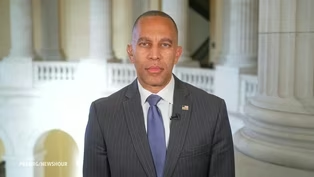
Affordability top priority if Dems take House, Jeffries says
Video has Closed Captions
Affordability and accountability top priorities if Democrats take House, Jeffries says (7m 51s)

Ayad Akhtar blurs fiction and reality in 'The Radiance'
Video has Closed Captions
Ayad Akhtar blurs fiction and reality in new novel, 'The Radiance' (6m 31s)
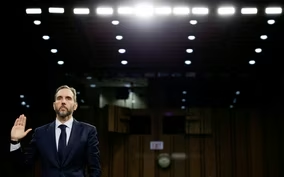
Jack Smith defends criminal investigations of Trump
Video has Closed Captions
During Senate hearing, Jack Smith defends criminal investigations of Trump (3m 36s)
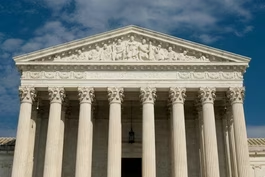
News Wrap: Supreme Court allows third-country deportations
Video has Closed Captions
News Wrap: Supreme Court allows Trump's deportations to third countries, for now (6m 17s)
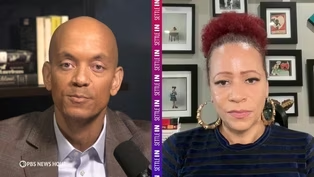
Nikole Hannah-Jones on her consequential school choice
Video has Closed Captions
Nikole Hannah-Jones reflects on her daughter's school experience (8m 11s)

Poland braces for potential confrontation with Russia
Video has Closed Captions
Poland braces for potential confrontation as Russia tests NATO defenses (7m 24s)

Prosecutors reopen Cornell University rape investigation
Video has Closed Captions
New York prosecutors reopen investigation into alleged rape at Cornell University (5m 55s)

Self-regulation 'not enough' for AI safety, Gary Marcus says
Video has Closed Captions
Self-regulation 'not enough' for AI safety, Gary Marcus says (6m 37s)
Providing Support for PBS.org
Learn Moreabout PBS online sponsorship New Episode
- News and Public Affairs

Today's top journalists discuss Washington's current political events and public affairs.
 New Episode
- News and Public Affairs

FRONTLINE is investigative journalism that questions, explains and changes our world.

 New Episode
 New Episode
 New Episode



 New Episode

 New Episode
Support for PBS provided by:
Major corporate funding for the PBS News Hour is provided by BDO, BNSF, Consumer Cellular, American Cruise Lines, and Raymond James. Funding for the PBS NewsHour Weekend is provided by...