
Women’s History Month, outlook for small businesses, Caregiving Conversations
Season 10 Episode 37 | 26m 46sVideo has Closed Captions
Celebrating the legacy of Marie Woo, honoring women jazz artists and a caregiver shares his story.
During Women’s History Month, One Detroit features stories honoring the women jazz artists who helped shape Detroit’s culture and reflects on the legacy of ceramic artist Marie Woo. We’ll take a look at the trends, challenges and opportunities for small business owners in 2026, and talk with a caregiver as part of One Detroit’s ongoing caregiving initiative.
Problems playing video? | Closed Captioning Feedback
Problems playing video? | Closed Captioning Feedback
One Detroit is a local public television program presented by Detroit PBS
Women’s History Month, outlook for small businesses, Caregiving Conversations
Season 10 Episode 37 | 26m 46sVideo has Closed Captions
During Women’s History Month, One Detroit features stories honoring the women jazz artists who helped shape Detroit’s culture and reflects on the legacy of ceramic artist Marie Woo. We’ll take a look at the trends, challenges and opportunities for small business owners in 2026, and talk with a caregiver as part of One Detroit’s ongoing caregiving initiative.
Problems playing video? | Closed Captioning Feedback
How to Watch One Detroit
One Detroit is available to stream on pbs.org and the free PBS App, available on iPhone, Apple TV, Android TV, Android smartphones, Amazon Fire TV, Amazon Fire Tablet, Roku, Samsung Smart TV, and Vizio.
Providing Support for PBS.org
Learn Moreabout PBS online sponsorship- Coming up on "One Detroit."
We reflect upon the legacy of artist Marie Woo during Women's History Month.
Plus we'll have details on an oral history project that highlights the women who contributed to Detroit's jazz legacy.
Also ahead, we'll examine the economic outlook for small businesses.
And as part of our caregiving initiative, we'll hear from a Detroiter who cared for his mother.
It's all coming up next on "One Detroit."
- [Advertiser 1] Across our Masco family of companies, our goal is to deliver better living possibilities and make positive changes in the neighborhoods where we live, work, and do business.
Masco, a Michigan company since 1929.
Support also provided by the Cynthia and Edsel Ford Fund for Journalism at Detroit PBS.
- [Advertiser 2] The DTE Foundation is a proud sponsor of Detroit PBS.
Through our giving, we are committed to meeting the needs of the communities we serve statewide, to help ensure a bright and thriving future for all.
Learn more at dtefoundation.com.
- [Advertiser 1] Nissan Foundation and viewers like you.
(gentle upbeat music) - Just ahead on "One Detroit."
March is Women's History Month.
In honor of it, we'll tell you about an oral history project focusing on the Detroit women who helped shape jazz culture in the city.
Plus, we'll hear about the challenges and opportunities for small business owners this year.
And we'll continue our series of conversations with local caregivers about their experiences.
But first up, we reflect on the contributions of artist Marie Woo.
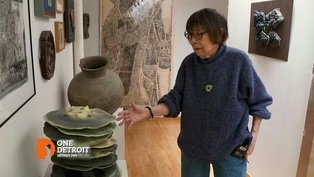
She recently passed away at the age of 97.
She made history as the first ceramic artist to receive the Kresge Eminent Artist Award in 2020.
She spoke with one Detroit that year about her art philosophy, her world renowned glaze called Woo Blue, and her commitment to preserving the art form for the next generation.
(gentle upbeat music) - A lot of potters are inspired by my work, which I'm happy about.
I'm the first potter and I'm the first Asian.
I'm the first Chinese to be nominated and awarded.
It's wonderful.
I went to graduate school at Cranbrook and I wanted to study with Maija Grotell.
She was a very dedicated artist.
And she was very influential and inspiring.
And she was my role model.
And she was a very knowledgeable as far as glaze is concerned.
- Glaze really is the combination of art and chemistry.
And really, if you simplify glaze, it's really a glass coating that goes on the surface of ceramics.
But to formulate it is fairly complex and it's something that Marie was able to do in her variety of glazes that still could be found in our studio today.
This is our Woo Blue Brown on the different clay bodies that we have here available at the studio.
And so, anywhere from a porcelain to a stone where you can kinda see that surface variation that students are really excited about.
- Now, there are so many young potters that I don't know them, but I'm very happy they like my glazes.
They use Woo Yellow and Woo Blue.
And I just, I hope it works for you.
(laughs) Oh, this was taken in Nepal, Kathmandu BC.
BC means before children.
We were very young in the '60s.
I traveled and noticed that folk pottery was just dying out.
So, I decided before they disappear, I should do some documenting and researching.
And so, it became a symposium and an exhibition.
Then it became a traveling show, about 40 pieces, and traveled from the Midwest to the East to museums.
2019, I said, "I can't do this anymore."
(laughs) So, I donated quite a few pieces.
Usually when you donate pieces to a museum, it goes in storage, and it's never seen again.
But I want the students to handle and study them.
(wind rustling) - In 1981, Pewabic became a 501(c)(3) nonprofit organization, and she joined the board at that time.
- In those days, nonprofits were very difficult.
They were always in the red.
And so, when they're in the red, they wanna eliminate education classes.
Some people and I fought for education.
- Historically, Marie really advocated for this program.
And at a time where maybe it didn't make a lot of sense, she had this kind of forward-facing vision of what this could be.
It's kind of nice to see today that we've become, I think, what she envisioned 30 years ago.
- This clay piece here is actually, I wanted it black all the way like this, but it came out of the kiln with all this texture.
Wonderful.
And then I took the hands and glued them on and made it as a wall piece.
I think that works pretty well.
- One really fun aspect that's come from the last few weeks of Marie popping around after winning this award is a lot of our students, we kind of encourage them to have goals of things that they should be working towards.
And now, there's this kind of similar goal that's been popping up since Marie came here, and that everyone wants to loosen up the way that they work with clay.
And so I think that's something that's really unique about Marie.
She has these incredible skill sets, but she has this kind of loose nature about working with clay that's very organic and kind of, you know, has been very like, magnetic for our students.
And so, I'm kind of finding now that the students kind of all have this shared goal of loosening up like Marie.
- I'm started with as a, this piece as a experiment.
So, I took these very individual pieces and fired them, and then I stacked them up and put some glue in between, and it became a piece of sculpture after it's fired.
I think it worked pretty well.
But by itself, each piece would not work.
But together, it's a whole.
- She's just so lovely.
And I think just simply loves what she does.
Her resume is pretty outstanding and she's someone that, you know, her impact isn't a secret.
And so, I expected her to almost carry that more than she does, but she's very open and infectious.
- I'm just trying to express how I feel and what I can do with the clay as a way to express myself.
I don't wanna fight it.
I just sort of go with it.
Hopefully my experiments will work.
Some do and some don't.
(engine rumbling) - Detroit's rich music history includes women whose voices and musical talent helped shape the city's jazz culture.
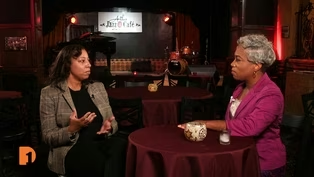
Oral historian Veronica Johnson partnered with the Detroit Sound Conservancy to chronicle the story of these groundbreaking women.
One Detroit contributor, Cecelia Sharpe of 90.9 WRCJ learned more about the project.
(gentle playful music) ♪ The rhythm exciting melodies ♪ - Jazz in Detroit is more than music.
It's a living archive of resilience, rhythm, and roots.
For generations, the city has been a magnet for jazz musicians.
Now, Veronica Johnson is documenting stories of women who shaped Detroit's jazz scene and beyond.
Voices often left out of the spotlight.
She's interviewing the musicians and sharing their stories.
What sparked your interest in jazz?
- Well, actually, my interest in jazz goes back to college.
I just became like, just really, I guess, enamored with the music itself, the history of it.
You know, the culture, just how important this music is to the foundation of Black American music.
What inspired you to take a closer look at the women in jazz and to collect their oral histories?
- I started doing all this research, and then I realized like, "Wow, who's covering the current female Detroit musicians that are all here kind of carrying on this lineage?"
So, that's kind of what really inspired me to wanna dig deeper and tell their stories.
- [Cecelia] Those stories are part of the growing Oral History Collection in Detroit Sound Conservancy's Digital Archives.
- It was at Cuyahoga Community College where I really started getting into jazz and playing jazz because they had a program there.
But it wasn't until I moved to Detroit where I started really establishing myself.
- [Cecelia] So far, dozens of jazz musicians have participated in the project.
- I basically interviewed everybody from Straight Ahead.
That great female jazz group from Detroit.
The great drummer, Gayla McKinney.
Alina Moor, piano player.
I've interviewed a lot of vocalists like Naima Shamborguer or Ursula Walker, Kate Patterson, Taslimah Bey, great ragtime pianist.
So, that's just a few, but there's plenty people I've interviewed so far.
- So my father would make sure that I had a chance to hear music.
He took me out to hear the Thad Jones/Mel Lewis Big Band.
That was fantastic.
We went to the Light Guard Armory on Eight Mile Road and heard them.
So he was really very, very good about making sure I had a chance to hear musicians when they came into town.
And then, little by little as I started to do a little bit more playing of, you know, Wendell and Marcus would actually, you know, hire me for gigs when I was really quite young.
And so, those were my opportunities to really hone my craft and really fall in love with the music in a really big way.
- You partnered with the Detroit Sound Conservancy on this oral history project.
How did the collaboration come together?
- So, I've always been connected to Detroit Sound Conservancy in some form or fashion.
So, when I started my Oral History project like several years ago, I did start off kind of going with Detroit Sound Conservancy.
So now we're working to, like I say, archive and digitize these oral histories for the world to see.
- [Cecelia] The public will be able to listen to them at detroitsound.org.
- [Veronica] What made you want to kind of like, you know, stay in Detroit and kind of build roots as a musician versus, like, going out?
- [Taslimah] I think it was the support that I got from the musicians in Detroit.
The way that they surrounded me.
Like, especially like when I had my son.
They surrounded me, supported me, surrounded me with love.
And when I had hard times, they were right there.
They weren't like snippy and gossiping- - Right.
- And judging and doing all of that.
They were just like, "We love you, we support you.
How can we help?"
And I was just amazed at that.
- Right.
- [Cecelia] Partnering with Johnson on the Oral Histories is just one way the Detroit Sound Conservancy is helping preserve music history.
Michelle Mama Jahra McKinney, Director of Collections explains.
- Well, we do it especially through place keeping.
So, an example would be us rehabilitating The Bluebird Inn.
We do it through actual archiving and preserving, which we are taking in the collections of musicians and people who create around the music.
And we make them accessible and digitize them, and whatever we have to do so that people from years later can come and see, "Wow, this is great.
This happened in Detroit?
This person did that."
And we also, we create educational resources and collaborations.
So, that's especially gonna show up when we get into The Bluebird Inn.
- Tell us a little bit about The Bluebird Inn.
- Well, The Bluebird Inn is an iconic historic jazz club.
And it's just a little neighborhood bar.
And that place became a haven because at that time it was a lot of segregation in the city of Detroit, and there were places where Black folks could go and Black folks could not go.
And it was a place where you could have Sunday brunch and you could see your neighbors and you could feel safe, and you could be your Black self.
(laughs) - Unapologetically?
- Unapologetic, yes.
- Without fear?
- Without fear - [Cecelia] For generations, Detroit has drawn artists from all over.
Some just passing through, but many staying for good.
The city is also home to the world's largest free jazz festival, the Detroit Jazz Festival, drawing hundreds of thousands of attendees each year.
♪ To you ♪ - [Pamela] I like the jazz scene in Detroit.
It's a Detroit thing, I think, where people just uplift each other and whatever you need, you know, they'll show you the way.
♪ It's time for you to get up and show the world ♪ ♪ What we have in store ♪ - How do women shape the jazz culture in Detroit?
- They had a great impact on it.
And you know, that kind of stuff that you can hear that's toe tapping and you can sing along with it and remember the melody, and be humming it to yourself.
That was made more possible by women singing in jazz to me.
The storytelling, ♪ All of me ♪ ♪ Why not take all of me ♪ ♪ Can't you see I'm no good without you ♪ - When we think about that Detroit sound, what is it about the sound of Detroit that makes it so unique?
- It still comes out of community.
Actually, not even community.
Familyhood.
That's what to me, is what makes the communication and the mentorship and the passing things down that Detroit musicians do, is it has extended worldwide.
And so not only is it a sound, it's a feeling.
It's a feeling of connectedness and a familyhood.
And somehow that's embodied in the music.
(bright jazz music) That Detroit sound that was in the really basic music that was there created by the jazz musicians, the improvisation, the African rhythms that are embedded in it.
All of that context is still going on and created that Detroit sound between the love that is in that music.
It's pure love.
- What made Detroit a destination for jazz?
Or did jazz, was jazz the destination for the people?
- Detroit is a destination for musicians.
It always has been because of the music that they brought as they migrated north.
But at the same time, it's also about the connections.
Like of Marcus Belgrave.
He was just coming through Detroit with Ray Charles and he said, "Ooh, I love this city!"
Yeah.
And people taking him under their wing and talking to him and he left Detroit and he came back, and he said, "I can't leave this place."
He didn't wanna leave.
- What is it that you hope that people walk away with after hearing some of these stories?
- Well, I just really wanna, you know, people to realize how, like, their work ethic, the resiliency of these women, you know?
Like again, a lot of the women I've interviewed, some in their 70s, 80s, still performing.
So, it just goes to show how much they love music.
And I just want people to realize like that, obviously women have as much of an influence and impact on Detroit jazz as the male counterparts.
So, I just want people to see the breadth and depth of these women and what they've done and what they've accomplished throughout their years.
(bright jazz music) (crowd cheering and applauding) - As we approach the end of the first quarter of 2026, small businesses are making plans for the rest of the year.
Inflation, tariffs, and labor shortages are still creating challenges for many small business owners.
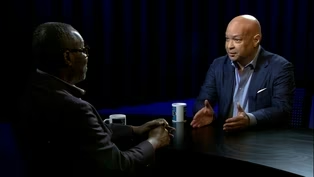
One Detroit contributor and American Black Journal host Steven Henderson, talked about the outlook for entrepreneurs and the opportunities for growth with Mark Lee, president and CEO of the LEE Group and a Detroit PBS board member.
(gentle upbeat music) - I talk to a lot of businesses and what they're experiencing is just this uncertainty.
This uncertainty is very persistent right now.
People are still feeling the effects about tariffs, high costs, revenue's not increasing.
Revenue, quite frankly is flat.
Collectively, when we go get the trend lines, if you will, business confidence is relatively middle of the roads.
Not highs, not lows.
In that mid range strain.
So, I'm experiencing a lot of, I'm sensing a lot of uncertainty from these businesses, and they're trying to figure out again, navigate these chartered waters.
I think with the president came in office, there was believe or not some optimism in that space.
But now that several months into his second year of his second term, optimism is really kind of gone down.
- Yeah.
We talk about this each year about how people ought to kind of approach these short term conditions with an eye toward the long term, right?
You don't wanna make rash decisions that don't put you in the right position for when things get better.
So, let's talk about what some of those things are.
Like, how do you react to the negative numbers that we're all seeing now without overdoing it in a way that doesn't put you in a position to benefit.
- And that's the hard balance right there.
- Yeah.
- And so, I think short term, what businesses need to do is to go back and retrench.
Look at your current plans.
Look at your current financials.
Make sure that you're on solid ground, right?
Look at your revenue projections.
Look at your diversification opportunities.
Can you diversify your income streams?
Don't just sit still.
Now is not the time just to sit still.
Work with partners, identify larger businesses and other smaller businesses that can become a partner of yours.
'Cause right now, the challenge is if you sit still in this today's economy, we don't, we can't predict the future.
We don't know what's going to happen.
I can also tell you that there's a 30 to 40% chance, according to various economists across the country, that there could be a recession issue.
- An actual recession.
Yeah.
- An actual recession.
The good news is that's only 30 to 40%, right?
The bad news is that there's an opportunity that could still happen.
So you have to continue to navigate those challenges and make sure you go back and retrench and get your foundational principles, as well as get your plan and your financials.
- Yeah.
You know, the one part of the economy that is doing very well is the stock market.
- Yeah.
- I mean, investments are doing extremely well.
Now, most Americans are not participants in the market.
But a lot of businesses are.
And certainly wealthier individuals are.
But how do you make or take advantage, I guess, of that part of the economy while also trying to sort of pull up the rear in the sort of core part of your business.
- So let me, also, when I just say this.
That 50% of the American public is not in the stock market.
- Not in the stock market at all.
- Not at all.
So, they're not seeing that benefit of the stock market boom that you're seeing right now.
- Right.
Every day I am getting a text message or an email from a bank or some other kinda lender trying to give my business money.
Trying to say, and I think they're looking at the same things we're looking at.
If revenue's down, costs are up, you might need cash.
But of course, that's a different kind of cash than than revenue, right?
You gotta pay it back.
- Yeah, pay it back.
- And it's adding to the bottom line.
What kind of counsel do you give small businesses about a restructure at this point that includes borrowing to get through what, you know, if it's a shorter term, kind of slow down.
Maybe that is that bridge that you need, you know, talk about that versus cost, discipline, spending discipline and the other things that you could do.
- That's a great question.
I counsel business owners by saying, "Look at your financials.
What is your business plan?
What's your long term objective?"
So yes, those banks are coming after you right now to try to give you some type of funding, but you wanna be careful.
Just understand there are two types of funding opportunities.
Here are quite a few, but two most famous ones, for lack of a better phrase.
One is taking a loan.
So, a bank will give you a short term loan, a longer term loan.
The challenge with that is what?
You have to pay it back.
- Yeah.
- You gotta pay back the interest.
So, therefore your cost will go up.
It affects your bottom line.
- Right.
- It affects your revenue and your overall profitability.
There's another opportunity though.
A grant.
- All right.
- We talked about that before.
- We've talked about that before.
- A grant, you do not have to pay back.
A grant is from an organization that simply provided you with revenue so that you can scale your business.
That you can address the outstanding challenges.
The only catch is, I just say that respectfully, is that you still have to demonstrate how you're gonna spend that money, - Right.
- What the return is going to be.
Not necessarily the business return, but what is the grantor getting for the resources they're giving to you.
So, to answer your question in a nutshell is look at your financial position.
Look at what your short term and your long term needs are.
Get your costs and make sure you make the decision based on the financial opportunities that you have for yourself and for your business.
- Yeah.
- As part of our ongoing caregiving coverage, "One Detroit" has a new series of conversations with local caregivers.
We've captured their stories as they share the challenges and rewards of caring for others.
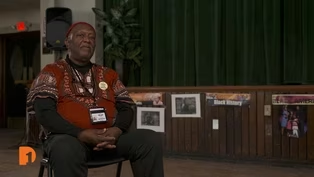
Today we hear from Detroiter, Leroy Callaway, who took care of his mother after she became ill.
(gentle somber music) - I took care of my mom.
When she got sick, my mom, my sister asked me to take care of her, who, my sister passed away July 24.
So, I stepped in.
And then at time came along to developing dementia.
I really didn't know what to do.
So, one of her cousins asked me to bring her to a place called St.
Patrick's Senior Citizen Place, which is here.
It was a big help for me to bring her down here every day.
You know, get involved with some of the activities that they had.
It was like, almost three years after I retired that I had to step in and help my mom.
I get up and cook breakfast for her, help her put her clothes on.
You know, then I take her out there, visit her cousins.
So when she passed away, I just kept going.
Coming back, stayed back.
(gentle music) - We'll have more caregiving conversations on future episodes of "One Detroit".
Plus you could see our other caregiving stories at onedetroitpbs.org.
That'll do it for this week's show.
Thank you for watching.
Head to the One Detroit website for all the stories we're working on.
Follow us on social media and sign up for our newsletter.
(gentle upbeat music) - [Advertiser 1] Brought to you in part by IMPART Alliance, Ralph C. Wilson Jr.
Foundation And by Across our Masco Family of Companies, our goal is to deliver better living possibilities and make positive changes in the neighborhoods where we live, work, and do business.
Masco, a Michigan company since 1929.
Support also provided by the Cynthia and Edsel Ford Fund for Journalism at Detroit PBS.
- [Advertiser 2] The DTE Foundation is a proud sponsor of Detroit PBS.
Through our giving, we are committed to meeting the needs of the communities we serve statewide to help ensure a bright and thriving future for all.
Learn more at dtefoundation.com.
- [Advertiser 1] Nissan Foundation and viewers like you.
(gentle upbeat music) (soft music)
 New
NewCaregiving Conversations: Leroy Callaway
Video has Closed Captions
Clip: S10 Ep37 | 1m 31s | We hear from Detroiter Leroy Callaway who took care of his mother after she became ill. (1m 31s)
 New
NewDiscussing the outlook for small businesses with Mark S. Lee, president and CEO of The LEE Group
Video has Closed Captions
Clip: S10 Ep37 | 5m 38s | Mark S. Lee also speaks to the unique economic challenges faced by African American entrepreneurs. (5m 38s)
 New
NewThe legacy of ceramics artist Marie Woo, 2020 Kresge Eminent Artist
Video has Closed Captions
Clip: S10 Ep37 | 5m 46s | Woo spoke with One Detroit in 2020 about her art philosophy and more. (5m 46s)
 New
NewOral history project preserves the legacy of Detroit women in jazz
Video has Closed Captions
Clip: S10 Ep37 | 9m 23s | Oral historian Veronica Johnson discusses the Detroit Women in Jazz Oral History Project. (9m 23s)
Providing Support for PBS.org
Learn Moreabout PBS online sponsorship
- News and Public Affairs

Top journalists deliver compelling original analysis of the hour's headlines.

- News and Public Affairs

FRONTLINE is investigative journalism that questions, explains and changes our world.












Support for PBS provided by:
One Detroit is a local public television program presented by Detroit PBS